Edge Tools and Wand Kits: Closing the Gap Scrubbers Leave at Walls
Plan the edge pass first, so the main scrubber cleans up after it.
Shop now
The ride-on scrubber finished the amenities corridor in twelve minutes. The supervisor's walk-through took two: a grey band, roughly a hand's width, ran along every wall, around each pan and behind the door stops. The machine had done its job. Nobody had planned for the part of the floor a squeegee and a round deck can never reach.
How do you clean the edges a floor scrubber misses?
Clean scrubber edges with a separate detail pass: a compact powered edge scrubber or a handled scrub brush and pad holder works the 50 to 150 mm band along walls, corners, pans and fixtures, then the main scrubber or a wet vacuum recovers the slurry. Schedule it as its own task with its own time.
This guide is for contractors and supervisors who price and schedule floor work. It focuses on the wall gap left by walk-behind and ride-on scrubbers. For choosing a small machine for tight rooms, see Freshway's guide to compact scrubbers for tight areas and amenities.
Why scrubbers leave a wall gap
- Deck shape. Round brush decks cannot reach into square corners.
- Squeegee overhang. The rear squeegee is wider than the brush path, so operators keep clear of walls.
- Skirting and fixtures. Coved skirting, pan bases, partition feet and door stops block the deck.
- Operator caution. Nobody wants to scuff a wall, so the machine runs a safe distance off.
Over a few weeks that strip collects soap, grit and dirty slurry pushed there by the main pass. The edge darkens, and the floor looks dirtier than it is.
Edge tool options
| Tool | Suits | Limits |
|---|---|---|
| Compact powered scrubber on a wand | Long wall runs, toilet pan bases, under benches, stair edges | Needs battery management and recovery of slurry |
| Handled deck scrub brush | Textured tiles, grout lines, ramps and corners | Manual effort; slow on long runs |
| Pad holder with swivel fitting | Smooth tiles, skirting faces, vinyl edges | Light soil only without chemical dwell |
| Hand grout brush | Small corners and around fixtures | Kneeling work; keep to touch-ups |
Freshway lists edge tools across the floor tools and heads and scrubbing pads ranges.
Powered wand scrubbers
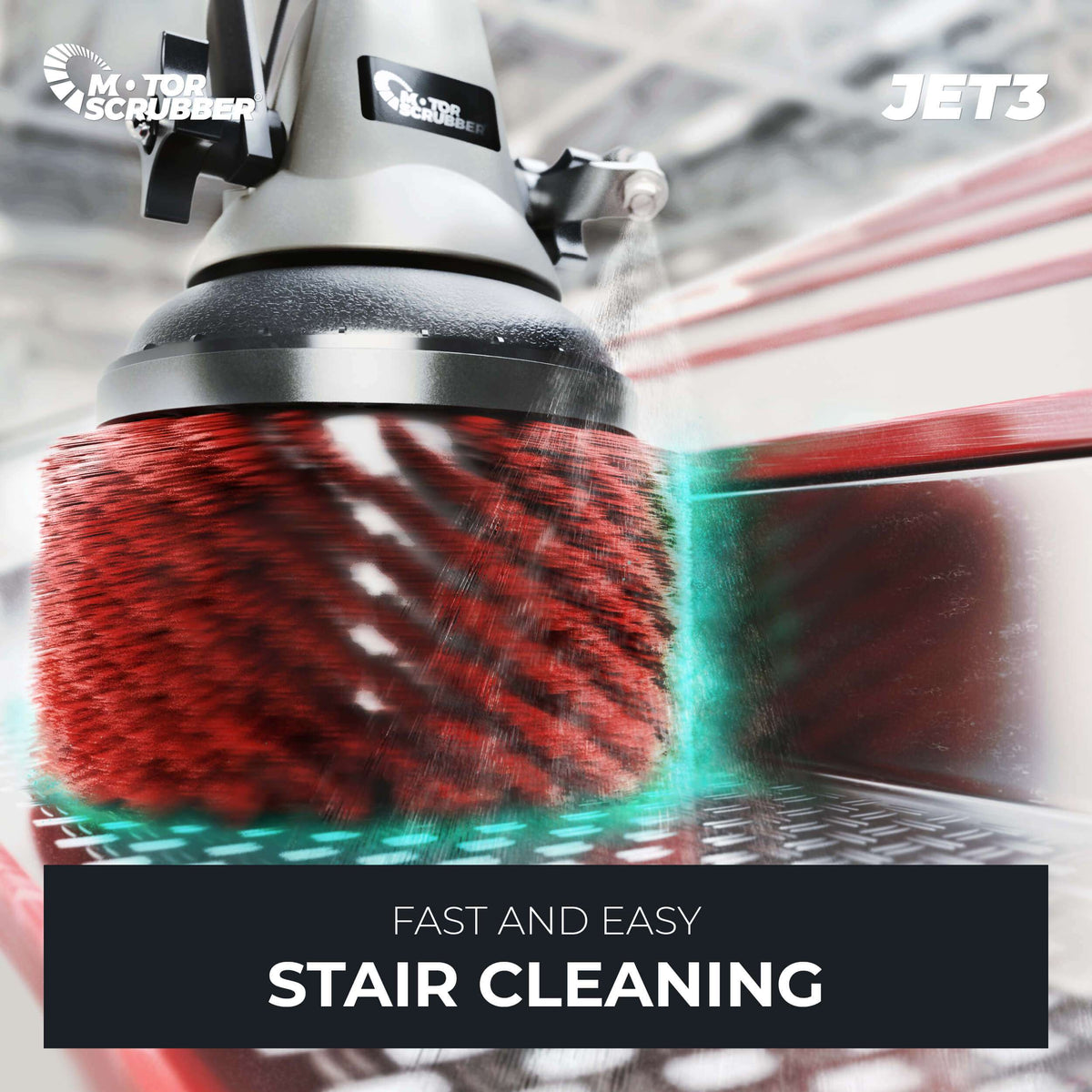
The MotorScrubber JET3, listed by Freshway, is a cordless scrubber with an 18 cm waterproof head at 360 RPM, a telescopic handle and a backpack holding a 1 litre solution tank and a pump rated at 7.9 bar (116 PSI) at 5 L/min. Its listed runtime is 3.5 hours and its linear performance is 144 m² per hour. The spray feeds detergent straight to the head, so the operator can work an edge without a bucket. Other machines sit in the MotorScrubber collection.

Manual edge tools
For short runs and textured floors, a handled deck scrub is often faster to set up than a machine. Edco's deck scrub has stiff bristle clusters and a 1.35 m soft-grip handle. An Edco scourer pad holder with a swivel fitting keeps a pad flat against skirting and floor edges, and Sabco utility pads add abrasion for heavy soil. WorkSafe Victoria's safer way to clean: mopping sheet flags bending, kneeling and reaching under furniture as a hazard, which is why long-handled tools beat kneeling at the skirting.

Sequencing the edge pass
- Sweep or vacuum edges first; grit in the corner turns into scratches under a brush.
- Apply diluted detergent to the edge band and let it dwell briefly.
- Scrub the edges and around fixtures with the edge tool.
- Run the main scrubber so its pass picks up the edge slurry.
- Recover what the squeegee misses with a wet vacuum or a damp mop.
- Check corners last and touch up by hand.
Doing edges first means the main machine cleans up after them. Doing them last leaves dirty slurry on a clean floor.
Time allowance
Price edge work separately. A worked example for an amenities block:
- Total wall and fixture edge length: 120 m.
- Edge band cleaned by an 18 cm head: 120 × 0.18 = 21.6 m².
- At the JET3's listed 144 m² per hour, that is 21.6 ÷ 144 = 0.15 h, about 9 minutes of scrubbing.
- Double it for corners, pan bases and repositioning: about 18 minutes, plus set-up.
Time a sample area on your own site and use that figure in the next quote.
Splash, slips and batteries
Edge work sprays solution onto skirting and walls. Keep pressure low near painted surfaces and wipe splashes before they dry. Wet edges are slip points; SafeWork NSW's slips, trips and falls guidance supports signage and keeping walkways dry. WorkSafe Victoria's hazardous manual handling page helps assess long edge shifts. If your edge machine runs on lithium-ion batteries, SafeWork NSW's lithium-ion battery guidance warns they can catch fire if handled, stored or charged incorrectly.
Training and kit lists
Give each crew a travelling edge kit: the edge tool, spare pads, a grout brush, a measured detergent bottle, a wet floor sign and microfibre for splashes. Train new staff on one wall run with a supervisor before they work alone, and use WorkSafe Victoria's cleaning injury hotspots page in the induction briefing. Mops and handles for recovery are in Freshway's mops, heads and handles range.
Quick answers
How wide is the edge band a scrubber misses?
Usually 50 to 150 mm along walls, more around fixtures and corners.
Should edges be scrubbed before or after the main pass?
Before, so the main scrubber recovers the edge slurry.
Can a hand brush replace a powered edge tool?
On short runs, yes. On long runs, a powered wand saves time and strain.
How often should edges be detailed?
Weekly in busy amenities, monthly in low-traffic areas, adjusted to what audits show.
Next steps with Freshway
Measure the edge length on each site, pick a powered or manual edge tool and price the time. Freshway's floor scrubbers and edge tool ranges cover both; contact the team to build an edge kit for your crews.