Cordless Vacuums for Commercial Cleaning: Runtime, Batteries and What Actually Breaks
Runtime is set by battery, weight and filter. Check all three before you buy.
Shop now
Cordless vacuums are sold on suction figures and runtime claims. In commercial use neither of those decides whether the machine works out. What decides it is how the runtime is measured, how many batteries you need, and what happens to the machine in year three.
Start here: work out the duty cycle before the specification
Commercial cordless vacuums are chosen on duty cycle, not suction. A domestic-rated machine run for six hours a day will fail early. Work out how long the machine runs continuously, how many battery changes that requires, and whether the batteries are still available in three years — then compare models.
That order matters because the battery is what ends a cordless machine’s life, and a battery that is no longer produced turns a working vacuum into waste. Suction figures are the easiest thing to compare and the least likely to be the reason you replace the machine.
Prices are Freshway catalogue prices as at 16 September 2026 and are subject to change. Confirm the current price, and whether GST applies, before quoting.
What the runtime number does not tell you
A quoted runtime figure is normally measured on the lowest power setting, with a clean filter, on a hard floor, with a new battery. Every one of those conditions changes on site:
- Power setting. Moving up a setting can halve runtime. A machine quoted at 50 minutes may deliver 20 at the setting you actually use on carpet.
- Filter loading. A part-loaded filter increases resistance and shortens runtime noticeably. This is also the most common cause of “the battery has gone” complaints.
- Floor type. Brush-driven heads draw more power on carpet than a bare floor tool.
- Battery age. Capacity declines with cycles. A battery in year two is not the battery that was specified.
The practical approach is to halve the quoted figure and check whether that still covers a site round. If it does not, the answer is more batteries rather than a bigger machine.
The cordless machines we stock
| Model | Form | Positioning | Price |
|---|---|---|---|
| Karcher WV 7 Signature Line | Window vac | Glass and flat surfaces only; not a floor vacuum | A$349.00 |
| Karcher VC 4 Cordless Premium | Stick | Light commercial and domestic stick | A$498.00 |
| Karcher VC 6 Premium | Stick | Quoted 50 min runtime, HEPA filter, 2-in-1 | A$649.95 |
| Nilfisk VU200 Professional | Upright stick | Professional-rated cordless for daytime cleaning | A$699.00 |
| Karcher FC 4-4 Hard Floor Cleaner | Hard floor 2-in-1 | Mop and vacuum combined; hard floors only | A$757.68 |
| Karcher FC5 Cordless | Hard floor 2-in-1 | Mop and vacuum combined | A$849.00 |
| Pacvac Velo Go | Backpack | Cordless commercial backpack | A$899.00 |
| Karcher FC7 Hard Floor Cleaner Premium | Hard floor 2-in-1 | Higher-capacity mop and vacuum | A$899.00 |
| Karcher BVL 5/1 BP | Backpack | Battery backpack for large floors and stairwells | A$1,099.00 |
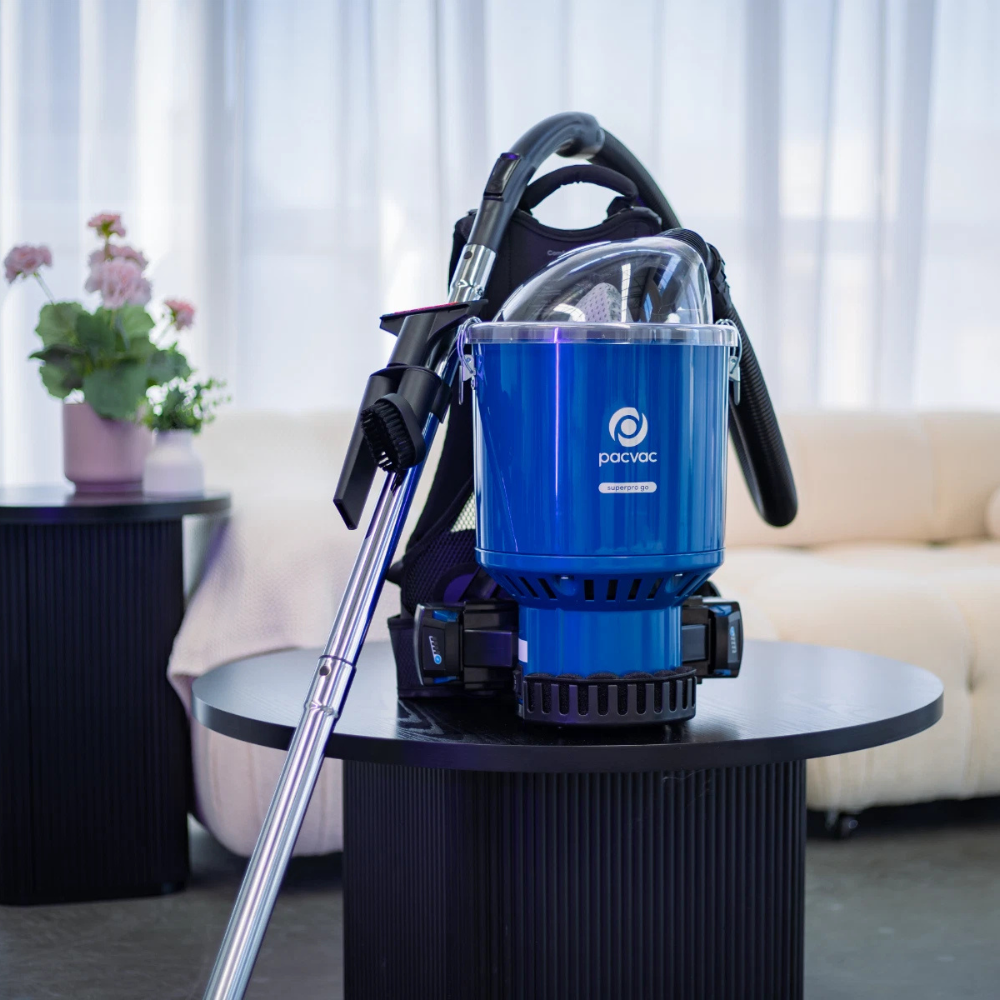
| Pacvac Superpro Go | Backpack | Cordless version of the Superpro platform | A$1,199.00 |
| Nilfisk GD5 Battery Powered | Backpack | 36 V, 650 W, 5 L | A$1,694.00 |
| Karcher CV 30/2 BP | Upright | Battery upright brush-type, kit form | A$1,699.00 |
Two things stand out. First, the range splits at roughly A$700: below that you are buying a domestic or light-commercial stick, above it you are buying a battery machine built for daily trade use. Second, the hard-floor 2-in-1 machines are not vacuums with a mop attached — they are a separate category, and they do not replace a dry vacuum on carpet.
Batteries: the decision that outlives the machine
Three questions decide whether a cordless machine is a good long-term purchase:
- Is the battery a standard platform? Makita, Kress and similar systems share batteries across a whole tool range, which means the batteries stay available and can be used elsewhere. Proprietary sealed batteries do not.
- Can you charge batteries away from the machine? On a multi-floor site, a charger per floor with spare batteries beats a machine that has to be taken to a powerpoint.
- How many batteries does a full shift need? Divide the real runtime into the shift length and add one. Charging while cleaning rarely keeps up.
We stock batteries and chargers separately for the platforms we sell, which is the reason standardising on one battery system across a cleaning cupboard is worth doing early. Our batteries and chargers range covers these, and the Makita platform is the widest example of batteries shared across tools.
What actually breaks, and what it costs
Cordless failures follow a predictable order:
| Failure | Typical cause | Repair or replace |
|---|---|---|
| Runtime collapses | Loaded filter far more often than a failed battery | Clean or replace the filter first |
| Battery will not hold charge | Cycle life reached, or stored flat over a long period | Replace the battery if the platform is still supported |
| Brush bar stops turning | Hair and fibre wound around the bar; belt on belt-driven heads | Usually a clean, sometimes a replacement bar |
| Suction weak but motor sounds normal | Blocked airway or a seal that has come loose | Strip and check before ordering parts |
| Motor failure | Dust ingress from a filter run past its interval | Compare part cost against a replacement |
The pattern across all five is that filtration maintenance prevents most of them. A cordless vacuum with a clean filter and a healthy battery performs close to its specification; one with a loaded filter is blamed on the battery nearly every time.
Matching the machine to the site
Charging infrastructure on multi-floor sites
This is the part of a cordless rollout that gets planned last and causes the most friction. A cleaning round across four floors with one charger on the ground floor is not a cordless round; it is a corded round with extra steps.
- Charger per floor, or a charging station in the cleaner’s room — the single biggest determinant of whether a battery programme works.
- Batteries charged between shifts, not during them — charging while cleaning rarely keeps pace with discharge.
- Storage at partial charge where batteries sit unused for weeks. Leaving lithium batteries flat for long periods reduces their capacity permanently.
- A labelled battery pool so a cycle count can be tracked. Without it, one exhausted battery rotates through the whole fleet and gets blamed on the machines.
Where a site cannot provide charging points, a corded machine with a long lead is the more reliable answer, and the money is better spent on the machine than on a battery system that gets charged from a van between jobs.
| Site and work | Machine | Why |
|---|---|---|
| Office, daytime cleaning around occupants | Stick or upright cordless | Quiet, no cable, quick spot work |
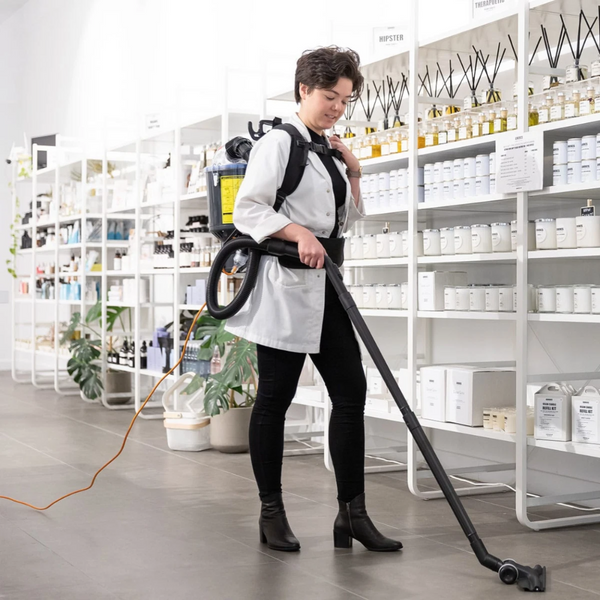
| Multi-storey building, stairwells | Battery backpack | Weight on the hips rather than the wrist; no cable to trail |
| Hard floors with spill risk | Hard floor 2-in-1 | Wet pickup and dry pickup in one pass |
| Mixed carpet and hard floor | Stick cordless plus a separate dry machine | A 2-in-1 does not replace a dry vacuum on carpet |
| Window and glass cleaning | Window vac | Different tool entirely; not a floor vacuum |
| Large open floors, full shifts | Corded or battery scrubber | A cordless vacuum will not cover the area in a shift |
Frequently asked questions
- Are Kärcher cordless vacuums any good?
- Yes, within their category. The VC series suits light commercial and domestic use, and the battery backpack range is built for daily trade work. The caveat is the same as for any cordless: runtime depends on setting, filter condition and battery age, so the quoted figure is a starting point rather than a specification you can rely on.
- Do Kärcher vacuums have good suction?
- Suction is competitive across the professional brands, and it is rarely the limiting factor in practice. Airflow, filtration condition and the floor tool matter more. A machine with a loaded filter will underperform a cheaper machine with a clean one, regardless of the quoted figures.
- Which is the best cordless vacuum cleaner on the market?
- It depends on duty cycle rather than on a single winner. For daytime office cleaning, a stick or upright cordless is the right tool. For multi-storey commercial rounds, a battery backpack such as the Pacvac Velo Go or Karcher BVL 5/1 BP is the appropriate specification.
- What is the number one rated cordless stick vacuum?
- Consumer rankings change frequently and are usually based on domestic testing, which does not translate to commercial duty cycles. For commercial purchasing, compare battery platform support, filter availability and quoted runtime at the setting you will use, rather than a review ranking.
- How many batteries do I need for a cleaning crew?
- Divide the realistic runtime — roughly half the quoted figure — into the length of the shift, then add one spare. On an eight-hour shift with a machine that genuinely runs 25 minutes per battery, that is four to five batteries per machine.
Working out the battery requirement?
Tell us the floor area, the number of levels and how long the machine runs each day, and we will work out the battery count and the right platform. Browse cordless vacuums or ask our team.
Filed under the commercial vacuum guide, with the backpack comparisons and the bag and filter matching guides.