Backpack Vacuum Cleaners Compared: Pacvac, Nilfisk, Ghibli, Karcher and Cleanstar
Same job, different brand logic. Compare bags, filters and parts before you commit.
Shop now
Every commercial backpack vacuum looks broadly the same and quotes similar suction. The differences that matter over a machine’s life are the ones that do not appear on a specification sheet: what the harness does after four hours, which consumables stay available, and whether the battery platform will still exist in three years.
Last updated:
Start here: compare the platform, not the suction figure
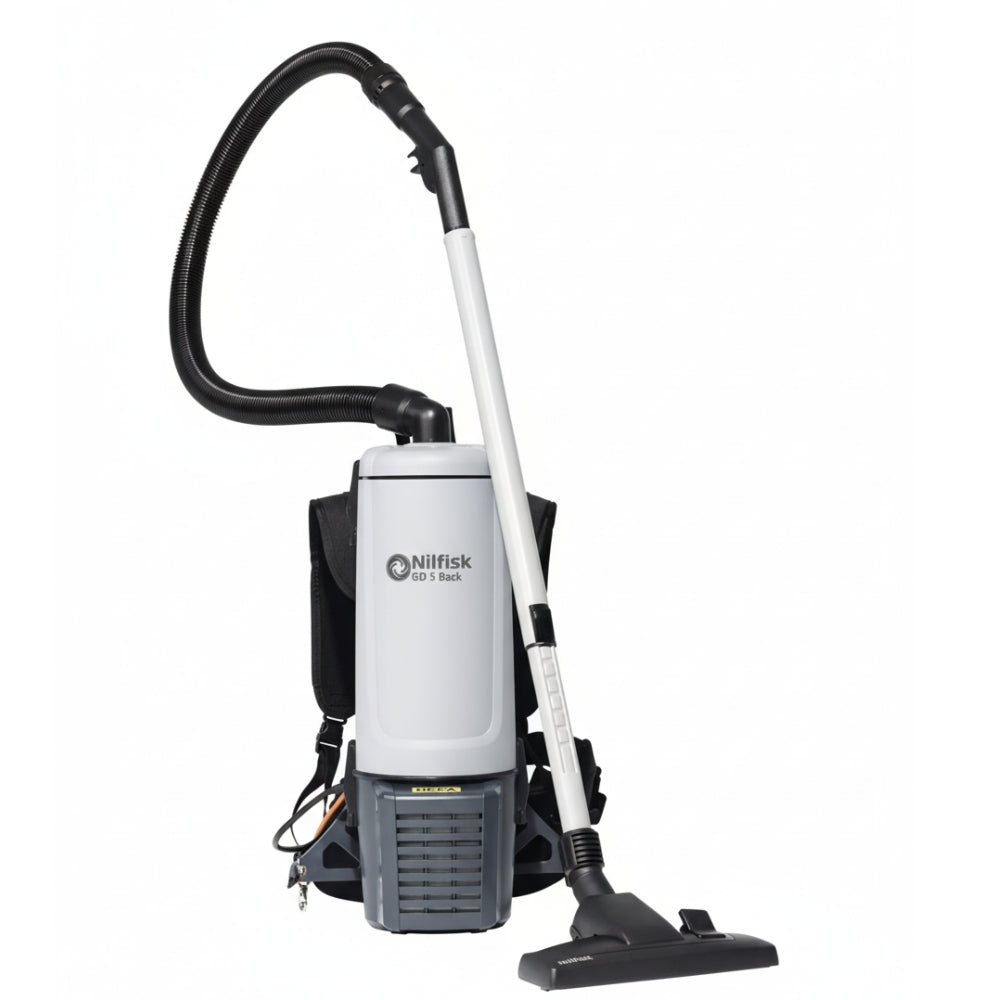
Backpack vacuums are compared on four things: harness comfort over a full shift, filtration level, whether the machine is corded or battery, and how long consumables stay available. Suction figures across the major brands sit close enough that they rarely decide a purchase. Choose on support.
We stock five brands — Pacvac, Nilfisk, Ghibli, Karcher and Cleanstar — and the reason is not to offer choice for its own sake. Each covers a different part of the range, and standardising a fleet on one platform matters more than picking the best individual machine.
Prices are Freshway catalogue prices as at 16 September 2026 and are subject to change. Confirm the current price, and whether GST applies, before quoting.

The backpack range compared
| Model | Brand | Positioning | Price |
|---|---|---|---|
| Thrift 650 | Pacvac | Entry commercial backpack | A$339.00 |
| Piggy Vac | Cleanstar | Compact backpack for lighter duty | A$359.00 |
| Superpro 700 | Pacvac | The commercial standard | A$389.00 |
| Superpro Duo | Pacvac | Dual configuration | A$479.00 |
| Superpro Micron | Pacvac | Finer filtration stage | A$499.00 |
| GD5 Dry | Nilfisk | Lightweight commercial backpack | A$499.00 |
| SAFE T1 1450 W | Ghibli | Backpack with safety-filtration heritage | A$526.24 |
| GD5 HEPA | Nilfisk | HEPA filtration version | A$599.00 |
| Velo Go | Pacvac | Battery backpack | A$899.00 |
| BVL 5/1 BP | Karcher | Battery backpack | A$1,099.00 |
| Superpro Go | Pacvac | Battery version of the Superpro platform | A$1,199.00 |
| GD5 Battery | Nilfisk | 36 V, 650 W, 5 L | A$1,694.00 |
The range splits cleanly at about A$850. Below that you are buying corded machines that differ mainly in harness and filtration; above it you are buying battery platforms, where the machine cost is dominated by the battery system rather than the vacuum itself.
Where the brands actually differ
| Brand | Strength | Practical note |
|---|---|---|
| Pacvac | Depth of range and consumable support | Widest parts and bag availability of any brand in this category; the default for fleets |
| Nilfisk | Filtration specification | HEPA and battery variants; the GD5 platform shares consumables across corded and battery versions |
| Ghibli | Safety filtration heritage | Long-standing European manufacturer; the SAFE series is built around filtration rather than features |
| Karcher | Battery platform integration | Shares the Karcher battery system, which matters if the site already runs Karcher equipment |
| Cleanstar | Value | Entry point for lighter duty sites where a Pacvac is more machine than the work requires |
The honest summary: if you are standardising a cleaning fleet and want one set of spares, Pacvac is the low-risk choice. If filtration is specified by the client, compare Nilfisk and Ghibli. If the site already runs Karcher battery tools, the Karcher backpack avoids adding a second battery platform.
Corded or battery, and what it changes
The A$500–1,100 step is almost entirely the battery system, so the question is whether the site justifies it.
- Corded — lower purchase cost, unlimited runtime, but it needs power and a cable trail through occupied space. Suits sites cleaned outside business hours.
- Battery — no cable, safe in public areas and on stairs, but runtime per battery is limited and you need enough batteries to cover a shift.
Where a site is cleaned while occupied, the battery premium is usually justified by the removal of the trip hazard and the cable management alone. Where cleaning happens after hours with power available, a corded backpack is the better use of the budget.
What actually breaks on a backpack
Backpacks fail in a different order from upright vacuums, because the load is carried on the operator.
- Harness and frame — the first failure on any backpack, because they take the physical load. Replacement harness kits are available, and using them is what keeps a machine comfortable into year three.
- Filters run past their interval — the most common cause of reported suction loss, and almost never the motor.
- Seals and latches — inexpensive parts that, when ignored, cause air leaks and the impression that the machine is worn out.
- Motors — available separately for the major brands, so motor wear is a repair rather than a replacement machine.
Our Pacvac filters, Pacvac bags and vacuum parts ranges cover the consumables, and the service team handles motor and harness work.
Matching the machine to the site
Setting up a fleet on one platform
The reason to standardise rather than buy the best machine each time is operational, and it shows up in three places.
- Consumables. One bag type, one filter type, one harness kit — which means stockholding is smaller and a crew is less likely to take the wrong consumable to a site.
- Training. A new starter learns one machine, and a fault on any machine in the fleet looks familiar to whoever diagnoses it.
- Spares. A single pool of spare harnesses and motors covers the whole fleet, which is usually the difference between a machine being repaired same-day and sitting idle for a week.
The trade-off is real: a single platform will not be the best machine for every site. In practice the operational gain outweighs that, provided the platform is one with deep consumable support — which is the practical argument for Pacvac on mixed commercial portfolios.
| Site and work | Machine | Why |
|---|---|---|
| Multi-storey office, after hours | Corded backpack | Unlimited runtime with power available on each floor |
| Occupied building, daytime cleaning | Battery backpack | No cable across public areas |
| Cleaning business, general commercial | Pacvac Superpro 700 | Widest consumable support; the safest fleet standard |
| Healthcare or filtration-specified site | Nilfisk GD5 HEPA or Ghibli SAFE | Filtration is the specification the client audits |
| Site already running Karcher battery tools | Karcher BVL 5/1 BP | Avoids adding a second battery platform |
| Light duty, limited budget | Cleanstar Piggy Vac | Entry point where the work does not justify a Pacvac |
Are they worth it? A three-year cost model
On parts alone a backpack is cheap to own: the machines list from $259 to $1,799 here, and a year of bags and filters for a daily-use unit costs less than a single service call.
The model below uses the listed prices in this catalogue and states its assumptions, so you can substitute your own numbers. It covers one machine running a full shift, five days a week, with a bag changed weekly and filters replaced annually. Bag counts are the assumption that moves the result most, so change it first if your sites differ.
| Line | Basis | Three-year cost |
|---|---|---|
| Machine, corded entry | Pacvac Thrift 650 or VELO, listed at $339 | $339 |
| Machine, corded mid | Pacvac Superpro 700, listed at $389 | $389 |
| Machine, HEPA filtration | Nilfisk GD5 HEPA, listed at $599 | $599 |
| Machine, battery platform | Makita 18Vx2 DVC261, listed at $599 | $599 |
| Bags, daily use | Pacvac disposable 5 L, 10 per pack at $22.95, about 3 packs a year | about $207 |
| Pre-motor cartridge filter | Pacvac cartridge filter at $25, one a year | about $75 |
| Exhaust foam filter | Pacvac exhaust foam at $9.50, two a year | about $57 |
| HEPA element, if specified | Nilfisk GD5 HEPA at $126.50, one over the period | about $127 |
Read across that table and the answer to "is it worth it" separates into two questions. On total cost of ownership, a corded backpack on consumables alone runs to roughly $680 over three years against a $389 purchase, so the running cost is real but it is not the deciding number. The deciding number is the labour the format saves: a backpack removes the drag and the cable management of a canister, and at a typical contract hourly rate the machine pays for itself in saved minutes long before the consumables matter. If you want the arithmetic done on your own labour rate and shift length, the difference between a $339 corded machine and a $599 battery machine is $260, which is the price of not having a cable in an occupied building.
What this model does not include: batteries and chargers for the battery platforms, which are a separate purchase and the item most likely to fail first; harness replacement, which is what usually ends a backpack's working life; and downtime, which is why the consumables above should be held as stock rather than ordered when a machine stops.
Frequently asked questions
Which backpack vacuum is best for commercial cleaning?
For most commercial teams the Pacvac Superpro 700 is the low-risk choice, because consumables and replacement parts are continuously available and the platform is well understood by technicians. Where filtration is specified, compare Nilfisk and Ghibli.
Is a battery backpack worth the extra cost?
Where the site is cleaned while occupied, usually yes — removing the cable removes a trip hazard and makes stairwells practical. Where cleaning happens after hours with power available, a corded backpack delivers the same cleaning result for roughly A$500 less.
How long should a backpack vacuum last?
Several years in daily commercial use, and the machine does not have a fixed end of life because motors, harnesses, seals and latches are all available as separate parts. What usually ends a backpack early is a harness that was never replaced rather than a failed motor.
Do all backpack vacuums use the same bags and filters?
No, and this is where compatibility errors happen. Bags and filters are specific to the model series, and even within a brand the consumables differ between tiers. Match by model, not by brand.
Can I use one brand of backpack across a whole fleet?
Yes, and it is usually the right decision. Standardising means one set of bags, one set of filters and one set of spare harnesses to hold, which reduces both stockholding and the chance of a crew taking the wrong consumable to site.
Are backpack vacuums worth it?
On parts and consumables, yes but not dramatically: a corded machine at $339 to $389 plus about $290 of bags and filters over three years is comparable with any commercial vacuum. The format earns its place through labour, because removing the cable and the canister drag saves minutes on every shift, and through filtration where a HEPA model is specified.
Choosing for a fleet?
Tell us how many crews you run, how many levels each site has and whether cleaning happens during or outside business hours, and we will narrow the range to one platform and set a consumable par level. Browse backpack vacuums or ask our team.
This article is one section of the commercial vacuum guide, which covers the other formats, filtration and the parts that keep them running.