Aviation and Transport Hubs: Scrubber Constraints
Size airport scrubbers on clearances, cleaning windows and real coverage rates.
Shop now
It is 4:15 am and the first passengers are already queuing at check-in. Out on the concourse, a ride-on scrubber sits half-way along its route with a flat battery, a wet strip behind it and an operator waiting at a security door for an escort who has not arrived. Nothing about this was a machine fault. The scrubber was sized for the floor area, but not for the access rules, the cleaning window or the charging plan.
Airports, rail stations and bus interchanges put unusual limits on floor scrubbers. This guide works through them as an engineer would: the constraints first, then the numbers, then the machine.
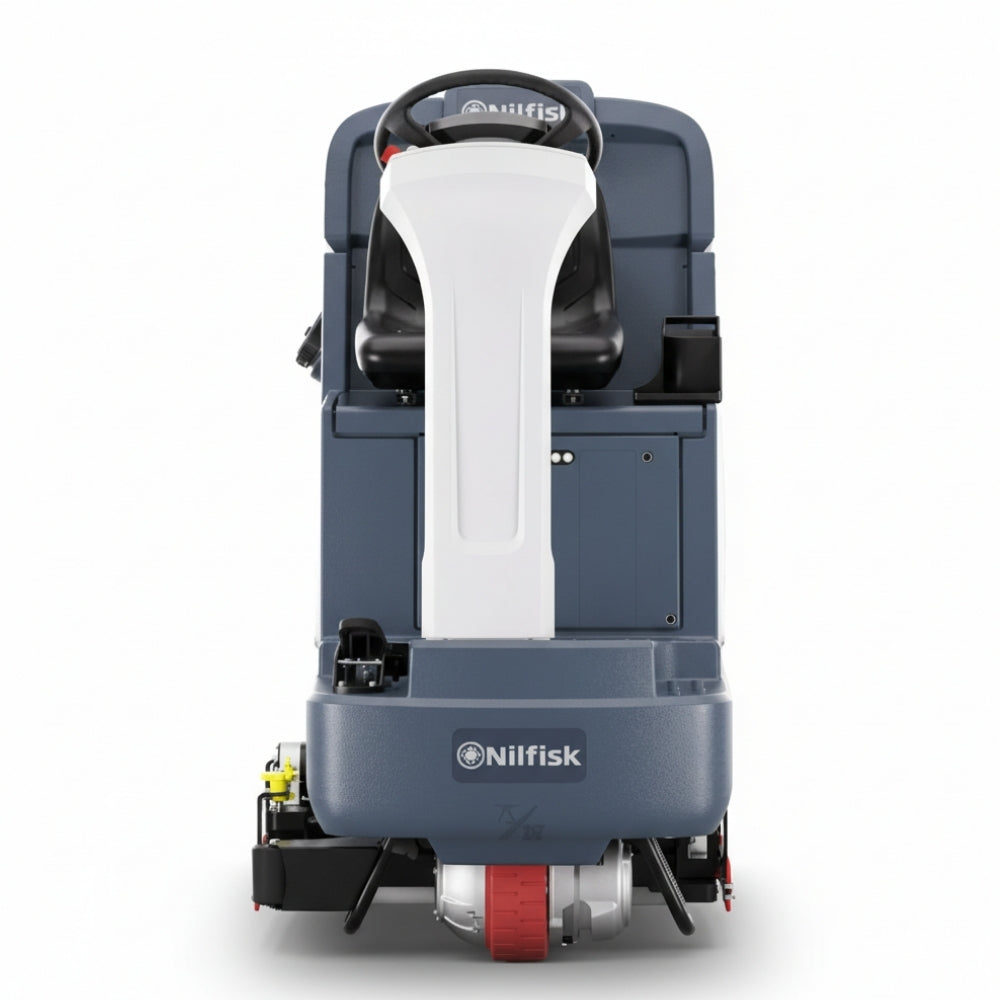
Airport floor scrubber: the short answer
An airport floor scrubber is usually a battery ride-on for concourses, backed by compact machines for gate lounges, amenities and escalator landings. Choose on realistic coverage rate, listed noise, weight and access controls such as supervisor keys. Then plan security clearances, quiet hours and charging space before you buy anything.
The same logic applies to large stations and transport interchanges. The floor is big, the public never really leaves, and the cleaning window is shorter than the floor plan suggests.
Access control: the operator is the bottleneck
Getting a machine airside is a logistics task. Getting the person who drives it airside takes longer. Sydney Airport's ASIC application process page advises applying for an Aviation Security Identification Card as soon as you can, before starting work at the airport, and says the process takes about six weeks but could take longer. Applicants also sit a security awareness test.
For a cleaning contractor, that has three practical effects:
- Relief operators need clearance in advance. A trained scrubber operator without the right card cannot cover a shift in a secure zone on short notice.
- Training must be site-specific. Induction should cover the machine, the route, the security doors and who to call when an escort is needed.
- Machine handovers take time. Each hand-off through a controlled door eats into the cleaning window. Plan routes so the machine crosses as few security boundaries as possible.
Rail stations and bus interchanges often have their own inductions and access rules too. Treat the access plan as part of the scrubber specification, not an afterthought.
Huge floor areas: doing the maths
Most listings quote a theoretical productivity: scrub width multiplied by speed, with no turns, refills or people in the way. Nilfisk's own figures show the gap. Freshway's listing for the SC6000 1050D gives 9,450 m²/h theoretical and 6,620 m²/h actual, which is 70% of theoretical. The SC6500 1300D listing gives 11,700 m²/h theoretical and 8,190 m²/h actual, also 70%.
Applying that same 70% to machines that list only a theoretical figure gives a working estimate. It is our assumption, not a listed figure, and a busy terminal with queues and furniture may fall below it. For an example 15,000 m² concourse and gate area:
- Nilfisk SC6500 1300D: 8,190 m²/h actual, so about 1.8 hours.
- Nilfisk SC6000 1050D: 6,620 m²/h actual, so about 2.3 hours.
- Nilfisk SC4000 860D: 6,020 m²/h theoretical × 0.7 ≈ 4,214 m²/h, so about 3.6 hours.
- Nilfisk SC2000 53B: 3,180 m²/h × 0.7 ≈ 2,226 m²/h, so about 6.7 hours. With listed runtime of up to 2.5 hours per charge, that is roughly 5,600 m² per charge.
- Nilfisk Liberty SC60 (autonomous): 2,811 m²/h × 0.7 ≈ 1,968 m²/h, so about 7.6 hours. Its listed 5.5-hour runtime covers roughly 10,800 m² per run.
Now set that against the window. Sydney Airport's site lists Terminal 1 opening hours as 3:00 am to 11:00 pm and the domestic terminals as 4:00 am to 11:00 pm, which leaves four to five hours of terminal closure, and some of that will be taken by other contractors. On these numbers, a single SC4000-class rider could cover the example area inside that window, provided one charge lasts the 3.6 hours (its listing does not state a runtime, so confirm it before relying on this), while a micro ride-on or an autonomous unit would need more than one charge, more than one machine, or daytime running.
Comparing the listed figures
The table collects the fields that matter most in a transport hub, taken from Freshway's product listings.
| Model (Freshway listing) | Scrub width | Tanks (solution / recovery) | Listed productivity | Listed noise | Listed weight |
|---|---|---|---|---|---|
| Nilfisk Liberty SC60 | 71 cm | 99 L / 105 L | Up to 2,811 m²/h | 57 dB(A) | Not listed |
| Nilfisk SC2000 53B | 53 cm | 70 L / 70 L | Up to 3,180 m²/h (theoretical) | 68 dB(A) | 340 kg (gross) |
| Nilfisk SC4000 860D | 860 mm | 125 L / 125 L | 6,020 m²/h (theoretical) | 64 dB(A) | 759 kg incl. battery |
| Nilfisk SC6000 1050D | 1,050 mm | 190 L / 190 L | 9,450 theoretical / 6,620 actual m²/h | 69 dB(A) | 1,070 kg (gross) |
| Nilfisk SC6500 1300D | 1,300 mm | 265 L / 265 L | 11,700 theoretical / 8,190 actual m²/h | 70 dB(A) | 1,506 kg with battery |
Weight is the column people skip. A machine over a tonne needs a check of lift rated loads, link bridges and any suspended slabs on its route. Ask the building engineer before the machine arrives, not after.

Security: locking machines away and controlling who drives
In a public building, an unattended ride-on is both a security concern and a safety one. Three controls help.
- Key or PIN control. Freshway's SC4000 860D listing describes SmartKey management with separate supervisor and user keys to control access and operational settings. The SC6000 1050D listing says SmartKey lets managers set performance parameters for different operators.
- A locked home base. Park and charge machines in a lockable plant or cleaners' room, never in a public corridor.
- Safe charging. For lithium-ion machines, SafeWork NSW's lithium-ion battery guidance says to store batteries away from heat sources and flammable materials, use chargers designed for the battery type and voltage, and not leave batteries charging unattended or for long periods. Plan supervised charging into the shift.
Autonomous machines add digital control. The Liberty SC60 listing mentions cloud connectivity, digital cleaning reports and TextAssist operator alerts, which give supervisors a record of what was cleaned and when.
Quiet zones and overnight windows
Gate lounges, lounges and platforms are rarely empty, so noise matters for passengers and operators alike. For hearing safety, SafeWork NSW sets the workplace exposure standard at 85 dB(A) averaged over eight hours, and notes that each 3 dB increase doubles noise intensity. Every machine in the table is listed below that standard, but the differences still matter to passengers.
Do the arithmetic. The SC6500 1300D at 70 dB(A) against the SC4000 860D at 64 dB(A) is a 6 dB gap, or about four times the sound intensity (10 to the power of 0.6 ≈ 4). The Liberty SC60 at 57 dB(A) is 7 dB below the SC4000, about one-fifth of its intensity.
Regulators point the same way. SafeWork NSW's guide to controlling hazardous noise in the workplace recommends obtaining noise emission data before buying and scheduling noisy work outside normal hours where possible, and WorkSafe Victoria's noise guidance says to buy the quietest tools and machinery available.

Spec priorities for transport hubs
- Realistic coverage: use actual figures where listed, or discount theoretical figures and say so in the tender.
- Runtime against the window: one charge should cover the planned zone, or plan a battery swap or second machine.
- Listed noise: compare within a brand where possible.
- Weight and dimensions: check lifts, doors and bridges. The SC4000 listing gives 1590 × 920 × 1460 mm and says it passes through standard doorways.
- Access control: supervisor keys, PINs or reporting.
- Tank size: fewer refills means fewer trips through controlled doors to a dump point.
Fleet notes: one big machine or a mix
No single scrubber suits an entire terminal. A typical fleet pairs a rider for concourses with compact machines for amenities, gate lounges and escalator landings. Freshway's listing for the Hako Wizzard W44P mentions airport terminals and optional brushes for metal escalator steps; the compact Hako models sit in our Wizzard floor scrubbers collection. Note that small is not automatically quiet: the W44P is listed at 71 dBA, above the larger SC4000.
Where carpets, dry debris or outdoor forecourts are involved, a sweeper may do the first pass. Our guide to floor scrubber vs sweeper explains the split, and walk-behind vs ride-on sizing covers when a rider pays off. Agree a repair route as well: Freshway's Service & Repairs workshop in Arncliffe lists floor scrubbers among the equipment it services.
Key risks
- Slips. SafeWork NSW's slips, trips and falls guidance notes that terrazzo can be slippery when wet and vinyl is slippery when wet, particularly if polished. Both are common in terminals.
- Spills in public areas. WorkSafe Victoria's slips, trips and falls hub names wet and slippery floors as among the most common causes in public and community services, and advises cleaning up spills immediately.
- Pedestrians and machines. Set speed limits, keep riders out of peak flows, and use spotters where sightlines are poor.
- Battery incidents. Supervised charging in a designated room.
- Access delays. Clearances lapsing or relief staff not cleared.
Checklist for site supervisors
- Operators and relief staff hold the clearances the site requires.
- Route crosses as few security boundaries as possible.
- Coverage maths uses actual or discounted figures, checked against the closure window.
- Machine weight cleared with the building engineer for lifts and bridges.
- Keys or PINs issued by supervisor; machines parked in a locked room.
- Charging supervised, away from heat sources and flammable materials.
- Wet-floor signs on every machine; spill response plan for trading hours.
Myth-busting FAQ
Isn't the widest scrubber always fastest in an airport?
Not always. Turns, queues and security doors cut real coverage, and weight limits on lifts and bridges can rule out the largest riders.
Can an autonomous scrubber replace the night crew?
Partly. It can cover open areas, but on our estimate one run of a Liberty SC60 covers about 10,800 m², so large terminals still need operators.
Do quiet machines need noise controls?
For hearing, machines listed well below 85 dB(A) are unlikely to be the main risk. For passengers, a 3 dB drop halves the sound intensity.
Is clearance only an airport issue?
No. Rail stations and interchanges often have their own inductions and access rules, so build lead time into rosters for every transport site.
Next steps with Freshway
Compare riders, walk-behinds and autonomous units in our floor scrubbers collection, and see machines and supplies grouped by sector on shop by industry. Freshway is based in Arncliffe, Sydney, and ships Australia-wide; check each product page for current pricing and full specifications.