Nozzle Orifice and Spray Angle: How They Change Effective Pressure
Size the nozzle to the pump, choose the angle for the surface, and replace tips before wear.
Shop now
The call usually starts the same way. A crew fits a fresh nozzle set, pulls the trigger and the gauge sits well below where it used to. The engine is pulling, the unloader is not leaking and the pump sounds normal. The problem is a small number stamped on the nozzle that nobody checked against the machine.
This guide works through the maths behind that call: how orifice size sets the pressure a pump can build, how spray angle spreads it, and how wear takes it away. Formulas and chart figures come from published Australian sources; worked examples use Freshway listings.
Pressure washer nozzle orifice effective pressure: the short answer
The orifice size sets how much pressure your pump can build at its rated flow; the spray angle only decides how widely that pressure is spread. Match the size to the machine's litres per minute and bar, choose the angle for the surface, and replace nozzles before wear opens the hole and drops pressure.
All West Softwash's nozzle size chart sums it up: angle is a surface decision, size is a machine decision.
Orifice basics: what the number on the nozzle means
The two or three digits stamped on a pressure washer nozzle are its orifice size, not its angle. All West Softwash explains that the size number is the flow the nozzle passes, in US gallons per minute, at 4,000 PSI (about 276 bar). An 040 nozzle passes 4.0 gallons per minute at that pressure; an 055 passes 5.5.
Australian charts turn that into litres per minute at the pressures local machines actually run. The nozzle selection table in Pumps Australia's High Pressure Water Cleaner Guidance Manual lists a size 04 at 13.2 L/min at 200 bar and 14.8 L/min at 250 bar, and a size 055 at 17.5 L/min at 200 bar. The same manual gives the conversion used throughout this article: 1 bar is 14.503 PSI.
Spray Nozzle Engineering's orifice flow calculator uses the orifice equation Q = C × A × √(2 × ΔP / ρ): flow is proportional to the orifice area and to the square root of the pressure difference. BecSpec's guide to reading a nozzle chart draws out the practical result: doubling pressure does not double flow, and to double the flow through the same tip you would need four times the pressure.
The maths: from litres per minute and bar to a nozzle size
All West Softwash publishes the sizing formula in plain terms: nozzle size = flow in US gallons per minute × √(4,000 ÷ pressure in PSI). Run it on a real machine and the steps look like this.
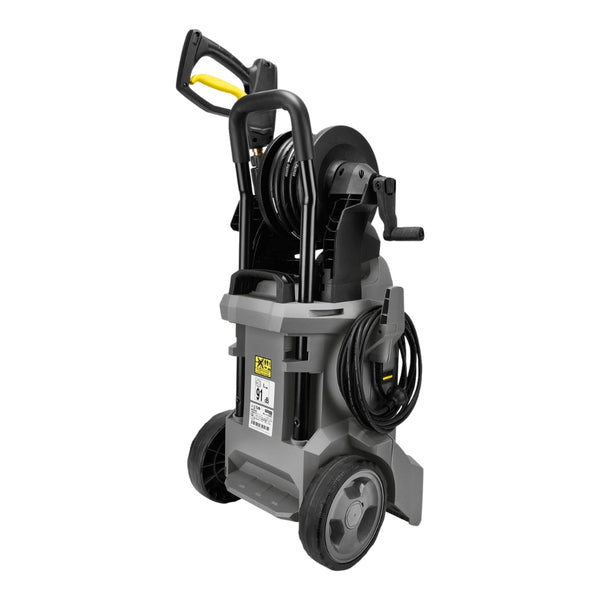
- Read the rating. Freshway's listing for the B.A.R BAR4013C-H gives 4,000 PSI (about 276 bar) and 15 L/min, with four quick-connect nozzles included.
- Convert the flow. One US gallon is about 3.785 litres, so 15 L/min ÷ 3.785 = 3.96 gallons per minute.
- Apply the pressure factor. √(4,000 ÷ 4,000) = 1, so the size is 3.96, which rounds to an 040 nozzle.
Pressure changes the answer too. All West shows a 15 L/min machine needs an 050 at 200 bar but an 045 at 250 bar. Check the first: 200 bar is 2,901 PSI, √(4,000 ÷ 2,901) = 1.174, and 3.96 × 1.174 = 4.65, between 045 and 050. All West's advice is to lean to the larger size.
Matching the nozzle to the pump: one size either way
Rearrange the same formula and you can see what a mismatched nozzle does. At a fixed flow, pressure = 4,000 × (gallons per minute ÷ size)². The table applies that to the BAR4013C-H's 15 L/min. These are theoretical figures from the formula; a real machine's unloader and pump condition will move them.
| Nozzle size | Theoretical pressure at 15 L/min | Change against the 040 | What it means on site |
|---|---|---|---|
| 035 | 353 bar (5,127 PSI) | About 30% higher | Above the 276 bar rating. |
| 040 | 271 bar (3,926 PSI) | Baseline | Close to the listed 4,000 PSI. |
| 045 | 214 bar (3,102 PSI) | About 21% lower | Softer clean, same flow. |
| 050 | 173 bar (2,512 PSI) | About 36% lower | Noticeably weaker on set-in soil. |
| 055 | 143 bar (2,076 PSI) | About 47% lower | Roughly half the rated pressure. |
Both directions cost something. Powerblast's nozzle size chart page says a nozzle that is too small causes pressure to build up inside the machine and can overload the motor, while one that is too large lets too much water through and drops both pressure and cleaning performance. All West adds that an undersized nozzle is hard on the unloader, hoses and fittings.
Angle effects: same flow, different footprint
Swapping a red tip for a white one does not change how much water leaves the lance. All West Softwash is explicit: a 0° jet and a 40° fan of the same size pass the same flow at the same pressure, and only spread it differently.
What changes is concentration. A wide fan spreads the flow along a longer line, so each part of the surface receives less force. Spray Nozzle Engineering's listing for a narrow flat-fan nozzle describes it as yielding the highest impact with the least atomisation, which is the same trade-off at work.
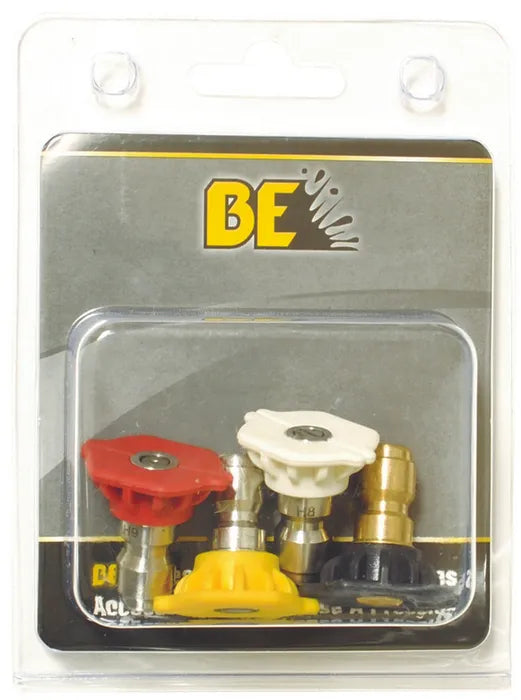
Colour coding is a quick guide to angle, not size. Freshway's listing for a stainless steel 035 quick-connect kit sets out the usual scheme: 0° red, 15° yellow, 25° green, 40° white and a black soap nozzle for low-pressure chemical application. For a surface-by-surface walk-through of those colours, see Freshway's pressure washer nozzle guide.

Effective pressure: what actually reaches the surface
Effective pressure is easier to manage if you treat it as a chain. The pump's rating is the starting figure, and each link can only hold it or lose some of it:
- Pump rating: bar at rated L/min.
- Nozzle fit: one size too large on a 15 L/min machine costs about a fifth of the pressure.
- Nozzle wear: behaves like a nozzle that is slowly getting bigger.
- Spray angle and stand-off distance: the wider the fan has spread when it lands, the less force each part of the surface receives.
Rotary nozzles are designed to add concentration. Freshway's listing for the Kränzle Dirtkiller 045 describes a zero-degree pencil jet spun in a conical pattern and claims it can raise effective working pressure by up to 70%. The same listing rates it to 220 bar, 20 L/min and 70°C on a 1,000 mm lance with a D12 plug, and states it is strictly designed for hard, robust surfaces.

Wear: why a slightly bigger hole costs a lot of pressure
Go back to the orifice equation and assume the pump keeps delivering its rated flow. If the area grows, the pressure needed to push that flow through falls with the square of the area. Area grows with the square of the diameter, which means pressure falls with the fourth power of the hole size.
The numbers are larger than most operators expect. If wear opens the orifice diameter by 5%, pressure drops to 1 ÷ 1.05⁴ = 0.82 of its original value, so a machine reading 200 bar would read about 165 bar. At 10% wider, the factor is 1 ÷ 1.10⁴ = 0.68, or roughly 137 bar. This assumes the discharge coefficient stays the same.
All West Softwash's field advice: swap the nozzle before blaming the pump. Pumps Australia's planned maintenance schedule gives 750 hours for the high-pressure nozzle under normal conditions. A crew running 30 hours a week reaches that in 750 ÷ 30 = 25 weeks, so plan two nozzle changes a year for that duty and check sooner if the gauge drifts.
Surface mapping and surface cleaners
Once the size is right for the pump, the angle follows the job:
- 0°: small, hard, isolated targets only. It concentrates everything on a point.
- 15°: stripping set-in soil from concrete and masonry.
- 25°: general washing and flushing debris away.
- 40°: rinsing, painted surfaces and anything softer.
- Soap nozzle: low-pressure chemical application before the rinse.
Surface cleaners need their own maths. All West notes that a surface cleaner shares the pump's flow between its nozzles, so each is sized for its share and all should match. For a 15 L/min machine at 200 bar, each nozzle on a two-nozzle bar sees 7.5 L/min: 7.5 ÷ 3.785 = 1.98 gallons per minute, × 1.174 = 2.33, which points to an 025, the size All West's chart lists for that setup.
Spec-sheet fields to check on a pressure washer
- Working pressure in bar and PSI, and flow in L/min.
- The nozzle size supplied, if stated.
- Connection type, such as a 1/4-inch quick-connect or a Kränzle D12 plug.
- Pressure, flow and temperature ratings for every nozzle, lance and hose.
Freshway's commercial pressure washers range lists pressure and flow on each product page: the two numbers the formula needs.
Safety and WHS notes for Australian sites
WorkSafe Victoria's high-pressure water jetting alert lists the main risks: the jet piercing skin, contaminated material being injected into the body, flying debris, and a flailing hose or out-of-control nozzle. It refers to AS 4233.1, which puts systems from 800 to 5,600 bar litres per minute in Class A and anything above 5,600 in Class B, with RTO training required for Class B operators.
The class is set by the pump, not the nozzle: for the BAR4013C-H, 276 bar × 15 L/min ≈ 4,137, Class A whichever tip is fitted. WorkSafe Victoria also says every part, fitting and hose must be rated at or above the equipment's maximum operating pressure, refresher training must be recorded at least every two years, and the operator controlling the jet should wear at least safety glasses and a face shield.
Frequently asked questions
Isn't a 0° nozzle the most powerful option?
Not in terms of pressure. A 0° jet passes the same flow at the same pressure as a 40° fan of the same size; it just concentrates that flow on a smaller spot. That makes it harsh on softer surfaces and slow over large areas, so keep it for small, hard targets.
Won't a smaller orifice give me more pressure?
Only up to the machine's rating. Past that, Powerblast says pressure builds up inside the machine and can overload the motor. Size the nozzle to the pump's flow and pressure rather than trying to squeeze more out of it.
Doesn't the nozzle colour tell me the size?
No. Colour normally shows the spray angle. The size is the number stamped on the nozzle, such as 035 or 040, so two red nozzles can suit completely different machines.
My pressure has dropped, so isn't the pump worn?
Check the nozzle first. As the orifice wears it opens up and pressure at the gun drops even though the pump has not changed. Pumps Australia's troubleshooting table lists a worn nozzle as a cause of low pressure.
Next steps with Freshway
Write down your machine's rated pressure and flow, run the formula, and compare the result with the number stamped on the nozzles in your kit. Replacement quick-connect sets, rotary nozzles and lances are in Freshway's pressure washer accessories range, and the full pressure washers collection lists the ratings you need for each machine. Check product pages for current pricing and stock. If the right nozzle does not bring the pressure back, Freshway's service and repairs team handles pressure loss, blocked nozzles and pump testing in its Sydney workshop.