Healthcare and Aged Care Floor Scrubber Requirements
Choose a scrubber that fits the infection-control routine, not one that tries to lead it.
Shop now
Here is the part that surprises people new to clinical cleaning: in a hospital or aged care home, the floor scrubber is not the front line of infection control. NSW Health's cleaning policy classes floors as low-touch surfaces, cleaned less often than bedrails, commodes and door handles. The scrubber's real job is quieter and more practical. It has to leave floors clean and dry without spreading what it picks up, without waking residents and without becoming a slip or trip hazard itself.
That changes what an operator should look for. This guide is written from the operator's side and set out as the questions that come up on site, using figures from four compact machines listed by Freshway.
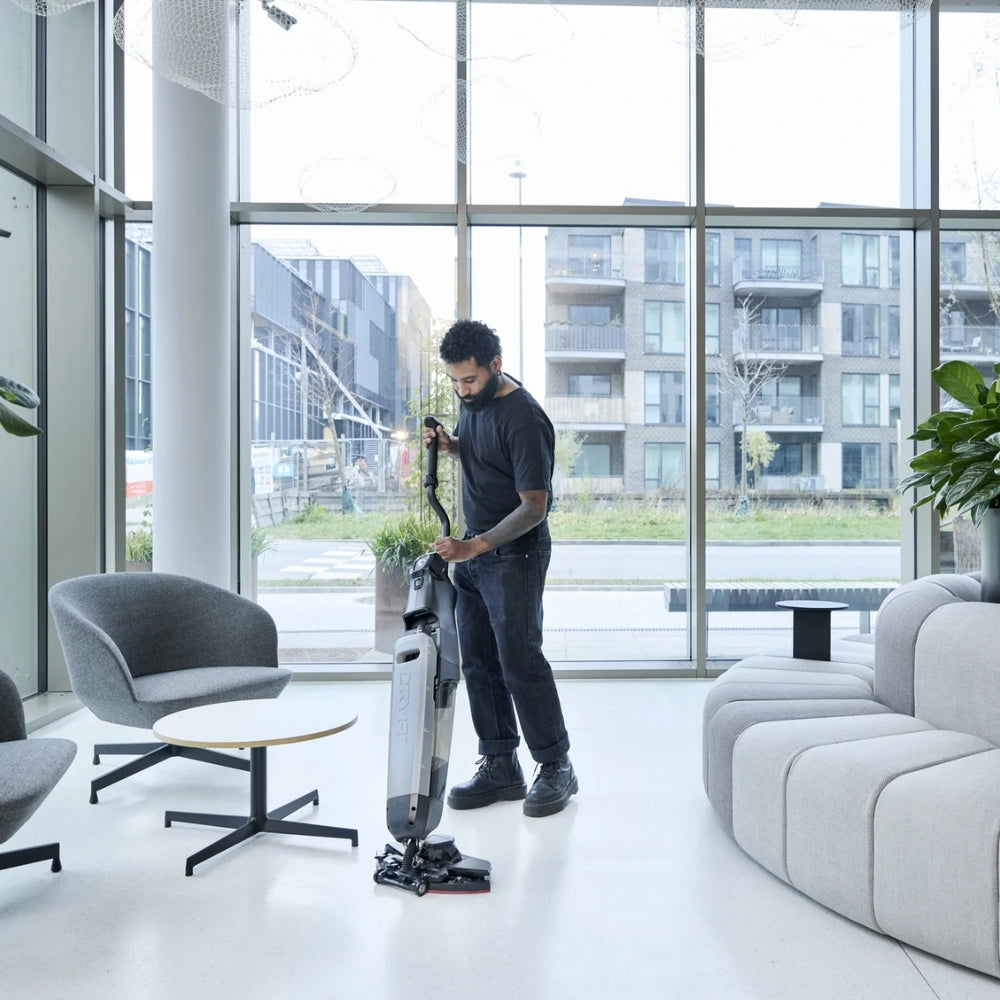
Healthcare floor scrubber: the short answer
A healthcare floor scrubber should be compact, battery powered where residents or patients move, and quiet, with tanks and pads that are easy to empty, clean and dry after each use. It should suit the facility's neutral detergent and colour-coding system. Blood and body-substance spills still follow local spill procedures, not the scrubber.
Each of those points is unpacked below as a question an operator would actually ask.
Is the scrubber an infection-control tool?
Partly. The Victorian Department of Health's cleaning and waste disposal procedures explain that deposits of dust, soil and microbes on surfaces can transmit infection, which is why thorough cleaning matters. The same page says cleaning methods should avoid generating aerosols, that cleaning items should be changed after each use, then cleaned and dried, and that cleaning solutions should be prepared fresh.
Applied to a scrubber, that means three habits. Fill the solution tank fresh for each shift. Empty, rinse and air-dry the recovery tank and squeegee at the end of each use. Clean or swap pads and brushes before moving between areas.
NSW Health's policy directive on cleaning of the healthcare environment adds two more. Before starting, staff must check that equipment is clean, in good working order and appropriate for the task; afterwards, reusable equipment must be cleaned and, if required, disinfected and stored. It also recommends colour coding reusable cleaning equipment by area, for example red for toilets, bathrooms and dirty utility rooms, yellow for infectious and isolation areas and blue for general cleaning. A scrubber that moves between those areas needs pads, and sometimes a machine, that follow the same code.
How quiet is quiet enough?
For workers, the benchmark is SafeWork NSW's noise code of practice, which sets the exposure standard at 85 dB(A) averaged over eight hours. The listed figures below all sit well under that. For residents and patients, there is no single number; lower is simply kinder, especially at night.
| Freshway listing | Cleaning width | Tanks (solution / recovery) | Power | Listed weight | Listed noise |
|---|---|---|---|---|---|
| Nilfisk Dryft micro scrubber dryer | 390 mm scrubbing width | 2.5 L / 2.8 L | 25.2 V 5 Ah lithium-ion, up to 60 minutes on high vacuum | 7.3 kg with battery | Under 70 dB(A) |
| Karcher BR 30/4 C compact upright | 300 mm | 4 L / 4 L | Corded, 12 m cable | 11 kg empty | Not listed |
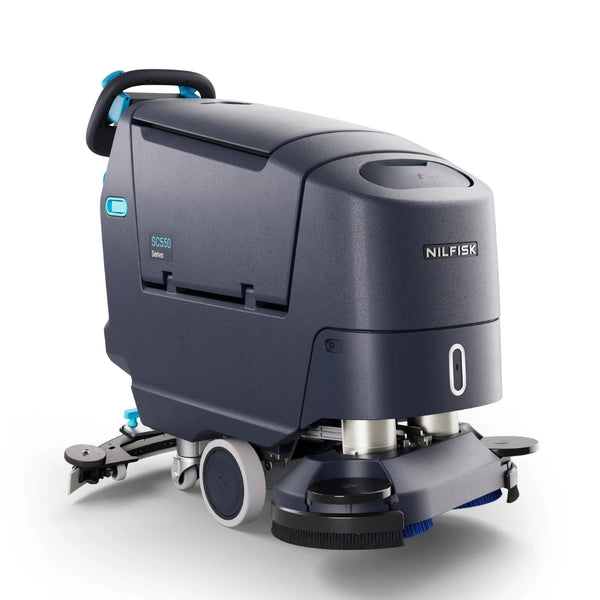
| Nilfisk SC250 compact | 34 cm | 6 L / 6 L | Lithium-ion battery | 25 kg with battery | 66 dB(A) |
| Nilfisk SC401 walk-behind | 43 cm | 30 L / 30 L | Maintenance-free battery, on-board charger | 151 kg with batteries | 65 dB(A) |
Listed figures may not be measured the same way across brands, so treat small gaps with caution. The bigger difference on a ward is the cord: the BR 30/4 is the only corded machine here, and a lead across a corridor is a trip hazard for residents using walking frames.
Which chemicals can go in the tank?
Start with what the facility already uses. NSW Health asks organisations to avoid unnecessary use of disinfectants when a neutral detergent suffices, and the Victorian guidance says detergents should not be mixed with other chemicals. In practice, that means one product per tank, at the labelled dilution, chosen with the facility's infection prevention staff.
Two machine-side checks follow. Confirm the product's label or safety data sheet covers use in a floor scrubber. And keep the dose right, because residue left on vinyl changes how the floor behaves underfoot. SafeWork NSW's slips, trips and falls guidance describes vinyl as slippery when wet, particularly if polished, and lists slippery floors resulting from cleaning products or methods as a common source of risk.
Will it fit the room?
Aged care rooms and hospital ensuites are full of bed legs, commodes, grab rails and narrow doors. That is where micro and compact machines earn their place.
Freshway lists the Nilfisk Dryft with a scrubbing deck under 50 mm high that reaches under shelving, bathroom partitions and low furniture, at 7.3 kg with the battery. It names healthcare and clinics among its uses, including tight patient rooms and restrooms, and has a magnetic click-on pad holder and quick-release squeegee, which makes swapping pads between colour-coded areas quick.
Corridors are a different job. Here the derivation is simple. At its listed rate of up to 2,330 m²/h, the SC401 would cover a 400 m² corridor run in about 10 minutes in theory (400 ÷ 2,330 = 0.17 h). The SC250, at up to 1,438 m²/h, would take about 17 minutes (400 ÷ 1,438 = 0.28 h). Both are theoretical rates with no turns or stops, but the gap shows why many sites pair a corridor machine with a room machine.

What about spills?
A scrubber is a routine cleaning tool, not a spill kit. NSW Health requires local protocols so that spots and spills of blood and other body substances are cleaned as soon as practicable. Small spills up to 10 cm across are wiped up with absorbent material such as paper towels; larger spills are first contained and confined with absorbent material, with any broken glass or sharps removed, before cleaning. Whether a disinfectant is used depends on a risk assessment with infection prevention staff.
Once the spill has been dealt with under that protocol, the floor can return to the normal scrubbing routine. Keep the scrubber's recovery tank out of the spill process altogether.

Spec-sheet fields to check on a floor scrubber
- Listed noise in dB(A), for night and day shifts near residents.
- Power source: battery near residents, corded only where leads can be kept out of walkways.
- Width and deck height, against the narrowest door and the lowest furniture.
- Tank access: how easily the recovery tank empties, rinses and dries.
- Pad and squeegee changes: tool-free is quicker between colour-coded areas.
- Runtime and charge time, for the length of the shift.
What training do operators need?
Every site has its own induction, but four topics come up again and again:
- The facility's cleaning and colour-coding procedure, including which pads go where.
- Battery charging. SafeWork NSW's lithium-ion battery guidance asks for chargers designed for the battery type and voltage and for batteries not to be left charging unattended or for long periods.
- Electrical checks for corded machines. SafeWork NSW's electrical risks fact sheet gives commercial cleaning equipment as an example for testing at least once every six months.
- Handling. Lifting a compact machine into a lift or onto a trolley is a manual task, so agree the method in advance.
Freshway's Service & Repairs workshop in Arncliffe services floor scrubbers, which is useful for a scheduled check between busy periods.
What to avoid
- Using the scrubber as the first response to blood or body-substance spills.
- Leaving recovery water in the tank overnight.
- Moving one set of pads from bathrooms to general areas.
- Trailing a lead across a corridor while residents are up.
- Adding disinfectant to every tank by default when a neutral detergent will do.
Summary: what to take away
In clinical settings, the scrubber has to fit the infection-control system rather than lead it. Choose compact battery machines for rooms and ensuites, a larger walk-behind for long corridors, and check listed noise, tank access and pad changes as closely as width and runtime.
Frequently asked questions
Battery or corded for aged care?
Battery wherever residents move. Corded only where leads can be kept out of walkways.
Does the scrubber disinfect the floor?
Not by itself. It cleans with the product in the tank, chosen with infection prevention staff.
Can one machine do rooms and corridors?
Rarely well. Most sites pair a compact room machine with a larger corridor machine.
How often should the recovery tank be cleaned?
After each use: empty, rinse and leave to dry.
Next steps with Freshway
Shortlist a room machine and a corridor machine from Freshway's floor scrubbers range, then check each product page for current pricing and inclusions. For neutral detergents, the floor cleaners range is the place to start. The aged care and healthcare collection and Freshway's guide to cleaning supplies for aged care and healthcare facilities cover the rest of the cleaning cupboard.