
Commercial Scenarios: Fleet Wash and Transport Depots
Size the fleet wash machine on flow, add heat for grease, and keep every litre in the bay.
Shop now
It is 5.15 on a Monday morning at a transport depot. A rigid truck has come back from a weekend run with road film on the cab, brake dust on the wheels and red dirt packed into the chassis rails. The yard hand grabs the small pressure washer from the workshop, starts on the grille, and twenty minutes later the cab is streaky, the chassis is still brown and a stream of grey water is heading for the stormwater grate by the gate.
Nothing in that scene is unusual. This guide replays it from the operator's side: what went wrong, which parameters fix it, and what a depot supervisor should check before a fleet wash machine is bought or moved into a bay.
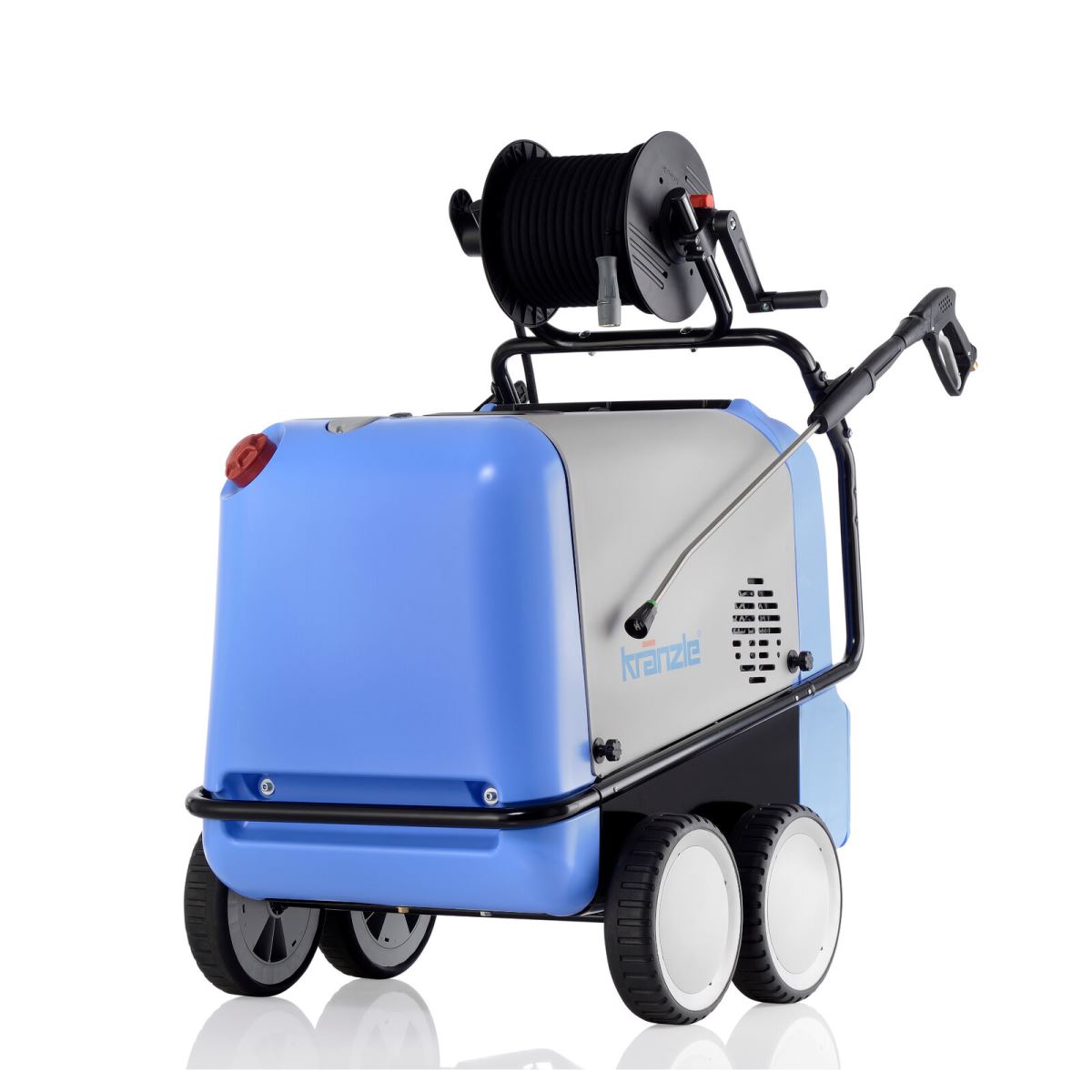
Pressure washer fleet wash commercial: the short answer
For commercial fleet washing, size the pressure washer on flow first, then heat, then pressure. Flow in litres per minute carries road film and mud off a vehicle. Hot water speeds up grease and diesel soot. Pressure only needs to lift soil without harming paint, seals or decals. Always wash in a proper bay.
The rest of this article works through the scene above, one mistake at a time, and turns each one into a spec you can check on a Freshway listing.
Case review: what went wrong in the wash bay
The scene is a composite, not a client story, but every step in it shows up on real sites. Here is the replay.
- The wrong machine. A workshop unit sized for tools and bins was asked to rinse a whole truck. Low flow meant the operator went over the same panel again and again.
- No dwell time. Detergent went on and came straight off. Road film needs a pre-spray that sits on the surface before the rinse.
- Cold water on grease. Chassis grease and diesel soot were attacked with pressure alone, so the nozzle went closer and closer to the metal.
- The wrong place. The truck was washed on open hardstand, and the runoff went toward stormwater.
Each of those is a buying or set-up decision, not an operator failing. Fix the decisions and the same yard hand gets a cleaner truck in less time.
Vehicle surfaces: what you are actually washing
A fleet vehicle is not one surface. Painted cab panels, glass, rubber door seals, vinyl decals and signwriting all sit next to steel chassis rails, alloy wheels, mud flaps and the tray or body. The soft surfaces want a wide fan nozzle, a sensible distance and a detergent that does most of the work. The chassis and wheels can take a narrower jet and hotter water.
That split is why a fleet machine needs easy pressure and nozzle changes. Freshway's listing for the Kärcher HDS 13/20-4 S describes a Servo Control dial on the EASY!Force gun that adjusts water flow and pressure from the gun itself. The Kränzle Therm 895-1 and WS-RP1000TS listings both describe the D12 quick release plug-in system for swapping lances and nozzles. Check the vehicle maker's own washing advice for paint, decals and seals, and set the nozzle choice from that.
Flow for rinse: litres per minute decide the shift
On a truck, most of the time goes on rinsing, and rinsing speed follows flow. The table below lists the pressure, flow and power that Freshway shows for four machines suited to depot work. Flow given in litres per hour has been divided by 60 to give L/min.
| Freshway listing | Listed pressure | Listed flow | Flow in L/min | Listed power | bar × L/min (upper figure) |
|---|---|---|---|---|---|
| Kärcher HD 6/15-4 Classic (cold) | 70 to 150 bar working, 190 bar max | 450 to 600 L/h | 7.5 to 10 | Single phase 220 to 240 V, 3.4 kW | 1,500 at 150 bar |
| Kränzle Therm 895-1 (hot) | 195 bar | 15 L/min | 15 | 415 V, 20 A, 3 phase | 2,925 |
| Kränzle WS-RP1000TS (cold, wall unit) | 200 bar | 16 L/min | 16 | 415 V, 20 A plug | 3,200 |
| Kärcher HDS 13/20-4 S (hot) | 200 bar max | 500 to 1,300 L/h | 8.3 to 21.7 | 3 phase, 400 V | about 4,330 |
The last column matters for safety as well as cleaning. WorkSafe Victoria's high-pressure water jetting alert summarises AS 4233.1 as Class A for 800 to 5,600 bar litres per minute and Class B above 5,600. All four machines land in Class A, even using the highest listed figures. The same alert says operators should be trained by a competent person, with refresher training done and recorded at least every two years.
A quick water sum helps with planning. At 15 L/min, every 10 minutes of trigger time puts 150 litres on the floor. Two guns at that rate produce 1,800 litres an hour, and that hourly figure is what the bay's drainage and pre-treatment have to handle.

Chemical choice and dosing
Detergent does the loosening, water does the carrying. Apply the pre-spray at low pressure, give it time to work, then rinse from the bottom up so streaks do not run over clean panels. On greasy chassis and engine bays, hot water does part of the chemical's job. Freshway lists the Therm 895-1 at up to 150°C and the HDS 13/20-4 S at 80 to 155°C.
Dosing hardware changes the routine. The HDS 13/20-4 S listing describes two separate 10-litre detergent tanks, so a degreaser for the chassis and a wash for the paintwork can both stay connected. The Therm 895-1 listing describes a high-pressure detergent system and adjustable burner performance.
The water authority has a say in the chemical as well. Water Corporation in WA says only quick breakdown detergents are to be used in its vehicle and machinery wash-down areas, and Sydney Water's car wash pre-treatment rules say no discharge of solvents to sewer. Choose products from the hot water pressure washers range and chemicals that suit the separator, not the other way round.
Recycle and runoff notes
Back to the grey stream heading for the gate. NSW EPA's stormwater guidance says runoff from washing cars, equipment or work floors must not enter stormwater drains. It says washing should be confined to a designated wash bay, with wastewater sent to sewer under a trade waste agreement, or treated and even recycled.
In Sydney, the sewer side has its own rules. Sydney Water lists truck washes among businesses likely to produce industrial trade wastewater, which needs approval and site-specific conditions. For a hand wash and pressure spray car wash, its pre-treatment page sets out a roofed and bunded wash area, in-floor bucket traps, a collection pit of at least 500 litres and an oil water separator sized to the flow rate, with a minimum size of 1 kL an hour.
That is where the 1,800 litres an hour from two guns becomes a real number. Sydney Water asks for pre-treatment sized to the maximum hourly flow now and into the future, so a bigger machine can mean a bigger separator. Outside Sydney, check with your local council or water authority. Water Corporation, for example, says unroofed wash-down areas are not to be greater than 20 square metres.
Spec-sheet fields to check on a pressure washer
- Flow in L/min. Convert L/h by dividing by 60. Compare machines on this before pressure.
- Power supply. Single phase or 415 V three phase, and the plug rating shown on the listing. Match it to the outlet in the bay.
- Heat. Hot or cold, the listed temperature range, and the burner fuel tank size.
- Motor and pump. Freshway lists the Therm 895-1 and WS-RP1000TS with 1400 RPM 4-pole motors, and the HD 6/15-4 Classic with a ceramic-piston crankshaft pump.
- Stop and protection systems. The Therm 895-1 listing includes Total-Stop with delayed motor cut-out, dry run protection and water flow monitoring. The WS-RP1000TS uses a flow-switch Total Stop system.
- Hose and mounting. Hose length for walking around a long vehicle, and whether the unit is mobile, like the 223 kg Therm 895-1, or fixed, like the wall or floor mounted WS-RP1000TS.

Common mistakes to avoid
- Buying on the PSI headline and ignoring L/min.
- Rinsing detergent off before it has had time to work.
- Running a petrol or diesel burner machine in a closed bay. SafeWork NSW's carbon monoxide guidance says enclosed spaces raise the risk and combustion-powered plant should be minimised where ventilation is not adequate.
- Plugging a mains machine into a wet bay without protection. SafeWork NSW says RCD requirements apply where plug-in equipment is exposed to conditions such as moisture.
- Adding a second gun without checking the separator and pit can take the extra flow.
Checklist for site supervisors
- Confirm the wash bay is roofed, bunded and connected under an approval, or that water is treated and recycled.
- Write down the vehicle types, the soils and how many vehicles are washed each shift.
- Pick flow first, then decide on hot water for grease and soot.
- Match the power supply to the bay outlet, and keep combustion units out of closed spaces.
- Choose quick breakdown, solvent-free chemicals that your separator can handle.
- Train every operator, record it, and book the refresher before two years are up.
- Line up pump servicing and parts before the machine goes into daily use.
Frequently asked questions
Isn't higher pressure the fastest way to clean a truck?
Not usually. Flow carries soil off the vehicle, so a higher L/min machine rinses faster. Extra pressure close to paint, seals and decals can do damage. Let detergent dwell, then rinse with flow at a sensible distance.
Doesn't hot water mean we can skip the detergent?
Rarely. Hot water speeds up grease and diesel soot removal, but road film usually still needs a pre-spray and dwell time. Choose a quick breakdown product that suits the oil water separator in your bay.
Can we wash trucks in the yard if we only use water?
Not in NSW. NSW EPA guidance says runoff from washing must not enter stormwater drains. Washing should happen in a designated wash bay that drains to sewer under a trade waste agreement, or where the water is treated and recycled.
Isn't a single phase machine too small for a depot?
It depends on the fleet. A single phase unit such as the Kärcher HD 6/15-4 Classic, listed at up to 600 L/h, suits vans and light vehicles. For trucks washed every shift, a 415 V unit with 15 L/min or more saves rinse time.
Next steps with Freshway
Start with the bay, then the machine. If the depot has three phase power, compare the hot and cold units in the hot water range above. If it only has single phase outlets, start with the electric pressure washers collection. For open yards well away from enclosed bays, the petrol pressure washers collection covers machines that do not need mains power. Check each product page for current pricing, and talk to the Arncliffe team through service and repairs about pump servicing and parts before the machine starts daily work.
Related articles
 Kärcher HD 7/10 CXF: What the Food-Industry Variant Changes for Washdown ...
 Nilfisk GM80PR Industrial Dry Vacuum: Where an Aluminium Canister Fits
 XL61 Diesel Radiant Heater (17 kW): What to Check Before Approving a Work...
 Nilfisk IVB 965-2H/M SD XC: Choosing a Twin-Motor H/M Class Extractor for...