Pacvac Backpack vs Canister Alternatives for Sydney Cleaning Teams
Same Pacvac airflow, different job: choose by capacity, floor layout and who carries it.
Shop now
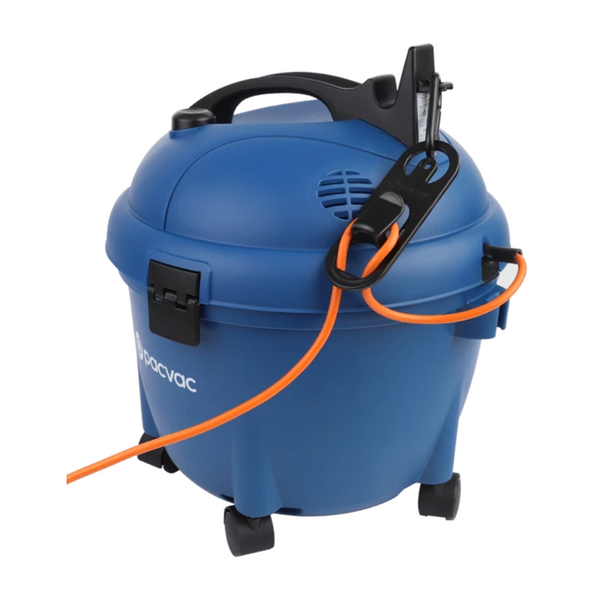
Same brand, same listed airflow: 38 litres a second. On Freshway's listings, the Pacvac Superpro 700 backpack and the Pacvac Glide 300 canister both move 38 litres of air per second, and both come with an 18-metre cord. One holds 5 litres of dust and rides on the cleaner's hips. The other holds 15 litres and rolls behind them on castors.
So when a Sydney contractor asks "backpack or canister?", suction is rarely the answer. Capacity, floor layout, who carries the machine and how the building feels about noise decide it. This comparison is written for the person signing the order.
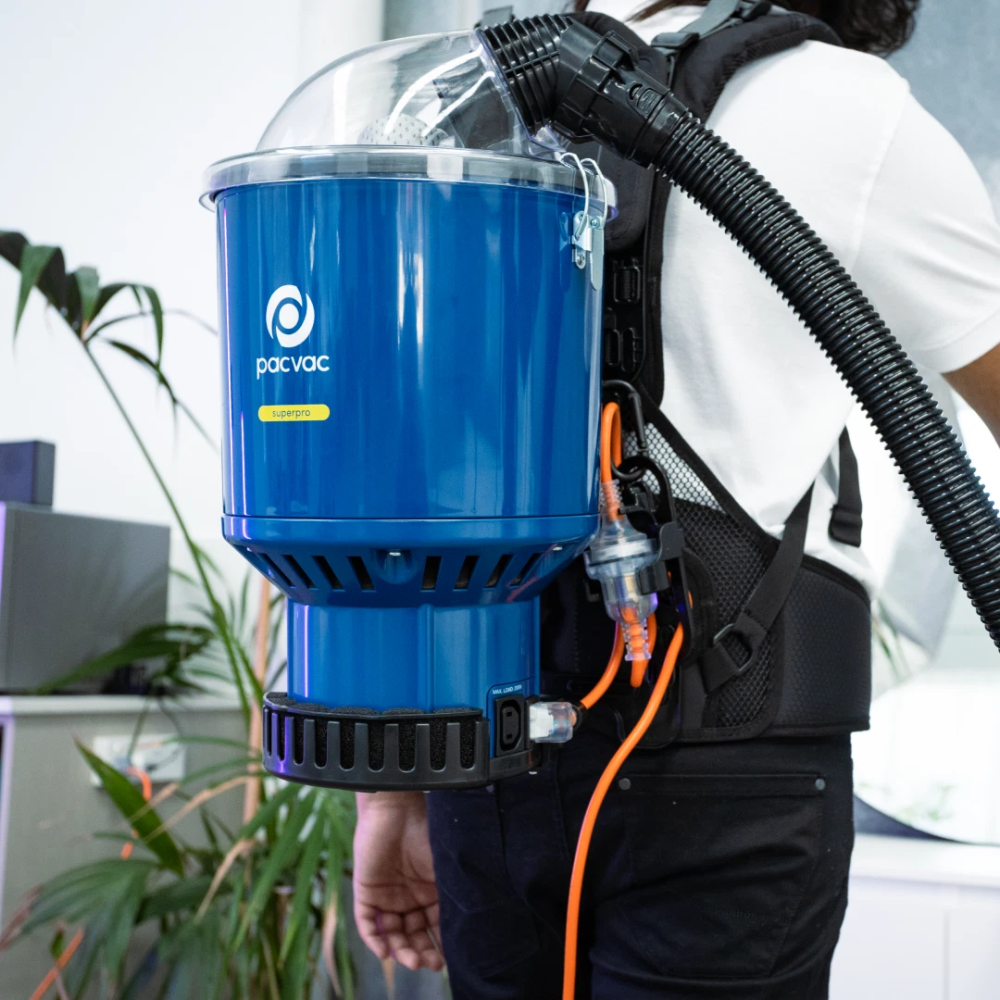
Pacvac backpack vs canister: the short answer
Choose a Pacvac backpack such as the Superpro 700 for stairs, desks, seating and tight rooms where speed between obstacles matters. Choose a canister such as the Glide 300 where a larger dust capacity, hard-floor lobbies or a shared cart machine suit better. A mixed fleet often covers a Sydney contract better than either.
For the differences between the Pacvac backpack tiers themselves (Thrift, Superpro, Duo, Micron), see Freshway's Pacvac backpack model range guide. This article only weighs backpack against canister.
Why Sydney teams ask this
Sydney contracts often mix building types. A single run can include a CBD office floor cleaned during the day, a strata block with stairwells and no lift, and a hotel with occupied rooms. A backpack-only fleet struggles with the high-volume nights. A canister-only fleet struggles with the stairs.
Standardising on one brand means bags, filters and repairs come from one place. That makes the Pacvac backpack vs canister question a fleet-mix question rather than a brand question.
Where the Pacvac backpack wins
Tennant Australia's vacuum selection guide points backpacks at cubicles, stairways, under furniture and other tight quarters, and notes that users can move through populated areas without disturbing passers-by. That describes most office and strata work.
The Superpro 700 listing adds the details a buyer checks: a 1000 W motor, 22 kPa vacuum pressure, a HEPA-rated Hypercone filter, an Ecoharness, a clear dome lid to see the bag fill, and a weight of 5.4 kg excluding cord and hose.

When a canister is still needed
Tennant describes canisters as wheeled machines that work across a variety of surfaces, with small heads that clean under desks and furniture. That suits sites with many floor types and long, open runs where nobody wants to wear a machine for hours.
Capacity is the other reason. The Glide 300 is listed with 15 litres, three times the Superpro 700's 5 litres, a 1300 W motor and a built-in motor protection valve that opens if the hose is blocked. On a high-debris night shift, such as a function venue after an event, that capacity means fewer bag changes.
The trade-off is handling. Pulling a canister is a manual task too. SafeWork NSW's hazardous manual tasks guidance lists pushing and pulling alongside lifting and carrying, and repetitive movement and sustained or awkward posture among the risk factors. Neither format removes the risk; they move it to different parts of the body.
Side by side: Superpro 700 vs Glide 300
All figures come from the two Freshway product pages.
| Field | Pacvac Superpro 700 (backpack) | Pacvac Glide 300 (canister) |
|---|---|---|
| How it moves | Worn on a harness | Pulled on castor wheels |
| Motor | 1000 W single-stage flow-through | 1300 W commercial flow-through |
| Airflow | 38 L/s | 38 L/s |
| Dust capacity | 5 litres | 15 litres |
| Listed noise | 66 dB(A) | 64 dB(A) |
| Cord | 18 metres | 18 metres |
| Weight | 5.4 kg (excluding cord and hose) | 5.8 kg |
| Filtration | HEPA-rated Hypercone filter | 3-stage: reusable SMS bag, disposable bag, pre-motor filter |
| Suits | Stairs, desks, seating, tight rooms | Open runs, mixed floors, high-debris shifts |
Read the table for what it does not say. Airflow is identical, so the canister's larger motor rating does not show up as more listed airflow. The 3 times capacity is the canister's real advantage.

Parts and bags availability
Standardising on Pacvac only pays off if consumables are easy to reorder. Freshway's Pacvac listings include Superpro disposable SMS cone bags, the Superpro H13 HEPA pre-motor cone filter, the Ecoharness and frame service kit (SEK018), and a cord and lead service kit. For the canister side there are 15-litre Glide and Hush disposable bags (DUB031), a reusable 15-litre SMS bag for the Glide 300 series, and a dust bag and filter service kit for Glide and Hush machines.
Two practical points for buyers: order bags by machine, because the backpack and canister use different bag sizes, and keep a spare harness kit on hand so a broken strap does not park a machine.
Service and repairs in Sydney
Freshway's service and repairs page lists Pacvac among the backpack vacuum brands repaired at its Arncliffe workshop, for suction, motor, cord and switch faults. It says a quote is given before work begins, and repairs carry a 30-day warranty for the same issue after the machine is ready for pickup.
Electrical checks are part of the service picture. SafeWork NSW says plug-in equipment used where it is likely to be damaged, for example by dust or moisture, must be regularly inspected and tested by a competent person, with AS/NZS 3760 setting out the method. Energy Safe Victoria's electrical safety guide warns never to use an appliance with a frayed cord or a cracked plug.
Noise in CBD buildings
Day cleaning in occupied CBD offices puts listed noise figures under scrutiny. SafeWork NSW's noise code of practice sets the exposure standard at 85 dB(A) averaged over eight hours, and explains that every 3 dB increase represents a doubling of sound energy. The 2 dB gap between the Glide 300 (64 dB(A)) and the Superpro 700 (66 dB(A)) is less than that 3 dB step.
In other words, the listed figures do not settle it. Run both machines for a few minutes near an occupied workstation and ask the tenant's facilities manager which is acceptable.
Battery options
Cords on stairs and in busy corridors are a trip hazard; SafeWork NSW lists loose cords and cables among slip and trip hazards. Freshway lists two cordless Pacvac backpacks. The Superpro Go has a 5-litre capacity, standard and boost modes and the Ecoharness. The Velo Go is listed with two 18 V lithium-ion batteries, up to 50 minutes of runtime and a 2.5-litre capacity. Freshway also lists a spare Pacvac 18 V 108 Wh battery, and chargers are plug-in equipment that belong in the test and tag schedule.
Common mixed fleets
- CBD office contract: one corded Superpro per cleaner, one cordless backpack for stairwells and lift lobbies, one canister per building for high-debris areas.
- Strata portfolio: backpacks for stairs and corridors, plus the Pacvac 18-metre extension lead listed by Freshway for long common areas.
- Hotel housekeeping: backpacks for rooms, a canister on the housekeeping cart for function rooms and back-of-house.
Browse the full range in Freshway's canister and barrel vacuums collection if the canister role needs a different brand.
Spec-sheet fields to check on a vacuum
- Airflow in L/s and vacuum pressure in kPa, read together.
- Dust capacity in litres, and the bag type it uses.
- Listed dB(A), then a site trial.
- Cord length against the spacing of power points.
- Weight and harness design for backpacks; castor quality for canisters.
- Filtration stages, and whether HEPA replacement filters are stocked.
Frequently asked questions
Do the Superpro 700 and Glide 300 have the same airflow?
Yes, on Freshway's listings. Both are listed at 38 litres per second.
Which holds more dust?
The Glide 300 canister, listed at 15 litres against 5 litres for the Superpro 700 backpack.
Which is quieter?
The Glide 300 is listed at 64 dB(A) and the Superpro 700 at 66 dB(A). Trial both on site.
Is there a cordless Pacvac backpack?
Yes. Freshway lists the Superpro Go and the Velo Go.
Does Freshway repair Pacvac backpacks in Sydney?
Yes. The Arncliffe workshop lists Pacvac among the backpack brands it repairs, with a quote before work starts.
Next steps with Freshway
Map each site to a format, count the machines, then compare the Pacvac backpack vacuum range with the Glide 300. Check each product page for current pricing. Sydney Metro buyers can ask about same-day delivery or arrange Click and Collect from the Arncliffe warehouse.