Hotel Housekeeping: Backpack Vacuum Workflows vs Canister Carts
Backpacks for guest rooms, canisters for corridors, and a harness check every shift.
Shop now
It is mid-morning on a heavy checkout day. A room attendant has stripped the beds and wiped the bathroom, and now reaches for the canister on the housekeeping cart. The hose catches on the bed leg, the machine tips against the bedside table, and the plug pulls out of the wall behind the desk. She walks back to plug it in, drags the canister round the end of the bed, then stops to wind the cord before moving next door. None of it is a disaster. Repeated across a full floor of departures, it is where the morning goes.
This playbook breaks a hotel room cycle into its vacuum steps and compares how a backpack harness and a canister on the cart handle each one. It is written for executive housekeepers and the people who spec equipment for them. It covers vacuum workflow only, not linen, amenities or trolley set-up.
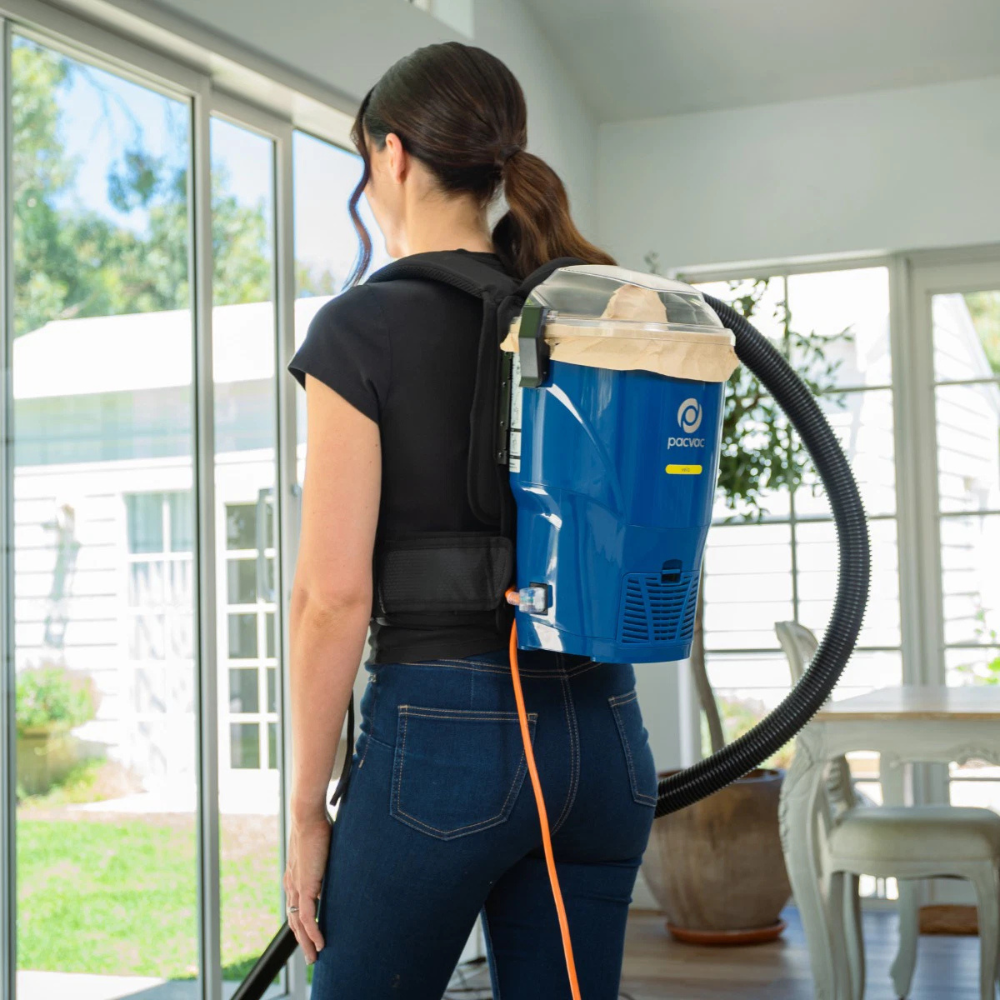
Hotel backpack vacuum workflow: the short answer
In guest rooms, a backpack keeps the machine on the attendant: no hose snag, no tipping, no dragging between bed, desk and wardrobe. A canister on the cart suits corridors, lobbies and function rooms, where long runs, a bigger bag and lower listed noise count for more. Plan for both formats.
The rest of this guide looks at where the vacuum minutes actually go and how to organise each step.
Where the vacuum minutes go in a room cycle
Vacuuming is only part of a room clean, but it has several hidden steps that add up across a shift. The table compares the two formats step by step. It shows which format adds friction at each point, not timed measurements; time your own rooms to put numbers against it.
| Room cycle step | Backpack on the attendant | Canister from the cart |
|---|---|---|
| Getting the machine into the room | Already worn; walk in | Lift off the cart, wheel in, unwind cord |
| Plugging in | Cord follows the attendant; reach is set by cord length | Cord and machine both need routing round furniture |
| Around bed, desk and wardrobe | Machine follows the body; hose stays short | Hose drags round furniture; machine can tip or snag |
| Under beds and furniture | Wand and floor tool do the reach | Same reach, once the hose is freed from furniture |
| Bag checks | More frequent on a small container | Less frequent on a large bag |
| Leaving the room | Unplug and walk out | Wind cord, wheel out, lift back on cart |
The backpack wins most room steps. The canister wins on bag changes, and on the attendant's body over a long shift if the backpack is poorly fitted. That is why the harness, not the motor, decides whether backpacks work in a hotel.
Corridor and lobby
Corridors, lift lobbies and function rooms are long and open, with fewer obstacles and more people passing. Here the canister's strengths show. On Freshway's listing, the Nilfisk GD930 PRO HEPA S2 has a 15-litre dust bag, a 15-metre cord and dual-speed operation listed at 52 / 48 dB(A). A large bag means fewer stops on a long run, and the lower setting helps near guest room doors.
WorkSafe Victoria's safer vacuuming guide suggests mechanised cleaning machines for large floor areas. It also suggests keeping a vacuum on each level of a multi-level building to cut carrying. For a hotel, that argues for a corridor canister stored on each floor rather than one machine moved between floors.

Cart vs harness
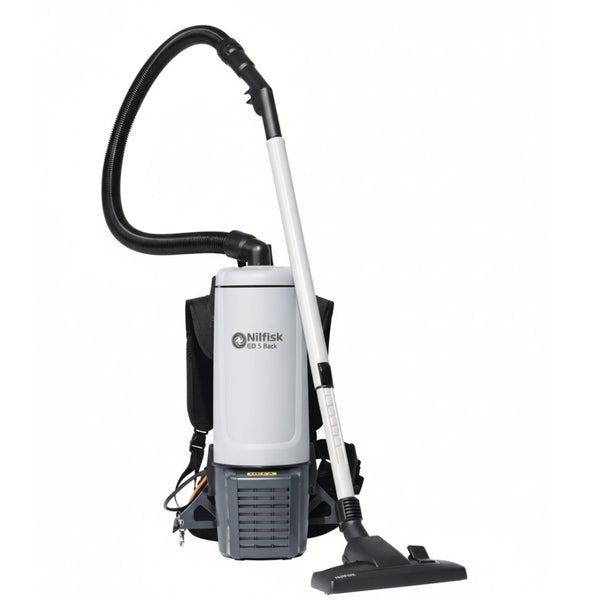
The real comparison is the attendant's body. A canister on the cart means lifting it on and off many times a shift; the GD930 is listed at 8 kg. A backpack means carrying the machine for the whole vacuuming task; the Pacvac Velo corded backpack is listed at 3.9 kg with an adjustable, ambidextrous Ecoharness.
SafeWork NSW lists repetitive movement and sustained or awkward posture among the risk factors that make a manual task hazardous. Both formats carry some of that risk, in different places. WorkSafe Victoria's cleaning injury hotspots page gives backpack vacuum cleaners as an example of mechanical aids to provide, alongside job rotation to limit long periods of repetitive work. A backpack only helps if each attendant adjusts it to their own body at the start of every shift.
Guest noise expectations
Guest noise is a comfort question, not a hearing-safety one. SafeWork NSW's noise code of practice sets the workplace exposure standard at 85 dB(A) averaged over eight hours. Freshway's listed figures for these vacuums sit well below that: 65.3 dB(A) for the Velo and 52 / 48 dB(A) for the GD930.
The same code recommends a purchasing policy that compares supplier noise data and chooses the quietest plant for the job. For housekeeping, that means comparing listed dB(A) figures, then scheduling around guests:
- Use the quieter corridor machine, on its low setting, before late checkout.
- Vacuum occupied rooms only on request, and with the door closed.
- Keep the noisier work, such as lobby detailing and function rooms, for when those areas are empty.
Attachments for soft furnishings
Hotel rooms are full of fabric: headboards, upholstered chairs, curtains, cushions and mattress edges. WorkSafe Victoria's guide recommends upholstery attachments for furniture, heads matched to the floor type, and attachments that are easy to change. On a Velo, Freshway lists:
- The FLT001 all-purpose floor tool, 285 mm wide, supplied with the machine. A foot pedal raises or lowers the bristles for carpet or hard floor.
- The ACC001 dusting brush, a 32 mm oval head with soft nylon bristles, listed as compatible with the Velo, for blinds, lampshades and vents.
Keep a small tool pouch on the harness or cart so the attendant swaps tools rather than forcing the floor tool onto a headboard. Spare tools sit in Freshway's vacuum parts and accessories range; check the listed fitting size against your wand.

Shift changeovers
The handover between shifts is where vacuum problems are found or buried. A two-minute changeover routine:
- Check the bag. The Velo's listed capacity is 2.5 litres, so a backpack handed over half full will need a change early in the next shift.
- Look along the cord and plug. SafeWork NSW's electrical risks fact sheet says unsafe electrical equipment must be disconnected and not used again until it is repaired or tested and found safe.
- Readjust the harness for the incoming attendant.
- Note any fault on the floor sheet, not just verbally.
Velo users should also check bag stock. Freshway's listing for DUB034 paper bags says they fit only second-release Velo machines and must be used with the reusable bag supplied with the vacuum.
Training script
A short script, run at induction and repeated whenever equipment changes:
- Fit. Adjust shoulder straps and hip belt before switching on.
- Wand length. WorkSafe Victoria's guide advises adjusting the wand so the shoulder and elbow stay in a natural position close to the body.
- Room order. Plug in near the door, vacuum from the far corner back toward it, and finish at the outlet.
- Under furniture. Face the area and push the vacuum forward rather than bending and twisting, as the same guide recommends.
- Empty often. A fuller machine is a heavier machine.
The Victorian Government's hospitality and tourism safety module lists vacuuming among hospitality manual handling tasks and says employers must train employees to use machinery and equipment correctly.
Measures to track
- Average vacuum time per room type, timed on a sample of rooms with each format.
- Outlet changes per room.
- Bag changes per shift, per machine.
- Machines out of service each week, and why.
- Attendant feedback on harness fit and wand length after the first month.
Collect a few weeks of data before deciding to switch a whole floor from canisters to backpacks.
Common mistakes to avoid
- Buying backpacks without a harness-fitting step at each shift start.
- Using one canister for both rooms and corridors and moving it between floors.
- Assuming the smaller machine is quieter. Here the canister has the lower listed figure.
- Mixing bag types across a fleet of similar-looking machines.
- Sending damaged machines back out because the fault was mentioned but not recorded. Freshway's Service & Repairs workshop in Sydney quotes before any work and offers pick-up and delivery for commercial clients.
Spec-sheet fields to check on a vacuum
| Field | Why it matters in a hotel | Pacvac Velo corded (listed) | Nilfisk GD930 PRO HEPA S2 (listed) |
|---|---|---|---|
| Weight | Carried on the back or lifted on and off the cart | 3.9 kg | 8 kg |
| Noise level | Guest comfort near occupied rooms | 65.3 dB(A) | 52 / 48 dB(A) |
| Capacity | Bag changes per shift | 2.5 litres | 15 litres |
| Cord length | Outlet changes per room or corridor | 18 metres | 15 metres |
| Filtration | Allergy-sensitive guests | H13 HEPA Hypercone 4-stage | HEPA S2 filter |
Frequently asked questions
Are backpack vacuums faster than canisters in hotel rooms?
They remove several steps, such as lifting the machine off the cart, dragging it round furniture and winding the cord. Time a sample of your own rooms with each format before switching a whole floor.
Which format is quieter for early-morning corridors?
Compare listed figures. On Freshway's listings the Nilfisk GD930 canister is 52 / 48 dB(A) and the Pacvac Velo backpack is 65.3 dB(A), so here the canister is the quieter option.
How often should the harness be adjusted?
At the start of every shift and whenever a different attendant picks up the machine. A harness set for one person rarely fits the next.
Do hotel vacuums need test and tag?
Yes. Corded vacuums are electrical equipment. SafeWork NSW gives commercial cleaning equipment as an example of equipment to test more often, for example at least once every six months.
Next steps with Freshway
Start with a room-type trial: one backpack from the backpack vacuums collection for guest rooms, and one corridor machine from the canister and barrel vacuums collection. For the wider range, browse all vacuum cleaners. Freshway's shop by industry page lists other hospitality equipment and supplies. Check each product page for current pricing and availability.