Electric vs Petrol Pressure Washers: Parameter Trade-Offs
Compare flow, power source and site rules, not just the bigger bar figure.
Shop now
The petrol machine with the bigger bar figure is not automatically the faster cleaner. On many commercial jobs a mains-powered electric unit finishes first, because it can run indoors, close to the work, with no refuelling stops and no fume controls to set up.
Our earlier article on electric vs petrol pressure washers for commercial cleaning in Australia compares the two in general terms. This one is a case review of two specific Freshway listings, worked through parameter by parameter.
Electric vs petrol pressure washer parameters: the short answer
Compare electric and petrol pressure washers on working pressure, flow in litres per minute, the power available on site, where the machine must run, and noise and fume limits. Petrol suits remote outdoor work and higher flow; electric suits indoor, wash-bay and occupied sites where fumes are unacceptable.
The two machines in this review
We compare two Freshway listings from the same brand so that pump design and accessories are broadly similar:
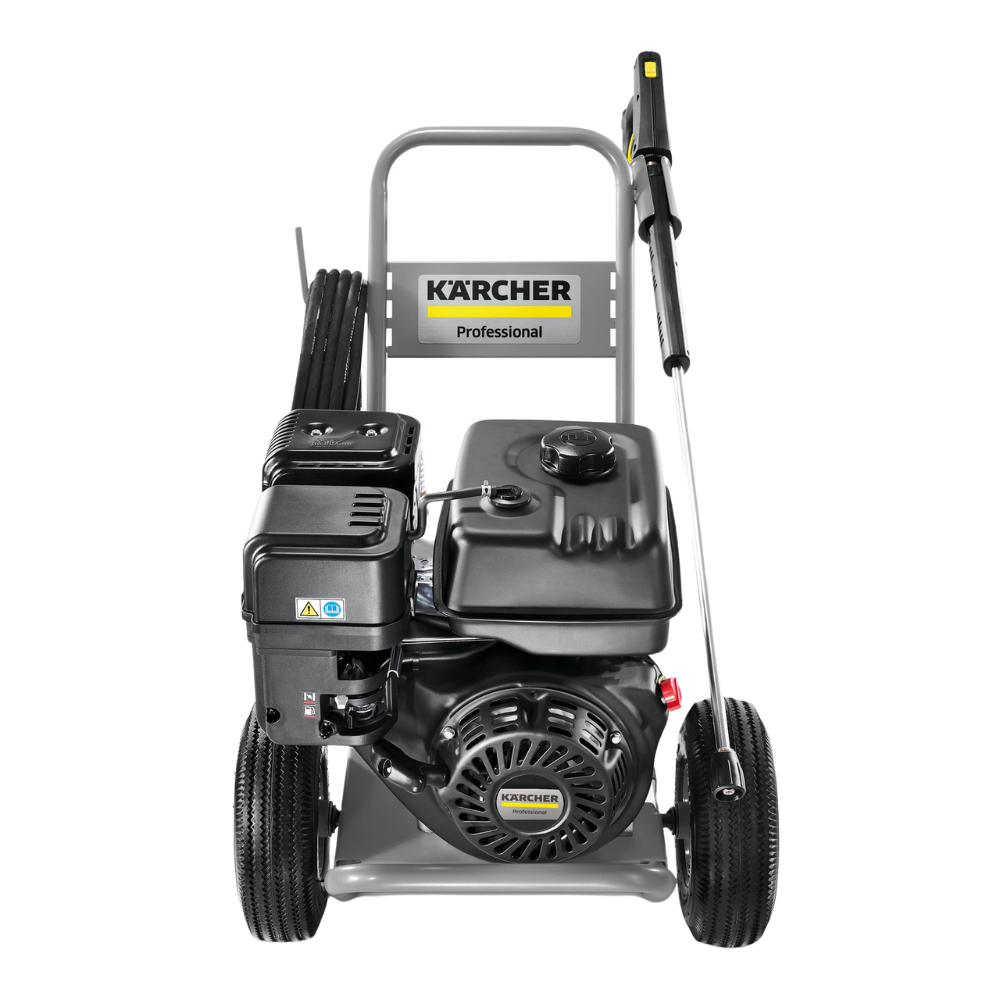
- Karcher HD 7/20 G Classic (petrol): Freshway lists 250 bar (3626 PSI), 11.7 litres per minute, a water-cooled pump, a tubular steel frame, pneumatic tyres and a weight of 80 kg.
- Karcher HD 6/15-4 Classic (electric): Freshway lists a 3.4 kW single-phase motor, a 4-pole pump, 150 bar working pressure (190 bar peak) and 600 litres per hour.

Peak bar versus working bar
Listings mix maximum and working figures. The electric unit's listing gives both (150 bar working, 190 bar peak); the petrol listing gives 250 bar. When a listing quotes one figure only, assume it may be the maximum and ask before comparing. Our guide to nozzle orifice and spray angle explains why the nozzle sets the pressure you actually feel.
Flow realities
Convert everything to litres per minute. 600 L/h ÷ 60 = 10 L/min for the electric unit, against 11.7 L/min for the petrol unit. That is a gap of 1.7 L/min, or about 17 per cent more water per minute from the petrol machine (1.7 ÷ 10 = 0.17). Flow moves loosened soil away, so on large open areas the petrol unit has a measurable edge.
Spitwater's note on water supply set-up is a reminder that either machine needs an inlet supply at least equal to its pump flow.
Site power and the electrical side
The electric unit needs a suitable outlet and a lead in good condition. SafeWork NSW's electrical risks fact sheet covers leads, wet conditions and inspection. Use RCD protection; SafeWork NSW explains residual current devices.
A petrol unit avoids the power question entirely, which is why it suits remote yards, farms and construction sites.
Emissions and noise
Petrol engines produce carbon monoxide. SafeWork NSW lists carbon monoxide as a priority chemical and warns against running engines in enclosed or poorly ventilated spaces. That rules petrol out for basement car parks, kitchens and enclosed wash bays.
Noise matters too. Employers must manage exposure under the WorkSafe Victoria noise rules, and occupied sites often have their own limits.

Runtime and handling. Electric machines run as long as power and water are available. Petrol machines stop for fuel and need fuel storage on the vehicle. At 80 kg, the petrol unit listed here is a two-person lift onto a ute; plan ramps or a tail lift.
Running cost mindset without price figures
Prices change, so check each product page for current pricing, but the cost structure is predictable. A petrol unit adds fuel, engine oil, spark plugs and air filters to the pump's own service needs, and the engine needs servicing on its own schedule. An electric unit adds electrical testing and tagging, and leads that get replaced when damaged. Both need inlet filters cleaned and nozzles replaced as they wear, because a worn nozzle lowers pressure at the gun on either machine.
Downtime is the other cost. A petrol unit that will not start on a cold morning stops the crew; an electric unit on a site with an overloaded circuit does the same. Ask which failure is more likely on your sites, then build spares and checks around it.
A fair comparison method
- Write each listing's pressure figure and note whether it is working or maximum.
- Convert flow to litres per minute.
- Do not compare anything until both machines are in the same units.
- Mark each job location as indoor, outdoor with power, or outdoor without power.
- Count which machine can legally and safely run at each location.
- Only then compare cleaning speed.
Side-by-side comparison
| Parameter | HD 7/20 G Classic (petrol) | HD 6/15-4 Classic (electric) |
|---|---|---|
| Pressure on Freshway listing | 250 bar | 150 bar working, 190 bar peak |
| Flow | 11.7 L/min | 600 L/h (10 L/min) |
| Power source | Petrol engine | 3.4 kW single-phase motor |
| Indoor use | No, fumes | Yes, with electrical controls |
| Remote site use | Yes | Needs power |
| Listed weight | 80 kg | Check product page |
When each one wins
Choose petrol for off-grid outdoor work, large hardstand areas and plant wash-downs away from power. Choose electric for wash bays, workshops, food sites, car parks and any enclosed area. Many contractors run one of each.
Mistakes buyers make:
- Comparing a peak figure on one listing with a working figure on another.
- Ignoring flow and looking only at bar.
- Buying petrol for jobs that are mostly indoors.
- Running a 15 A machine from an undersized lead.
Frequently asked questions
Do I need two machines?
Many contractors do, because indoor and off-grid jobs pull in opposite directions. If most work is in one category, start with the machine that suits it and hire for the exceptions.
Is petrol always more powerful than electric?
Not always. In this comparison the petrol unit has higher listed pressure and flow, but some three-phase electric machines match or exceed petrol units. Compare the listed figures.
Can I use a petrol pressure washer in a car park?
Not in an enclosed or basement car park, because of carbon monoxide. Open-air sites may be suitable with ventilation and a risk assessment.
How do I compare L/h and L/min?
Divide litres per hour by 60. For example, 600 L/h equals 10 L/min.
Next steps with Freshway
List where the machine will work most weeks, then compare listings in petrol pressure washers and electric pressure washers. Check each product page for current pricing and full specifications.