Education Campuses: Scrubber Selection for Halls and Amenities
Size one machine for the hall and one for the toilets, then plan who uses them.
Shop now
It is 3.40 pm on the last Thursday of term. The assembly hall has just hosted a farewell with cordial, cupcakes and three hundred pairs of shoes. The canteen floor has a trail of sauce to the bins, the Year 2 toilets need their daily scrub, and the hall is booked for a community basketball competition at 6 pm. One cleaner, one mop bucket and two hours and twenty minutes.
That afternoon is where most schools find out whether their floor equipment fits the campus. This guide sets out an implementation path for choosing a school floor scrubber fleet: halls first, then classrooms and amenities, then the timing, safety and sharing rules that make it work.
School floor scrubber: the short answer
Most schools need two scrubber sizes, not one. A 40 to 55 cm battery machine with larger tanks covers halls, gyms and canteens quickly after the bell. A compact machine under 35 cm reaches toilets, sick bays and classrooms. Choose battery power around students, and lock settings where several staff share machines.
The steps below turn that into a shortlist using figures from Freshway's own listings.
Step 1: Map the campus by floor type and scale
Before comparing machines, walk the campus and sort every hard floor into three groups: large open floors (halls, gyms, covered learning areas, canteens), small rooms (classrooms, staff rooms, offices) and amenities (student toilets, change rooms, sick bays). Note the floor type for each.
Floor type changes the slip risk. SafeWork NSW's slips, trips and falls guidance describes vinyl as slippery when wet, particularly if polished, glazed ceramic tiles as slippery when wet, particularly with soapy water, and terrazzo as slippery when wet or when excess polish is used. All three are common on Australian campuses. That is why one-pass scrub-and-dry beats a mop on them.
For many state schools the cleaning scope is already written down. Victoria's Department of Education school cleaning policy describes a cleaning service plan that identifies areas based on the school plan, agreed between the school and its cleaning provider. If your campus has one, start your floor map from it.
Step 2: Size the hall machine
Halls and gyms are where width and tank size pay off. Four Freshway listings show the range from hall to toilet block:
| Machine | Listed width | Tanks (solution / recovery) | Power and runtime | Listed noise | Campus role |
|---|---|---|---|---|---|
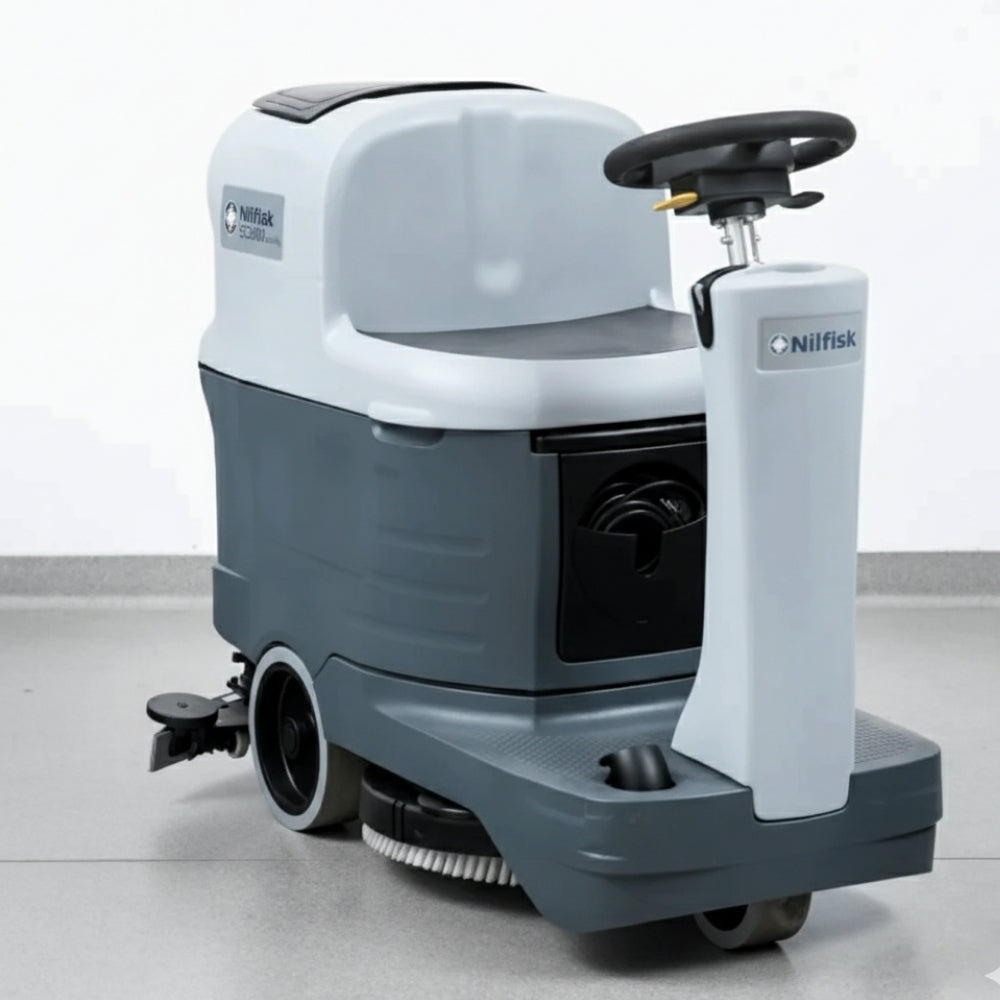
| Nilfisk SC2000 53B micro ride-on | 53 cm | 70 L / 70 L | Battery, up to 2.5 hours | 68 dB(A) | Assembly halls, gyms, long corridors |
| Cleanstar MIRA 40 | 410 mm | 3 L / 5 L | 2 × 36V lithium batteries, up to 3 hours heavy scrubbing combined | Not listed | Canteens, smaller halls, toilet blocks |
| Nilfisk SC100 | 31 cm | 3 L / 4 L | Corded mains | 72 dB(A) | Classrooms, staff rooms, carpet kit included |
| Hako Wizzard W24N | 215 mm | 1.2 L solution listed | Corded mains | 68 dBA | Student toilets and around pedestals |
Work the hall time out before you buy. Take a 600 m² hall as an example. At a steady 3 km/h, the SC2000's 53 cm path covers 0.53 m × 3,000 m/h = 1,590 m²/h, so about 23 minutes before turns. The MIRA 40's 410 mm path covers 1,230 m²/h at the same pace, so about 29 minutes. The time gap is small. The real gap is tank size: 70 litres against 3 litres of solution decides how often the operator stops to refill.
The SC2000 is listed as fitting through standard doorways and is promoted for gyms and assembly halls. Freshway lists it at 1,270 × 550 mm and 340 kg gross, so check ramps, lifts and the storage room door along its route.

Step 3: Set the limits for classrooms and amenities
Small rooms set the lower limit on the fleet. Classrooms are full of desk and chair legs, and many have carpet as well as vinyl. The Nilfisk SC100 is listed for tight classrooms and staff rooms where larger scrubbers cannot fit, and its carpet kit lets one machine handle both floor types.
Amenities are tighter again. Freshway lists the Hako Wizzard W24N for moving around toilet pedestals and bathroom cubicles, with a 650 RPM roller that reaches into non-slip tile. The MIRA 40 is listed with a 360º controlled inclination handle that lets it lie flat under low fixtures and into tight toilet cubicles. More compact options are in the Wizzard floor scrubbers collection. For a daily toilet routine, see Freshway's commercial washroom cleaning schedule.

Step 4: Fit the work into after-hours windows
School floors are cleaned in the gaps: after the bell, before early-morning sport, and around community hire of halls. Victoria's cleaning policy provides for additional cleaning when needed, such as after external hire of school rooms, before or after fetes or sports events, and for out-of-hours use. Those are exactly the jobs a hall machine has to fit.
The aim is to scrub each area when the fewest people are walking on it. Build the window into the plan in this order:
- Amenities and canteen first, while the hall is still in use.
- Hall and corridors next, with the large machine.
- Classrooms last, once desks are clear.
- Machines back on charge before the cleaner leaves.
Step 5: Plan safety around students
Some cleaning will overlap with students, staff or hirers, so the rules need to be simple:
- Battery near students. No trailing cords in corridors or halls while children are moving.
- Electrical checks on corded machines. SafeWork NSW's electrical risks fact sheet gives commercial cleaning equipment as an example for inspection and testing at least once every six months. It also suggests cleaners can use portable RCDs and their own maintained equipment rather than the client's.
- Signs and dry floors. Wet-floor signs stay out until the floor is dry, especially at toilet entries.
- Site information shared. Victoria's policy expects site-specific information to be shared with the cleaning provider, and incidents involving cleaners that relate to child safety to be reported. Follow your own school system's rules.
Step 6: Share the fleet between buildings or campuses
Machines often move between buildings, or between campuses in a multi-site school. Three things make sharing work. First, lock the settings. The SC2000 is listed with a SmartKey system that lets supervisors lock speed and water settings for different operators. Second, plan the charging. SafeWork NSW's lithium-ion battery guidance calls for chargers designed for the battery type and voltage, and safe work procedures that cover charging and storage. The MIRA 40's two batteries suit a swap-and-charge routine. Third, plan the lifting. SafeWork NSW lists lifting, pushing and pulling among the actions in manual tasks. Moving a 20 kg W24N into a van is one, and needs a method.
Freshway's Service & Repairs workshop in Arncliffe services floor scrubbers, with pick-up and delivery for commercial clients across Sydney. That is useful when a shared machine needs a check over the school holidays.
Spec-sheet fields to check on a floor scrubber
- Path width and overall dimensions against the narrowest door on the route.
- Solution and recovery litres against the hall area.
- Power and runtime, including spare or swappable batteries.
- Listed noise, if the machine runs near staff rooms or during hire events.
- Operator controls such as lockable settings for shared use.
- Carpet capability for mixed classrooms.
Checklist for site supervisors
- Floor map with type and area for every room.
- Hall machine sized against the time window and tank refills.
- Compact machine for toilets and classrooms.
- Charging point and storage space agreed.
- Corded machines tested and tagged.
- Canteen and toilet recovery water emptied to sewer, never to stormwater, in line with the NSW EPA's "the drain is just for rain" guidance.
- One-page method and sign-off for each operator.
Common mistakes to avoid
- Buying one hall-sized machine and expecting it to clean the toilets.
- Running a corded machine through a corridor during recess.
- Choosing small tanks for a large hall and losing the time to refills.
- Leaving shared machines with no settings lock or charging routine.
Frequently asked questions
What size scrubber suits a school hall?
Usually a 40 to 55 cm battery machine. Larger tanks matter as much as width, because refills eat into a short after-school window.
Can one scrubber do the hall and the toilets?
Rarely well. Most campuses pair a hall machine with a compact machine under 35 cm for toilets, sick bays and classrooms.
Is a ride-on practical for a school?
For large halls and long corridors, it can be. Check doors, ramps and storage first. The Nilfisk SC2000 53B is listed at 1,270 × 550 mm.
Battery or corded around students?
Battery wherever students may be moving. Corded machines suit locked areas after hours, with regular electrical testing.
Next steps with Freshway
Start with the floor map, then shortlist one hall machine and one compact machine from Freshway's floor scrubbers range. Check each product page for current pricing. For the consumables side of the plan, see Freshway's school cleaning supplies guide, and the shop-by-industry page for other sectors on the same contract.