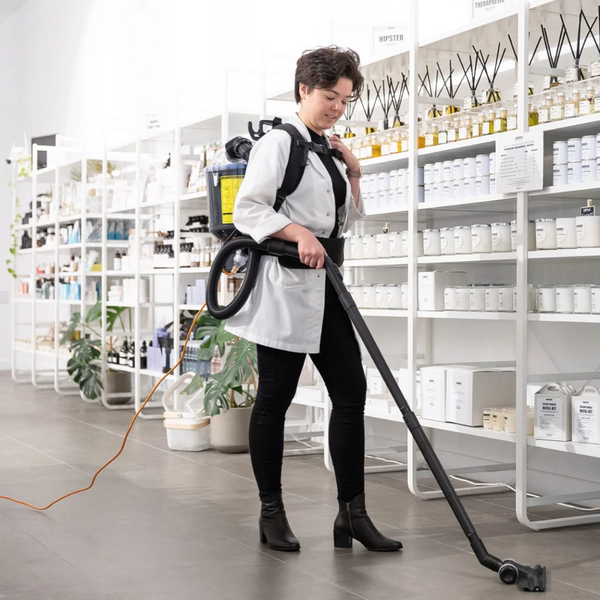
School cleaning is not office cleaning with smaller chairs. A school has zones with different risks, a timetable that decides when each zone can be cleaned, and shared surfaces that hundreds of people touch between cleans. Buying school cleaning supplies Australia wide from a generic list produces a cupboard of products that do not match the timetable or the surfaces, and a program that fails inspection in the same places every term.
This guide is for business managers, facilities staff and cleaning contractors specifying supplies for Australian schools and education facilities. It covers zoning, high-touch surfaces, surface compatibility, storage and the documentation that keeps a program consistent across terms and staff changes.
School Cleaning Supplies Australia: Build the List Around Zones
Start with the building rather than the catalogue. A school typically has classrooms, toilets and washrooms, a staff room, a canteen or kitchen, sick bay, offices, corridors, a gym or hall, and outdoor hard surfaces. Each of those zones has a different soil, a different surface mix and a different risk, and each has a window in the timetable when it can be cleaned.
The timetable is the constraint that shapes the supply list. Toilets may need cleaning during the day as well as after hours, classrooms are only available after the last bell or before the first, and the canteen has a narrow window between service periods. Supplies have to support the cleaning that can actually happen in those windows, not the cleaning a generic schedule assumes.
Then consider who is doing the work. A school may use in-house staff, a contracted cleaner, or a mix, and each group needs the same method, the same colour system and access to the same safety data sheets. A specification that only one group can follow is not a specification.
Map Products to Zones and Risk Levels
Zoning turns an untidy list into a method. Group areas by risk rather than by room name: toilets and sick bay are high risk, canteen and food areas are high risk for different reasons, classrooms and offices are general, and corridors and outdoor areas are low risk but high traffic.
Each zone then gets a small set of products: a cleaner for the soil, a disinfectant where the procedure requires one, cloths and mops in the zone colour, and the tools that reach the surfaces in that area. Toilets need an acidic descaler on a schedule, a daily washroom cleaner and a toilet brush system that is not shared. Classrooms need a neutral cleaner, a glass cloth and a dusting method. The canteen needs a food-safe degreaser and a sanitiser applied at the label dilution and contact time.
Risk mapping also tells you where the budget should go. High-risk zones need the chemistry, the colour discipline and the time; low-risk zones need coverage and frequency. A school that spends the same on every zone usually over-spends on corridors and under-spends on toilets.
| Zone | Frequency | Core products |
|---|---|---|
| Toilets and washrooms | Daily, plus daytime checks | Washroom cleaner, descaler, disinfectant, colour-coded cloths |
| Canteen and food areas | After each service | Food-safe degreaser, sanitiser, separate cloths |
| Classrooms and offices | Daily to weekly | Neutral cleaner, glass cloth, duster |
| Corridors and halls | Daily | Floor cleaner, scrubber or mop system |
| High-touch points | At least daily | Disinfectant at label dilution, cloths |
Deep Cleans in the School Holidays
Term time is for maintaining the school; the holidays are when the work that cannot be done around students happens. That includes carpet extraction, hard floor stripping and sealing, high dusting, light fittings, store rooms and the areas behind furniture. The supplies for those tasks are different from the daily kit, and they are usually bought or planned once a year.
The holiday program should be scoped before the term ends, because it determines what has to be ordered and who is available. A carpet extraction program needs machines, chemistry and drying time; a floor strip and reseal needs stripper, pads, neutraliser and finish, plus time for the finish to cure before the students return. Where the school shares a contractor with other sites, the holiday window is often the contractor's busiest period, so the booking is part of the plan.
The holiday clean is also the moment to audit the term program. Look at the toilets, the canteen, the high-touch surfaces and the store, and record what failed and why. That record, rather than the holiday clean itself, is what improves the next term.
High-Touch Surfaces and Cleaning Frequency
High-touch surfaces decide how often a school needs cleaning rather than how thoroughly. Door handles, light switches, taps, handrails, shared desks, keyboards, sports equipment and canteen counters are touched by many people between cleans, and they are the surfaces most associated with illness transmission in a school environment.
The practical approach is a schedule that names the surface, the frequency and the product. Many schools clean high-touch surfaces at least daily, and some increase frequency during illness outbreaks or in shared specialist rooms. The schedule should state whether the task is cleaning, sanitising or disinfecting, because the three require different products, dilutions and contact times.
Frequency also depends on the timetable. A hall used for assembly, sport and evening events may need cleaning between uses rather than once a day. Where the timetable changes, the schedule and the supplies have to change with it, which is why the zone map and the timetable should be reviewed together each term.
Surface Compatibility and Contact Time
Schools are full of surfaces that react differently to chemistry: laminate desks, vinyl and carpet floors, stainless steel in the canteen, ceramic tiles in toilets, glass, painted walls, and interactive screens. A cleaner that suits one can damage another, and the damage usually appears after repeated use rather than immediately.
Contact time is the other half. A disinfectant that is sprayed and wiped has not been given the contact time its claim depends on, which matters in a school where the procedure may name a disinfecting step. The method should state the product, the dilution and the dwell for each high-risk task, and the schedule should allow enough time for the dwell to happen.
Where a surface is unknown, use a neutral product and a test patch. Where a screen or electronic surface is involved, use a method that keeps liquid out of the device rather than a general spray. Freshway Supplies lists cleaning chemicals by task, and the practical guide to school cleaning supplies covers the product side in more detail.

Sick Bay, First Aid and Isolation Areas
Sick bay and first aid areas are the highest-risk spaces in a school and the ones most often cleaned with whatever is left on the trolley. They need their own equipment, their own products and their own procedure, because the soil may include blood, vomit, urine or other body fluids, and the response to those is not the same as a classroom clean.
The practical kit is small and separate: disposable gloves, an apron or gown, absorbent material, a spill kit suitable for body fluids, a disinfectant that the procedure names, and a waste route that keeps contaminated material away from general waste. The area should have its own colour-coded cloths and its own mop, stored in the sick bay or with the first aid supplies rather than on a general trolley.
Staff need to know when to clean and when to escalate. A body fluid incident involving a student is a first aid matter first, and the cleaning follows the school's procedure and the advice of the first aid officer. Where the school has an outbreak or a notifiable infection, the cleaning frequency and the products may change, and the local public health unit's guidance applies.
The same logic applies to isolation rooms and to any space used for a student who becomes unwell. Those areas should be on the schedule with their own frequency, their own products and their own record, because they are the spaces where a gap in the method carries the greatest consequence.
Storage, Colour Coding and Cross-Contamination
Storage is a safety issue in a school because cleaning chemicals sit in buildings full of children. Products belong in a locked or supervised store, in labelled containers, separated by family, with the safety data sheets accessible to staff and out of reach of students. Decanting into unlabelled bottles is the most common way a school store becomes unsafe.
Colour coding is the control that travels with the equipment. Cloths, mops and buckets are assigned to zones, stored by colour and laundered separately, so a washroom cloth cannot be used on a classroom desk. Where the school uses a contractor, the contractor's colour system should match the school's, or the school should adopt the contractor's and document it.
Cross-contamination also comes from storage practices: a mop stored damp, a bucket used for both toilets and classrooms, or a cloth left in a sink. The store layout should make the correct choice the easy one, and the supervisor should be able to see at a glance whether the colours are complete.
Training and Documented Procedures
Schools have high staff turnover and relief staff, which makes documentation more valuable than memory. The documents that matter are the zone map, the task schedule with frequencies, the product list with dilutions and contact times, the colour coding chart, and the safety data sheets for every product on site.
Training should be short and specific: which product for which zone, the dilution in a measure the operator uses, the contact time where a claim depends on it, what must never be mixed, and where the sheets are. A fifteen-minute induction repeated each term is more effective than a long manual nobody reads.
Documentation also protects the school. Where a parent or an auditor asks how a washroom or a sick bay is cleaned, the answer is the schedule, the product, the dilution and the record of the task, and that is far easier to produce when the method was written before the question.
Supplier Continuity and Approved Substitutions
A school term runs for weeks, and a supply failure in week three is a real operational problem. The specification should name the products and the approved substitutes, keep a buffer of the high-use items, and confirm that the supplier can deliver consistently through the year rather than only at the start of a contract.
Substitution is where the method drifts. A different disinfectant at a different dilution, a mop head in a different colour, or a cleaner with a different pH all change the result, and the operator often has no way to know whether the substitute is acceptable. The rule should be that substitutions are approved in writing, with the product, dilution and any change to the method recorded.
Supplier continuity also covers the equipment. Where a floor machine or a vacuum is part of the program, confirm the local parts and service arrangements, because a machine out of service during term time affects the schedule immediately.

Approval Checklist for the Final Specification
Before a school supply list is approved, confirm the following in writing so it survives staff and contractor changes.
- Zones: every area mapped to a risk level, with the cleaning window for each.
- Tasks: frequency and method for high-touch surfaces, toilets, canteen and general areas.
- Products: cleaner, disinfectant and descaler per zone, with dilutions and contact times.
- Colour coding: the zone scheme, storage positions and laundry separation.
- Safety: locked or supervised storage, labelled containers and accessible data sheets.
- Training: induction content, records and refresher frequency.
- Continuity: approved substitutes, buffer stock and the supplier's delivery and service arrangements.
That checklist is the document that makes a school program auditable. Without it, the program depends on whoever is on shift, and in a school that changes more often than the term does.
Conclusion
Build school cleaning supplies around zones, timetables and shared surfaces. High-risk areas get the chemistry, colour discipline and time; classrooms and corridors get coverage and frequency; and every zone gets a method that fits the window it can be cleaned in.
Then protect the method with storage, training and documentation, and agree substitutes in writing. That is what keeps a school clean through the term rather than only on the day the program was set up.
Questions we get asked most
- What cleaning supplies does an Australian school need?
- At minimum: a neutral cleaner for general surfaces, a washroom cleaner and acidic descaler for toilets, a food-safe degreaser and sanitiser for the canteen, colour-coded cloths and mops, waste handling, hand hygiene products and personal protective equipment. The exact list follows the zones and the tasks in the school's schedule.
- How often should high-touch surfaces be cleaned in a school?
- Many schools clean high-touch surfaces at least daily, with more frequent attention during illness outbreaks and in shared specialist rooms. The schedule should name the surface and state whether the task is cleaning, sanitising or disinfecting, because each requires a different product, dilution and contact time.
- Can a school use one disinfectant everywhere?
- Rarely. A disinfectant suitable for washrooms may be unsuitable for food-contact surfaces or for screens, and the claim depends on the surface, dilution and contact time on the label. Match the product to the zone and the surface, and keep the data sheets with the products.
- How should cleaning chemicals be stored in a school?
- In a locked or supervised store, in labelled containers, separated by chemical family, with safety data sheets accessible to staff and out of reach of students. Decanting into unlabelled bottles should be prohibited, and working solutions should be made up for the shift rather than stored indefinitely.
Public health and cleaning guidance: NSW Health environmental health and Agar cleaning chemicals. Work health and safety: Work Health and Safety Regulations 2011, SafeWork NSW and WorkSafe Victoria.
Compare colour-coded cloths, mops, trolleys and cleaning chemicals for education facilities in the Freshway range.