Most cleaning failures that get blamed on the product are actually pH failures. An alkaline product on a protein soil, an acid on a sealed surface, or a neutral detergent asked to cut through grease will all underperform, and the operator usually responds by adding more of the same product rather than changing the chemistry. This cleaning chemical pH scale guide explains what acidity and alkalinity actually do to soil and to surfaces, and how to match the product to the job before dilution or technique is discussed.
It is written for facility managers, cleaning contractors and procurement teams who have to specify chemistry across mixed sites, and it stays on the practical side: which soils sit at which end of the scale, which surfaces limit the choice, and what to check on the label and the safety data sheet before the product goes into a sprayer.
Cleaning Chemical pH Scale Guide: Start With the Soil, Not the Shelf
pH is a measure of how acidic or alkaline a solution is, running from strongly acidic at the low end to strongly alkaline at the high end, with neutral in the middle. Cleaning chemistry uses that scale for one reason: soils behave differently depending on where they sit on it. Protein and fat-based soils, body oils and greasy films respond to alkalinity. Mineral deposits, scale, rust staining, cement residue and hard-water film respond to acidity. General dust, light traffic soil and everyday maintenance respond best to neutral products that clean without attacking the surface.
That is the whole decision in principle, but three practical constraints shape it. The surface sets the limit, because acid attacks cementitious and acid-sensitive surfaces and alkaline products can dull or damage aluminium, some natural stone and certain coatings. The process sets the dwell, because chemistry needs contact time to work and a product that is rinsed off immediately behaves like water. And the site sets the constraints: what the safety data sheet requires for handling, what the surface manufacturer permits, and what the waste stream can accept.
Start with the soil, then check the surface, then confirm the chemistry. Sites that reverse that order usually end up with a cupboard full of products and a cleaning problem that never quite resolves.
Match Chemistry to Soil and Surface
Alkaline products lift the soils that make a site look dirty. Kitchen grease, cooking oils, body oils, food residues and oily traffic films all respond to alkalinity, which is why heavy-duty degreasers and kitchen cleaners sit at that end of the scale. The trade-off is compatibility: high alkalinity can affect aluminium, zinc, some paints and coatings, .
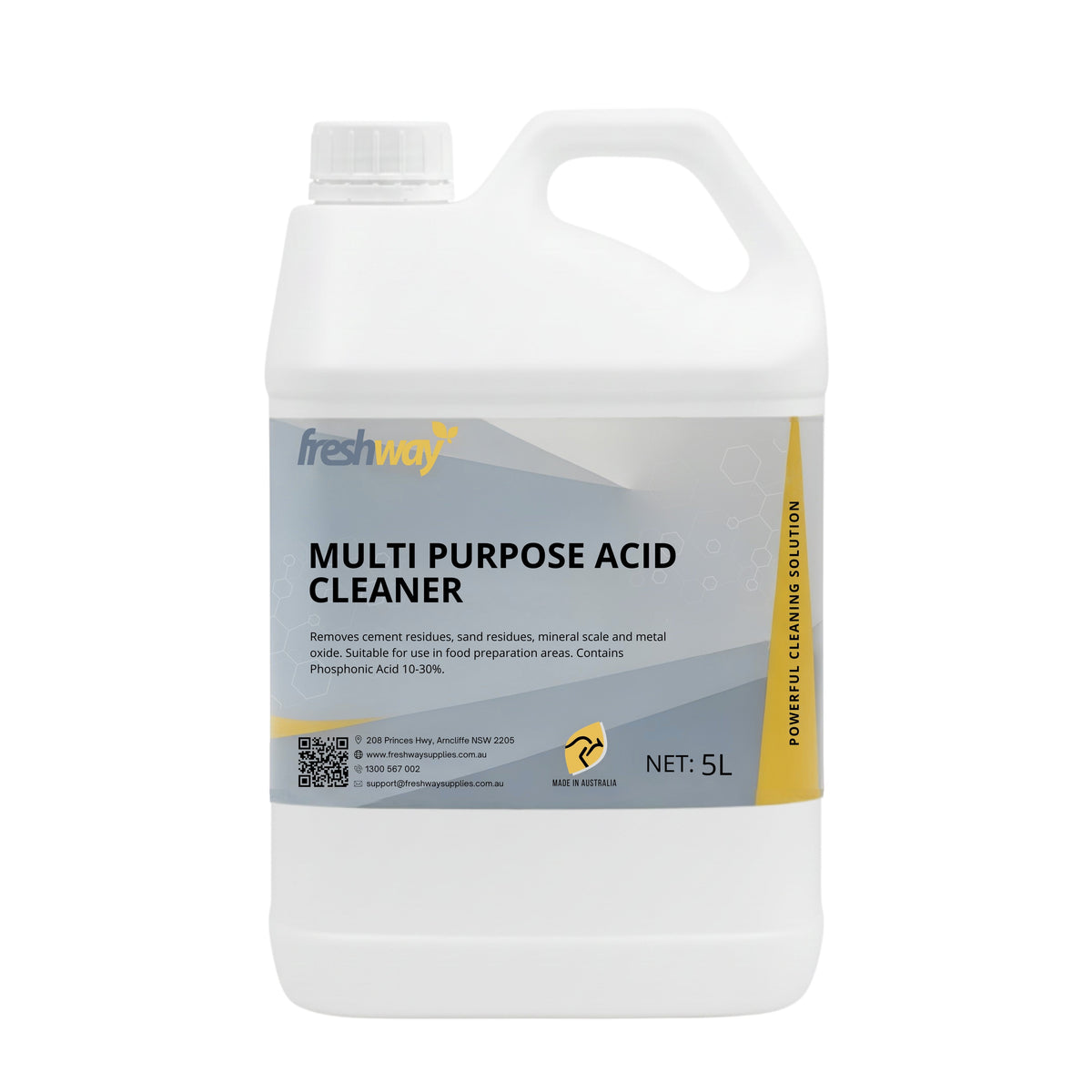
Acidic products dissolve the soils that alkaline chemistry cannot. Scale in washrooms and around taps, hard-water film on glass, rust staining, cement and grout residue, and effluent staining are all acid jobs. The trade-off is that acid attacks cementitious surfaces, damages some stone and metal finishes, and must never be mixed with chlorine-based products. On coated, sealed, anodised or unclear surfaces, the safe starting point is a neutral product and a test patch.
Neutral products sit in the middle and do the majority of daily commercial work: floor cleaning, general surface wiping and maintenance cleaning on finishes that cannot tolerate aggressive chemistry. On a site with mixed substrates, a neutral detergent plus specific spotters for specific soils is usually a better system than a strong all-purpose product used everywhere. The products exist in the Freshway range as commercial cleaning chemicals grouped by task, which makes the comparison easier than working from a shelf of unlabelled bottles.
Which pH Suits Which Soil?
Match the product to the soil family, then to the surface.
Grease, oils, food and protein soils sit at the alkaline end, mineral scale, rust and cement residue at the acidic end, and everyday dust and light traffic soil in the middle, so identify the soil first and let the surface rule out the options it cannot tolerate.
In practice the soils that cause callbacks cluster into four groups. Fats and greases, including cooking oil, body oil and lubrication films, need alkaline or strongly alkaline chemistry with dwell time. Proteins, including blood, milk and food residues, respond to mild alkalinity but can be fixed onto fabric by heat, so temperature matters. Mineral soils, including limescale, efflorescence, cement film and rust, need acid. And particulate soils, including dust, sand and tracked-in grit, are a mechanical problem more than a chemical one, which is why a neutral detergent plus agitation often outperforms a stronger product.
Where two soils sit together - a shower screen with both soap scum and scale, or a kitchen floor with grease over mineral soil - the answer is usually two products used in sequence rather than one compromise product used twice. Where the surface is unknown, the safest sequence is a neutral product at the label dose, a test patch in an inconspicuous area, and an inspection after the surface dries, because some coatings and stone finishes show damage only after the water has gone.

Read the Label and the Current Australian SDS
The label states the dose, the contact time and the surfaces the product is intended for. The safety data sheet states what the product actually is, how it should be handled, what personal protective equipment the manufacturer expects and what to do if it is spilled or splashed. Both documents matter, and both are the supplier's obligation to provide and the site's obligation to keep accessible.
Two habits stop most chemistry problems. First, work from the current sheet rather than a memory of the product, because reformulations change dose rates without changing the bottle. Second, keep the sheet with the product rather than in an office filing system, because the person who needs it is the person holding the bottle. Freshway Supplies publishes a safety data sheet library by brand, including the SDS pages for the chemicals it supplies, so the sheet that matches the shelf stays within reach.
Check the pH range on the sheet against the surface list on the label. Where the sheet warns against a substrate that the operator intends to clean, that is a stop, not a judgement call. Mixing products is a separate risk entirely: chlorine-based products and acids must never be combined, and decanting into unlabelled bottles removes the only warning the next operator would have had.
Dilution, Dwell Time and Mechanical Action
pH tells you which direction to work in; dilution decides how hard the product works. Every commercial chemical has a labelled dose range, and the correct point in that range depends on soil load rather than preference. Stronger than specified does not clean proportionally better, and on some surfaces it damages the finish that the cleaning was meant to protect.
Dwell time is the second control. Alkaline products need time to saponify fats and lift oils; acidic products need time to dissolve mineral deposits. Work in sections sized to the dwell time rather than spraying an entire floor and starting at one end. Mechanical action is the third: agitation helps chemistry reach soil that traffic has pushed into a surface, but it has to be matched to the substrate, and on polished or coated finishes the least aggressive method that works is the right one.
Rinsing is the step that finishes the job. Residue left on a surface continues to work after the operator has gone, attracts soil, and can damage finishes or leave visible streaks. Rinsing with clean water, and recovering that water where the site requires it, is part of the method rather than an optional extra. The practical guides to choosing, diluting and storing commercial chemicals cover the site side of the same decisions.
Claims That Require Regulatory Evidence
Cleaning chemicals are sold with claims, and some of those claims carry regulatory weight. A disinfectant or sanitiser that claims to kill organisms has to be supported by evidence in the product's registration and documentation, and the claim usually applies only at a specified dilution and contact time on a specified surface. Cleaning chemicals that carry no such claim can still be effective cleaners, but they are not disinfectants, and the distinction matters in healthcare, aged care, education and food environments where the procedure may name a specific product class.
The practical control is to match the claim to the requirement rather than the marketing. Read what the label actually claims, note the dilution and contact time the claim depends on, and confirm that the operators are following both. Where a site's infection-control procedure names a product class, the purchase has to satisfy that requirement, and where the requirement is simply general cleaning, buying a high-level claim that the process does not deliver is wasted spend.
Storage, Dispensing and Staff Training
Chemistry is a work health and safety matter as well as a cleaning one. Products belong in labelled containers, stored according to the site's chemical storage arrangements, separated so that incompatible products cannot be confused, with the safety data sheet available and the dose recorded. Australian duties require the risks to be managed, and the framework sits in the Work Health and Safety Regulations 2011, with practical guidance published by the regulators including WorkSafe Victoria's hazardous substances material and the resources at SafeWork NSW.
Dispensing is where dosing drifts. Wall-mounted dispensers, pre-measured capsules and labelled spray bottles all reduce the guesswork, and any of them is better than an operator estimating a splash into a bucket. Where dilution is manual, colour coded bottles with the dose written on them keep the method repeatable across shifts and staff changes.
Training should cover three things: which product is for which soil, what the dose and dwell are for each, and what the product must not touch. Products that are correctly specified but used on the wrong surface cause more damage than products that are simply under-dosed, and the operator is the only person who can prevent it.

Calculate Cost at the Approved Dose
Chemical cost is calculated at the approved dose, not at the purchase price per litre. A concentrated product dosed at the label rate can cost less per task than a ready-to-use product that appears cheaper per bottle, and a product that is overdosed costs more than either while damaging surfaces the site will eventually have to repair or refinish.
The calculation is straightforward once the method is fixed: the volume of working solution a task consumes, the concentration required, the price per unit of concentrate, and the number of tasks per week. Add the labour implications, because chemistry that needs long dwell or heavy agitation costs more in time than in product. Where a site is comparing two suppliers, the comparison should be cost per completed task at the labelled dose, using the same dilution and the same method.
Consumption is also a check on the method. A site that uses noticeably more chemical than the task requires is usually overdosing, under-diluting or cleaning soil that a more frequent neutral clean would have prevented. Auditing consumption per area against the approved method is one of the quickest ways to find both waste and surface damage before either becomes expensive.
When Should the Original Selection Be Reviewed?
Review the chemistry when the site changes rather than when a complaint arrives. New flooring, a change of finish or coating, a refurbishment that introduces natural stone, a switch in the cleaning schedule, or a new client requirement around infection control can all invalidate the products that were working.
The signals are specific: films or streaks that return quickly, dulled or discoloured surfaces, scale that stops responding, adhesive residue that the current product leaves behind, or operators reporting that a product no longer works. Those symptoms point to a mismatch rather than to an operator problem, and the fix is usually to re-run the soil and surface assessment rather than to buy a stronger version of the same thing. Where several sites share a specification, review them together, because a product that suits a food production floor may be exactly wrong for a polished stone foyer.
Questions we get asked most
- Is an alkaline cleaner stronger than an acidic cleaner?
- They are not stronger or weaker; they do different jobs. Alkaline products lift grease, oils and protein soils, while acidic products dissolve mineral scale, rust and cement residue. Which one to use depends on the soil and on what the surface will tolerate, and a neutral product is often the right answer for everyday cleaning on finishes that cannot take either extreme.
- Can I use the same chemical for floors and washrooms?
- Sometimes, but the soils are different. Washroom scale, uric acid deposits and soap scum need acidic chemistry, while most floors need neutral or mildly alkaline products to protect the finish. Using one product across both usually means under-cleaning the scale or over-exposing the floor, so separate products with separate doses are the more reliable arrangement.
- Does a higher pH mean a better clean?
- No. pH indicates which soils a product can break down, not how well it will perform. Performance comes from the right chemistry for the soil, the correct dose, adequate dwell time and appropriate mechanical action. Going stronger than the label on a surface that cannot tolerate it costs far more in refinishing than it saves in cleaning time.
- Where do I find the pH of a cleaning product?
- On the safety data sheet, which lists the pH of the product as supplied and sometimes of the diluted working solution, and on the label, which states the intended use and dilution. Keep the current sheet on site with the product, because formulations change and the dose on an older sheet may no longer apply.
Conclusion
pH is a shortlist tool. Grease, oils and protein soils respond to alkalinity, mineral scale and cement residue to acidity, and everyday soil to neutral chemistry, and the surface decides which of those options is actually available.
From there the discipline is ordinary: read the current label and safety data sheet, dose to the label, respect the dwell, rinse the residue, keep the sheets with the products and the doses written down where operators can see them. Chemistry that is matched to the soil and controlled at the dose does more for a cleaning budget than any stronger product used instead.
Manufacturer technical information: Agar cleaning chemicals. Disposal and water guidance: NSW EPA.
Compare acidic, neutral and alkaline cleaning chemicals by task, with safety data sheets available for each product, in the Freshway chemical range.