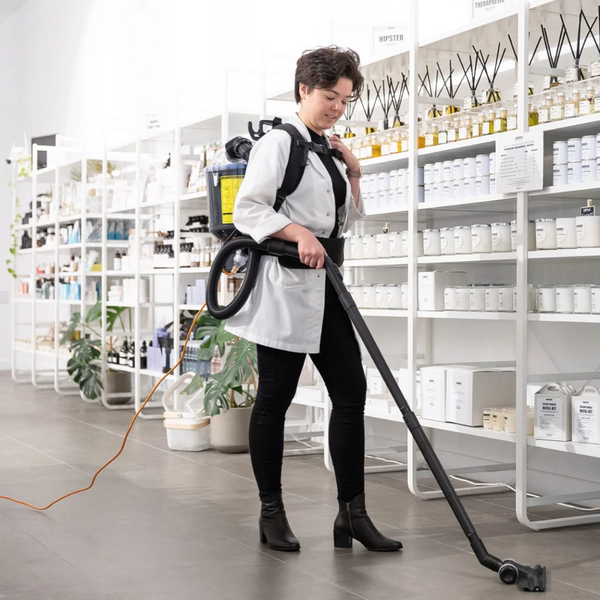
How to Choose a Commercial Floor Scrubber in Australia
Audit the floor first, then match path width, power and brush type.
Shop now
The purchase goes wrong like this. A compact walk-behind scrubber is approved for a large floor because the quote fits the budget. In the first week the operator stops every few aisles to refill and empty a few litres of tank, then quietly goes back to the mop. The machine is not faulty. It was simply the wrong class for the job.
The steps below avoid that outcome by narrowing the field in a fixed order, from the floor itself to the chemical in the tank.
Commercial floor scrubber Australia: the short route to a shortlist
Decide in this order: floor area and narrowest aisle, then surface and soil, then power source, brush type and tank size. Compact walk-behinds suit tight rooms, larger walk-behinds suit open aisles and big rooms, and ride-ons suit very large floors. Trial the shortlisted model on your own floor before you order.
Each step removes options, so by step five you are comparing two or three models rather than the 39 listings currently in Freshway's floor scrubbers collection. Check each product page for current pricing.

Step 1: audit the floor and the job
Start with measurements, because every later step depends on them.
WorkSafe Queensland notes that incorrect cleaning can make floors more slippery, and that a floor which grips when dry may not grip when wet. The audit should therefore also record who walks the floor while it is being cleaned, since a scrubber that leaves the surface properly dry matters most where the public is present. Note the corners and edges a machine cannot reach, because those still need the hand tools in the janitorial supplies range. Capture these six items on one page and keep it with the quote file:
- Area per shift in square metres, split by zone.
- Narrowest aisle, door or lift the machine must pass.
- Floor surface and condition, including grout, texture and coatings.
- Soil type: dust, grease, rubber marks or food residue.
- Cleaning window, and whether the building is occupied.
- Where water, power and a charging point are available.
Step 2: size the machine by path width, speed and tanks
Path width and travel speed set the theoretical output, and tank size decides how long you can keep going.
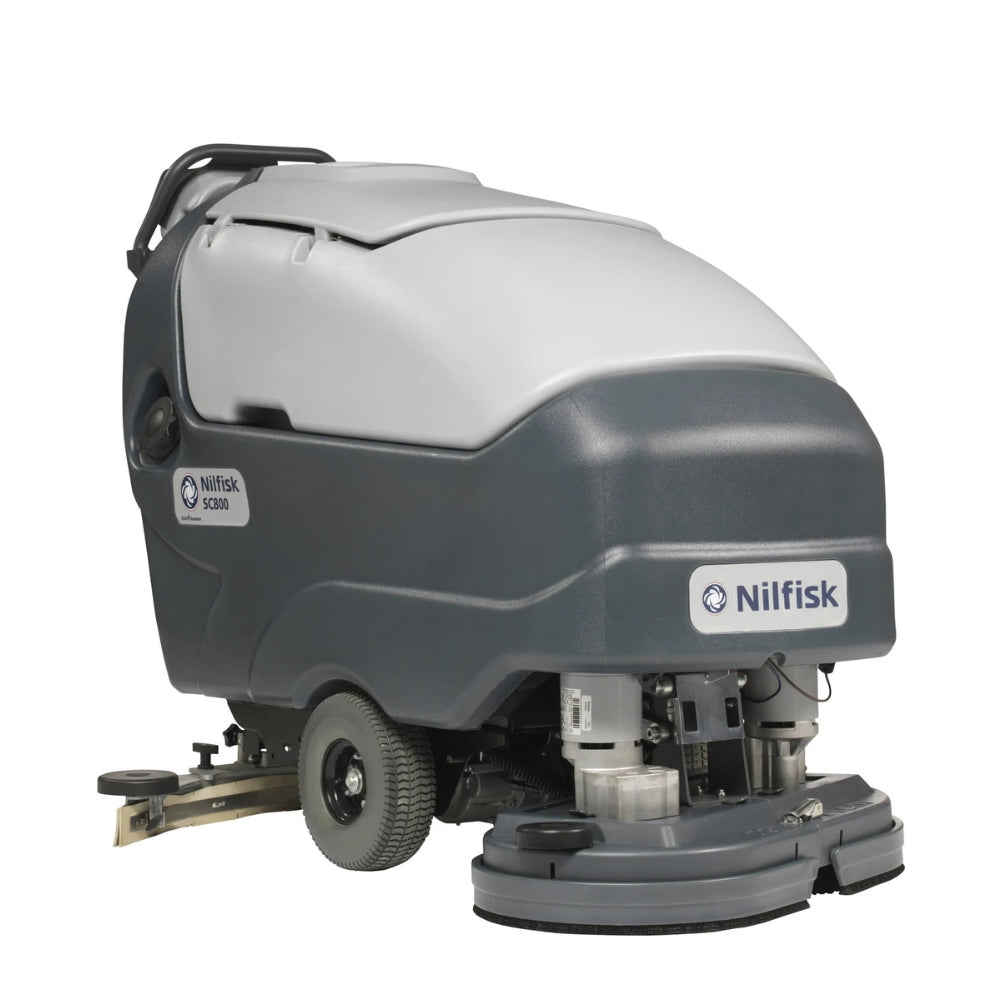
The simple formula is path width in metres times speed in km/h times 1,000, which gives square metres per hour. Freshway's listings for the Nilfisk SC800 (710 mm, up to 5.8 km/h) and the Nilfisk SC2000-53B (530 mm, up to 6 km/h) show theoretical outputs of 4,120 and 3,180 m²/h, which match that formula within rounding. Read a listed "theoretical" figure as a ceiling, not a forecast. Real output is lower once turns, refills and emptying are counted, which is why step 8 records it.
| Machine | Type | Path | Tanks (solution / recovery) | Listed output | Power |
|---|---|---|---|---|---|
| Karcher BR 30/4 | Compact upright | 300 mm | 4 L / 4 L | not listed | Corded, 12 m cable |
| Hako Wizzard W34P | Compact walk-behind | 315 mm | 4 L solution | up to 350 m²/h | 230 V mains, 600 W |
| Nilfisk SC401 | Walk-behind | 43 cm | 30 L / 30 L | up to 2,330 m²/h | Battery, onboard charger |
| Nilfisk SC800 71 / 71C | Walk-behind, traction drive | 710 mm | 95 L / 95 L | up to 4,120 m²/h | 24 V battery |
| Nilfisk SC2000-53B | Micro ride-on | 530 mm | 70 L / 70 L | up to 3,180 m²/h | Battery, up to 2.5 h per charge |
Read the table sideways. A 710 mm walk-behind lists a higher theoretical output than a 530 mm micro ride-on. A ride-on earns its place when the floor is large enough that walking becomes the main cost, or when operator fatigue is the issue, not because its speed figure is automatically higher. For a first estimate, divide your area by the listed output, then replace that number with your own once the trial is done.
Step 3: cable or battery
Cable suits compact machines on short runs, and battery suits anything that has to cover long aisles.
The BR 30/4 lists a 12 m cable and the Wizzard W34P runs from 230 V mains, which is fine in a room but awkward across a warehouse. Battery machines trade the cable for a charging routine: Freshway lists up to 4 hours of operating runtime on the Nilfisk SC500 and up to 2.5 hours per charge on the SC2000-53B. Ask what the listed runtime assumes before you build a shift plan around it.
Also ask which battery chemistry is fitted, because charging rules depend on it. The SC401 listing says "maintenance-free battery" and the SC351 listing says lithium, so the type is not always obvious. On lead-acid batteries, WorkSafe Queensland’s guidance on battery energy storage systems says most lead-acid batteries generate hydrogen and oxygen while charging and need good ventilation to avoid an explosion or fire, whereas lithium-ion batteries give off no exhaust gases in normal operation but can produce flammable gases if there is a fault. Whatever you buy, put the charger where the supplier's instructions and your site rules allow.
Step 4: disc or cylindrical brush
Disc decks suit smooth, finished floors, and cylindrical decks suit texture, grout and loose debris.
Tennant's Australian guide to disc and cylindrical brushes gives the practical split. Disc brushes run flat at roughly 250 to 300 rpm, can carry pads for polishing and apply more down pressure for heavy build-up, but they cannot pick up debris, so the floor must be swept first. Cylindrical pairs turn in opposite directions at 600 to 800 rpm, throw loose dirt into a tray, avoid pre-sweeping and reach into grout lines. Tennant lists vinyl tile, sheet vinyl and polished concrete under disc, and natural stone, rubber-studded and safety floors under cylindrical.
Freshway lists the Nilfisk SC800 in both versions: 270 rpm and up to 77 kg of brush pressure for the disc, 840 rpm and up to 43 kg for the cylindrical. If your floors vary, ask about that choice before committing one deck type to a whole site. The floor cleaning machines guide covers the wider family of sweepers, polishers and scrubbers.

Step 5: tanks and brush pressure
Match tank volume to the longest uninterrupted run, and brush pressure to the soil.
In the listings above, solution and recovery tanks are the same size, and where a page gives only one figure it is worth asking for the other. Brush pressure is listed in kilograms and runs from 30 kg on the SC2000-53B to up to 77 kg on the SC800 disc. Heavier soil needs more, but Nilfisk Australia's operating tips advise adjusting water flow and down pressure to the soil load and allowing enough dwell time, instead of simply pressing harder.
Step 6: decide how the chemical gets into the tank
Dosing is the step most buyers skip and most crews notice.
Manual dosing relies on every operator measuring the same way every shift. Nilfisk Australia's Ecoflex page describes onboard dosing that lets operators switch between water-only cleaning, ultra-low detergent and standard detergent, with a short burst-of-power setting for tougher soil, which is worth asking about for any model on your shortlist. Whichever route you choose, standardise on one scrubber-compatible product and keep its safety data sheet to hand. Freshway's cleaning chemicals range covers the options.
Step 7: check the spec sheet and the safety details
Check the exact model before a quote is approved, starting with handling and noise.
The walk-behinds above run from 11 kg (the BR 30/4, empty) to 151 kg (the SC401 with batteries), the SC2000-53B ride-on lists 340 kg gross, and SafeWork NSW guidance on hazardous manual tasks explains how to manage loading, ramps and pushing risks. Listed noise on the Nilfisk walk-behinds ranges from 61 dB(A) on the SC800 to 72 dB(A) on the SC100, and the operator hears it for the whole shift, so the SafeWork NSW noise code of practice is the reference for an occupied building. Then confirm the following in writing:
- Cleaning path, tank sizes and the exact battery or cable arrangement.
- Included kit: brushes or pads, charger and squeegee blades.
- Supply of replacement brushes and squeegee blades, and how quickly they arrive.
- Warranty, service support and whether pick-up for repairs is offered.
- Freight for heavy machines, covered in the shipping and delivery policy.
Step 8: trial it on your own floor
A trial is only useful if it measures what the spec sheet cannot. Use the same operator, floor and time window as the real job, and keep a one-page log. The sequence below works for most sites.
- Run the machine over the longest route and time it from first fill to final empty.
- Record square metres cleaned per hour including turns, refills and emptying.
- Check that the floor is dry and safe to walk on once the machine has passed.
- Note the operator's comments on steering, fatigue and tank access.
- Repeat on the worst floor in the building, not the easiest one.
That log, not the brochure, becomes the productivity figure in your approval file.
Floor scrubber questions, answered quickly
Are floor scrubbers worth it?
Yes, when labour hours or finish quality are the problem. Compare the hours saved per week in your trial against the full cost of the machine, its consumables and its servicing.
How long should floor scrubber batteries last?
It depends on the battery chemistry and how it is charged. Ask for the cycle-life rating and the battery warranty for the exact model before you order.
What chemical to use in a floor scrubber?
Use a product whose label says it is suitable for scrubber dryers, dosed as the label directs. Check the safety data sheet and the machine's own instructions.
What are floor cleaning machines called?
Most suppliers say scrubber dryers, auto scrubbers or floor scrubbers. They all describe machines that apply solution, scrub and recover the dirty water in one pass.
Next step with Freshway
With a floor audit and a shortlist in hand, send Freshway the area, aisle width and surface for each site and ask for a model recommendation. Heavy machines ship differently, so check the delivery details first. Businesses that buy regularly can also ask about a trade account on Freshway's B2B page, where the terms are set out.