Backpack vs Canister Vacuum for Commercial Cleaning in Australia
Match the vacuum to the floor plan: stairs and desks, or long open floors.
Shop now
Picture two sites on the same contract. One is a four-level office with a fire stair at each end and a desk in every bay. The other is a single-level retail floor with a long run of open carpet. Give both crews the same vacuum and one of them will spend the night fighting the machine.
That is the real backpack-versus-canister decision. This guide is written for the person signing the purchase order, so each section ends with something you can check against a quote.
Backpack vs canister vacuum (commercial): the short answer
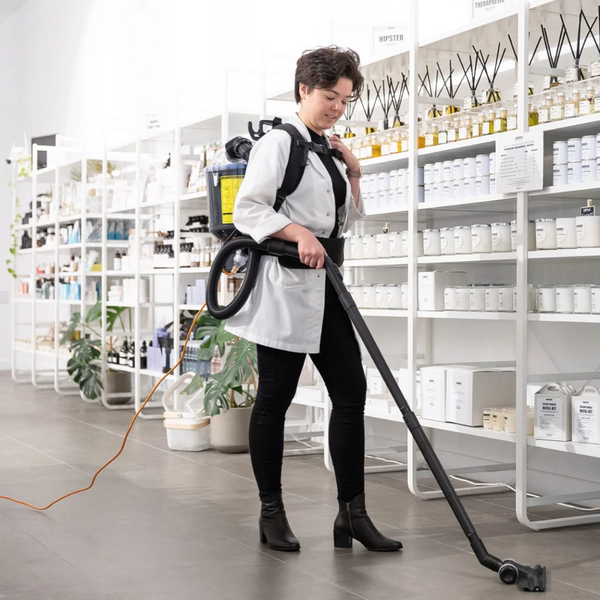
Choose a backpack where stairs, desks and tight rooms make a floor-standing machine awkward. Choose a canister where long open floors, larger dust capacity or a stricter filtration specification matter more. Most commercial contracts end up running both formats. Layout, dust capacity per shift and who carries the weight decide the rest.
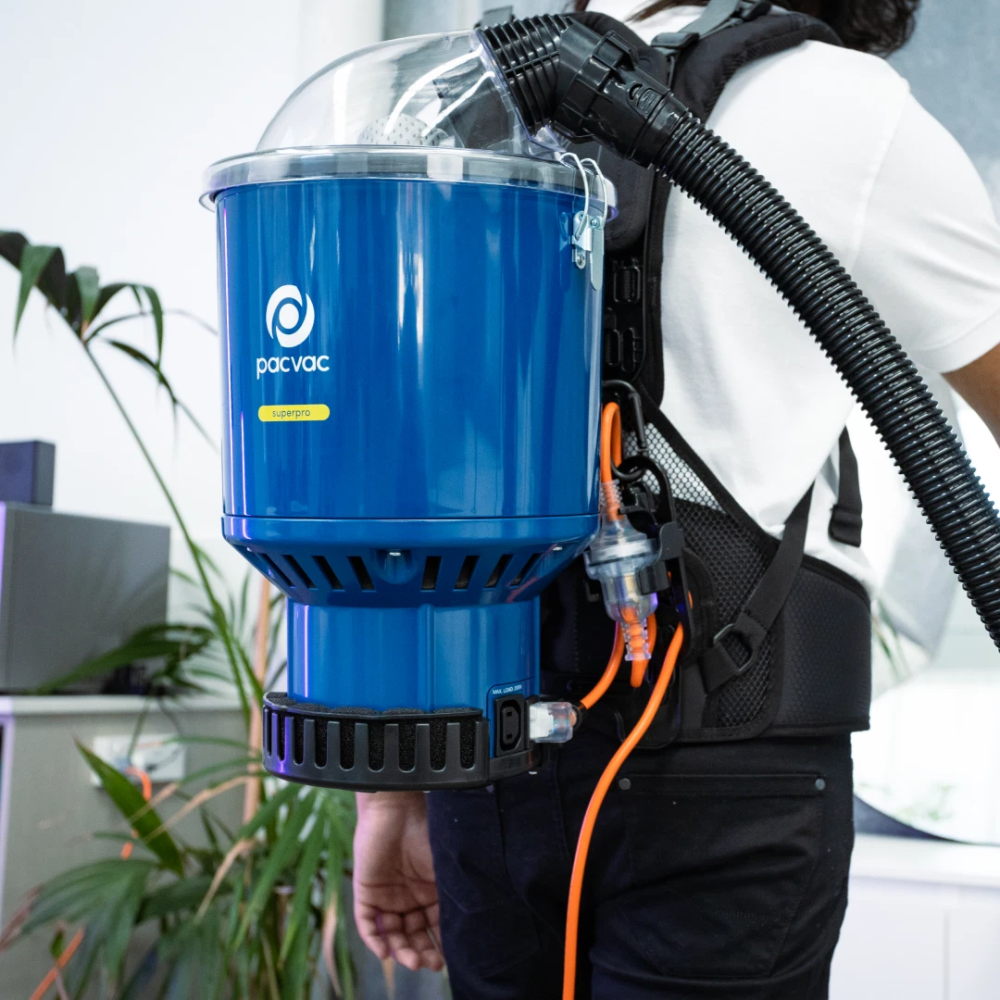
The difference comes down to where the machine sits. A backpack puts the motor and bag on the operator's hips and leaves the hands for the wand. A canister rolls on the floor behind a hose, so the floor carries the weight and the operator tows it. Capacity, noise, filtration and cordless runtime all follow from that one design choice. Both formats are in Freshway's backpack vacuum collection and canister and barrel vacuums ranges.

Backpack and canister specs side by side
The table uses figures from Freshway product pages for six machines. Treat weight and noise as indicative, because each brand measures them under its own conditions. Check each product page for current pricing.
| Machine | Format | Motor | Dust capacity | Listed weight | Noise |
|---|---|---|---|---|---|
| Pacvac VELO corded | Backpack | 900 W | 2.5 L | 3.9 kg | 65.3 dB(A) |
| Nilfisk GD5 | Backpack | 1,300 W | 5 L | 4.2 kg | 59 dB(A) |
| Pacvac VELO Go | Cordless backpack | 250 W (400 W boost) | 2.5 L | 4.5 kg with batteries | under 69 dB |
| Pacvac Glide 300 | Canister | 1,300 W | 15 L | 5.8 kg | 64 dB(A) |
| Nilfisk VP300 HEPA TC | Canister | 800 W | 10 L | 5 kg | 57 dB(A) |
| Karcher T 11/1 Classic HEPA | Canister | 850 W | 11 L | about 4.2 kg | 61 dB(A) |
Three things stand out. Dust capacity is the clearest split: the backpacks hold 2.5 to 5 L and the canisters 10 to 15 L, so a canister fills roughly two to six times less often. Listed weights overlap, at 3.9 to 4.5 kg for the backpacks and 4.2 to 5.8 kg for the canisters, but the backpack's weight sits on the operator while the canister's rides on its wheels. Noise overlaps almost completely, so a rating alone will not choose the format for you.
Floor type and layout decide more than suction
Layout usually settles the format before any suction figure does.
Tennant's Australian guide to commercial vacuum types describes backpacks as the answer for cubicles, stairways and under furniture, because the machine travels with the operator. The same source names the limit: with only a floor nozzle fitted, a backpack may not lift carpet soil as well as an upright with revolving brushes. Canisters cope with several floor types and fit under desks with a small head, but they have to be towed around every corner.
Walk the route before you order. Count level changes, the doorways a canister must pass and the power points each cord can reach. The corded backpacks above list 15 to 18 m of cable, while the VP300 HEPA TC lists 10 m, which matters on a floor where sockets are far apart.

Noise and filtration in occupied buildings
Daytime and healthcare sites turn noise and filtration from preferences into requirements.
The corded machines in the table list 57 to 65.3 dB(A) and the cordless VELO Go lists under 69 dB. The operator is closest to the machine for the longest, so a sheet figure is the start of a noise assessment, not the end of one; the SafeWork NSW noise code of practice sets out how to do the rest.
On filtration, "HEPA" names a filter, not a whole machine. WorkSafe Queensland makes the distinction plainly: HEPA does not mean H-class, and a domestic-rated vacuum, even one fitted with HEPA filtration, is neither guaranteed to give suitable protection nor designed for a commercial environment. Its H-class machines, rated under AS/NZS 60335.2.69, are the ones it lists for dusts such as lead, silica and asbestos. Freshway lists H13 filtration on the VELO corded and the VP300 HEPA TC, and HEPA 14 on the Karcher T 11/1 Classic HEPA. H13 and H14 are European EN 1822 filter classes, and Camfil Australia lists its H13 and H14 filters at 99.95% and 99.995% at the most penetrating particle size, each one individually tested and certified to EN 1822. If a site specification names a class, ask for test documentation on that exact model, and check whether the specification means a filter class or a machine class.
Cord or battery: runtime is the catch
A cordless backpack swaps the cable for a battery schedule.
The VELO Go lists two 18 V lithium-ion batteries, up to 50 minutes of runtime and a 1 hour 45 minute charge. Its corded sibling, the VELO, has no battery schedule at all, and the cordless VELO Go is priced higher on the product pages before any spare batteries are added. That premium buys freedom from cords and trip hazards around the public, not more cleaning time. Fifty minutes covers a lot of corridor but not a shift, so plan battery sets the way you would plan a fleet.
A quick sum helps: divide each operator's vacuuming minutes per shift by a runtime figure well below the listed maximum, round up, and you have the battery sets needed. The charge time then tells you whether they can be topped up between rounds. Corded backpacks avoid the sum entirely, and the full Pacvac backpack range includes both types.
Operator fatigue, training and manual handling
Fatigue is a safety matter as well as a comfort one.
SafeWork NSW lists the risk factors that make a manual task hazardous: repetitive or sustained force, high or sudden force, repetitive movement, sustained or awkward posture, and vibration. A backpack puts a sustained load on hips and shoulders, so harness fit and weight matter. A canister adds pulling and twisting, and lifting whenever it must be carried between levels. The same page says "how to lift" training is not an effective control on its own and that workers should trial controls before they are made permanent. Put both formats on the real route for a shift, then ask the operators which one they would still choose at the end of it. Nilfisk's own brief for its GD5 backpack is a useful checklist for what a backpack should do: light weight, even weight distribution and low noise.
A fleet mix by site type
Most buyers should not pick one format for a whole contract. The table is a starting point for splitting a fleet, built from the points above rather than from any one brand's claims.
| Site type | Lead format | Why | Check on the quote |
|---|---|---|---|
| Multi-level offices and schools | Backpack | Stairs, desks and cubicles | Harness fit, cord reach per level |
| Single-level open retail floors | Canister | Long runs, larger bag | Capacity, hose length, cord length |
| Aged care and clinics | Either, with sealed HEPA | Dust control and low noise | Filter class, test documents, dB(A) |
| Mixed hard and soft floors | Canister | Several floor types, tool choice | Floor tools supplied |
| Daytime cleaning around the public | Cordless backpack or quiet canister | No cable across walkways | Battery plan, noise rating |
What an ownership sketch should include
A quote that shows only the machine price hides the lines that decide whether a format works in practice. Ask the supplier to price each item below for the exact model, then compare totals rather than invoices. Support matters as much as the first price: Freshway's service and repairs page says Freshway repairs vacuum cleaners and backpack vacuums, among other equipment, across Sydney.
- Bags and filters, including how often a 2.5 L or 5 L bag fills compared with a 10 to 15 L bag.
- Batteries, chargers and spare sets for cordless backpacks.
- Harness, hose, wand and cuffs, which wear faster than the motor.
- Repair turnaround, and whether a spare machine is needed while one is away.
Buying mistakes to avoid
Wattage is not performance. Two Pacvac machines in the catalogue list the same 38 L/s airflow with different motors: 1,000 W on the Superpro 700 backpack and 1,300 W on the Glide 300 canister. Compare airflow and the filtration path, not motor watts alone.
Assuming wet pickup comes free is the second. Dry-pickup machines such as the VELO, GD5, VP300 and T 11/1 are not built for liquids, so if the job includes spills or damp floors, look at wet and dry vacuums instead.
The third is standardising too early, buying one format for every site because one site had a problem. The fourth is forgetting that bags, filters and batteries are model-specific, so a mixed fleet needs a consumables plan from day one.
Frequently asked questions
Are vacuum backpacks worth it?
Not automatically. Judge one by time per route and bag changes per shift in your own building, not by the spec sheet. If stairs and desk work are a small share of the night, a canister may still be the better primary machine.
Which is better, a canister or an upright vacuum?
Not as a general rule. An upright's revolving brush earns its place on wall-to-wall carpet that needs agitation, while a canister is the more flexible tool for mixed floors and under-furniture work. Counting the floor types in your building settles this faster than any ranking.
Do backpack vacuums have good suction?
Often, but suction is rarely what limits the result. On carpet the floor tool matters as much as airflow, so ask what head is supplied and whether a brush-roll option exists before you compare airflow figures.
What is a commercial grade vacuum?
There is no certified grade. "Commercial" is a label, so check what sits behind it: all-day duty, serviceable bags, hoses and filters, documented filtration, and warranty terms that actually cover commercial use.
Next steps with Freshway
If you are costing a mixed fleet, list your sites by number of levels, floor type and cleaning hours, then shortlist one backpack and one canister for each site type. Trial them on a real route and send Freshway the results if you want help narrowing the choice. Businesses that buy regularly can also ask about a trade account on Freshway's B2B page, where the terms are set out.