Bonnet Cleaning: When It Helps and When It Harms Commercial Carpet
Treat the bonnet as interim care, run it slow and keep the pads clean.
Shop now
Bonnet cleaning has a reputation problem. Some supervisors call it a cheat that hides dirt. Others run it every week and swear by how the carpet looks on Monday. Both camps are partly right. Carpet maintenance guides in Australia treat the bonnet as a surface tool. The harm starts when a contract asks it to do a deep clean's job.
When does bonnet cleaning help commercial carpet?
Bonnet cleaning helps commercial carpet when it is used as interim maintenance: a light, low-moisture surface clean between scheduled deep cleans, mainly on traffic lanes and entries. It harms carpet when it replaces extraction, runs too wet or too fast, uses dirty pads, or is repeated on pile that cannot take rotary friction.
That line comes straight from Australian carpet guidance. A Carpet Court care brochure lists bonnet buffing as an interim maintenance method and notes these methods are unlikely to remove dirt at the bottom of the pile, so they should not replace periodic deep cleaning. This guide is written from the supervisor's side of the job: what to allow on the schedule, what to stop, and how to set up the machine.
How bonnet cleaning works
A rotary floor machine spins a soft textile pad over the carpet. Cleaning solution is sprayed onto the carpet or the pad, and surface soil transfers to the pad. A Carpet Court wool carpet maintenance guide describes exactly this and adds that the pad must be reversed or changed frequently to be effective. Its cleaning-technique table marks bonnet cleaning as suitable for immediate cleaning but not for heavily soiled carpet.
Where it helps
- Traffic lanes and entries that look grey between deep cleans.
- Before events, when a foyer or boardroom must look fresh the same day.
- Occupied offices, where low moisture means short drying times and little disruption.
- Encapsulation programs, where a bonnet or pad agitates a polymer cleaner that dries and is vacuumed out.
For the wider low-moisture picture, see Freshway's guide to low-moisture carpet cleaning in occupied offices.
Where it harms
Most bonnet damage comes from method, not the pad itself:
- Pile distortion. Rotary friction can twist and flatten cut pile, especially plush or high-pile carpet, leaving swirl marks.
- Soil pushed down. A dirty, saturated pad spreads soil and can drive it lower in the pile, where only extraction will reach it.
- Residue and resoiling. Too much detergent left behind attracts new soil.
- Hidden decline. The surface looks clean while the base of the pile loads up, and the carpet wears faster.
Bonnet vs encapsulation vs extraction
| Method | What it removes | Moisture | Main risk | Place in the schedule |
|---|---|---|---|---|
| Bonnet buffing | Surface soil transferred to the pad | Low | Pile distortion, dirty pads spreading soil | Interim only, traffic lanes |
| Encapsulation (pad, brush or bonnet) | Surface soil held in dried polymer, then vacuumed | Low | Skipping the follow-up vacuum | Interim, with a fixed vacuum routine |
| Hot water extraction | Soil, residue and deep-seated grit | Higher | Over-wetting, long drying times | Periodic deep clean |
The Freshway comparison of encapsulation vs hot water extraction for office carpets covers the chemistry side in more depth.
Machine speed and pad choice
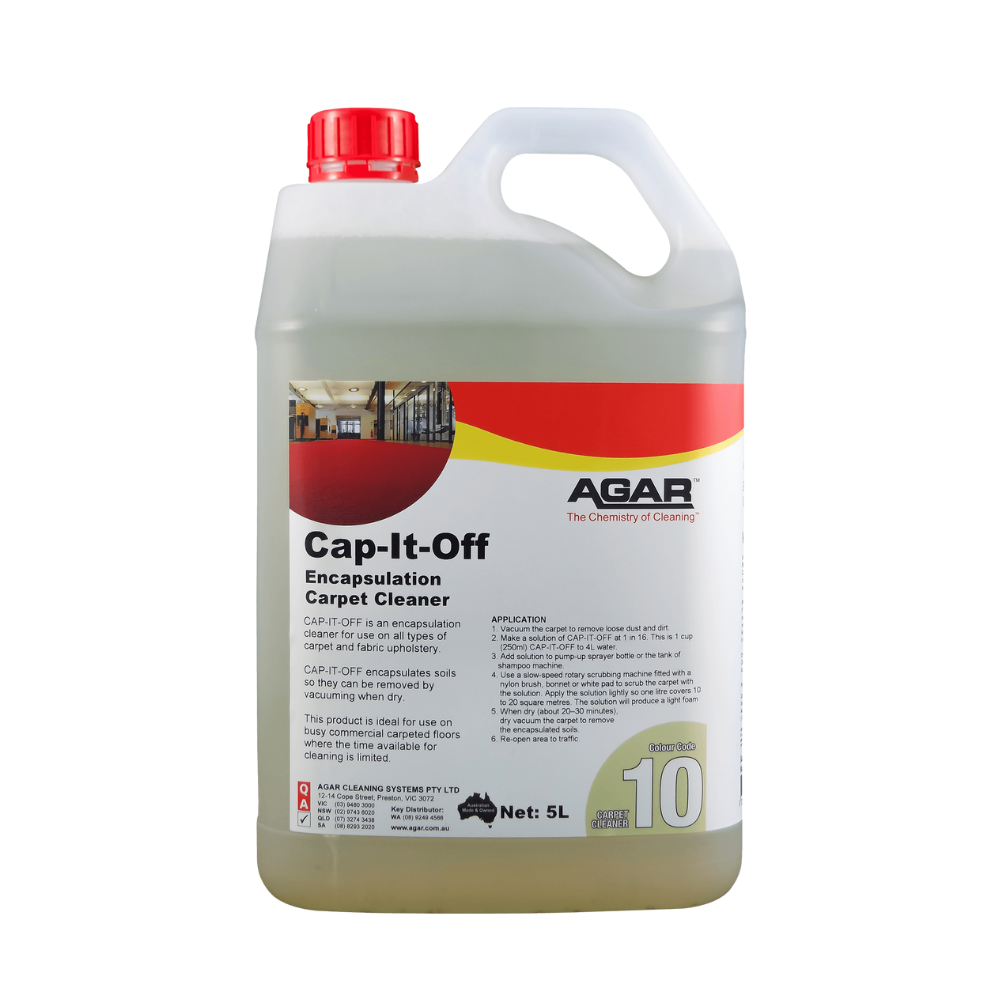
Slow-speed rotary work suits carpet. Agar's Cap-It-Off encapsulation cleaner, sold by Freshway in 5 litre packs, is directed to be applied lightly, agitated with a slow-speed rotary machine fitted with a brush, bonnet or white pad, left to dry and then vacuumed. Its dilution is 1 part to 16 parts water, about 250 ml per 4 L. The Polivac PV25TS is a dual-speed machine at 188 and 375 RPM with a 40 cm pad holder; run the low setting for carpet and keep the high setting for hard floor polishing. Compare machines in Freshway's burnishers and polishers range and pads in scrubbing pads.

A safer bonnet routine
- Vacuum thoroughly first. Bonnet work on gritty carpet grinds soil into the pile.
- Pre-test the solution on a hidden area for colour fastness.
- Mist the solution lightly; never flood the carpet.
- Run the machine at slow speed with overlapping passes, without dwelling in one spot.
- Turn or change the pad as soon as one face is loaded. Carry several clean bonnets per job.
- Let the carpet dry, then vacuum again to lift released or encapsulated soil.
- Launder bonnets after the shift so the next job starts with clean pads.

Setting the schedule
The Carpet Institute of Australia points to AS/NZS 3733 for carpet cleaning and suggests interim low-moisture cleans for commercial carpet every 3 to 9 months, with deep cleaning every 6 to 18 months depending on traffic. Write both into the contract. If bonnet work appears more often than the deep clean is ever done, the schedule is the problem. Carpet ranges and extraction options are listed in Freshway's carpet and floor care collection.
Operator safety
Rotary machines can kick if a pad catches, and damp carpet plus cords creates trip and slip risks. WorkSafe Victoria's cleaning injury hotspots page and its hazardous manual handling guidance help frame the risk assessment. SafeWork NSW's slips, trips and falls page is useful for cord routing and signage.
Frequently asked questions
Isn't bonnet cleaning just hiding dirt?
Only when it replaces deep cleaning. As interim maintenance with clean pads and a vacuum before and after, it removes surface soil and keeps traffic lanes presentable between extractions.
Doesn't it always damage the pile?
No. Damage comes from high speed, heavy pressure, dirty pads and repeated passes on plush cut pile. Slow speed, light moisture and frequent pad changes keep the risk low.
Can encapsulation with a bonnet replace extraction?
Not fully. Encapsulation holds released soil in polymer for vacuuming, but deep-seated grit still needs periodic hot water extraction.
Is a fast polisher fine if the pad is soft?
No. Use a slow-speed rotary for carpet. High-speed burnishing settings are meant for hard floors.
Next steps with Freshway
Set the interim and deep-clean cycle first, then choose the chemistry and machine. Freshway's Agar carpet and upholstery cleaners and slow-speed rotary machines cover the interim side; contact the team to match pads and solutions to your carpet types.