Alpine NSW and VIC: Winterising Commercial Pressure Washers
Drain it, protect the pump, card it, and recommission before the first spring job.
Shop now
First job after the snow season. The trailer washer has sat in a shed since June. The contractor pulls the cord, the Honda engine starts, the gun goes on, and water weeps from the pump head instead of building pressure. Nothing was wrong when it was parked. What changed was a few dozen nights below zero with water still inside the pump. It is a failure we rarely see on machines that live in Sydney, and a routine one for machines that winter at altitude.
How do you winterise a commercial pressure washer for alpine use?
To winterise a commercial pressure washer, flush it with clean water, drain the pump, hoses, gun and lance, then run a pump-saver antifreeze through the inlet until it appears at the high-pressure outlet. Store the machine dry and frost-free, deal with fuel as the engine manual directs, and recommission it before the first spring job.
This is a maintenance guide for machines that work or wait in cold country. For how hours and duty cycle affect wear year-round, see Freshway's guide to pressure washer duty cycle and hours per week, and for machine classes in general, the commercial pressure washer guide.
Freeze failure modes
Start with the numbers. The Bureau of Meteorology's climate statistics for Thredbo Village show a mean of 127.4 days a year at or below 0 °C over the 1969 to 2026 record, with a July mean minimum of minus 3.5 °C. The newer Perisher Valley station shows 158.3 days a year at or below 0 °C for 2010 to 2026. BOM's frost potential maps note that frost is particularly common in the alpine regions and is mainly confined to late autumn to early spring.
Water expands as it freezes. In a pressure washer, the places that hold water after use are the pump manifold or head, the unloader, the inlet filter housing, the hose, the gun and the lance. B.A.R. Group's pump saver product page puts it plainly: after use a pump often retains small amounts of water, and in cold weather that residual moisture can freeze, expand and fracture components.
Where to look on the first start after a freeze:
| Part that holds water | Typical symptom after a freeze | First check |
|---|---|---|
| Pump head or manifold | Water weeping from seams; pressure will not build | Inspect for hairline cracks before connecting water |
| Unloader | Pressure pulses or the machine cycles erratically | Have it checked with the pump; do not adjust blindly |
| Inlet filter housing | Cracked bowl, air drawn in, water leaking at the inlet | Remove, inspect and replace if cracked |
| High-pressure hose | Split along its length or bulge near a fitting | Run the hose out fully and inspect before pressurising |
| Gun and lance | Leak at the trigger or gun will not shut off cleanly | Test at low pressure; replace if it leaks |

Purge and antifreeze steps
Work through this list at the end of the season, or before any night when a machine will be parked below zero with water in it:
- Run clean water through the machine for a few minutes to flush out detergent.
- Shut the engine down, disconnect the water supply and release pressure at the gun.
- Remove the hose, gun and lance, and drain them. Hang the hose in loops so water runs out.
- Drain the pump as the machine's manual describes; RYOBI Support Australia's winter storage advice is to drain all water from the pump and hoses and store the machine in a dry, frost-free area.
- Connect a pump saver at the inlet. B.A.R. Group's instructions are to turn off and disconnect the machine from water and power, connect the product to the inlet, and squeeze until fluid appears at the high-pressure side.
- Tag the machine "winterised, pump saver in" with the date, so the next operator knows to flush before use.
Use a product made for pressure washer pumps, and follow its label. Do not improvise with whatever coolant is in the workshop.
Fuel and battery on petrol units
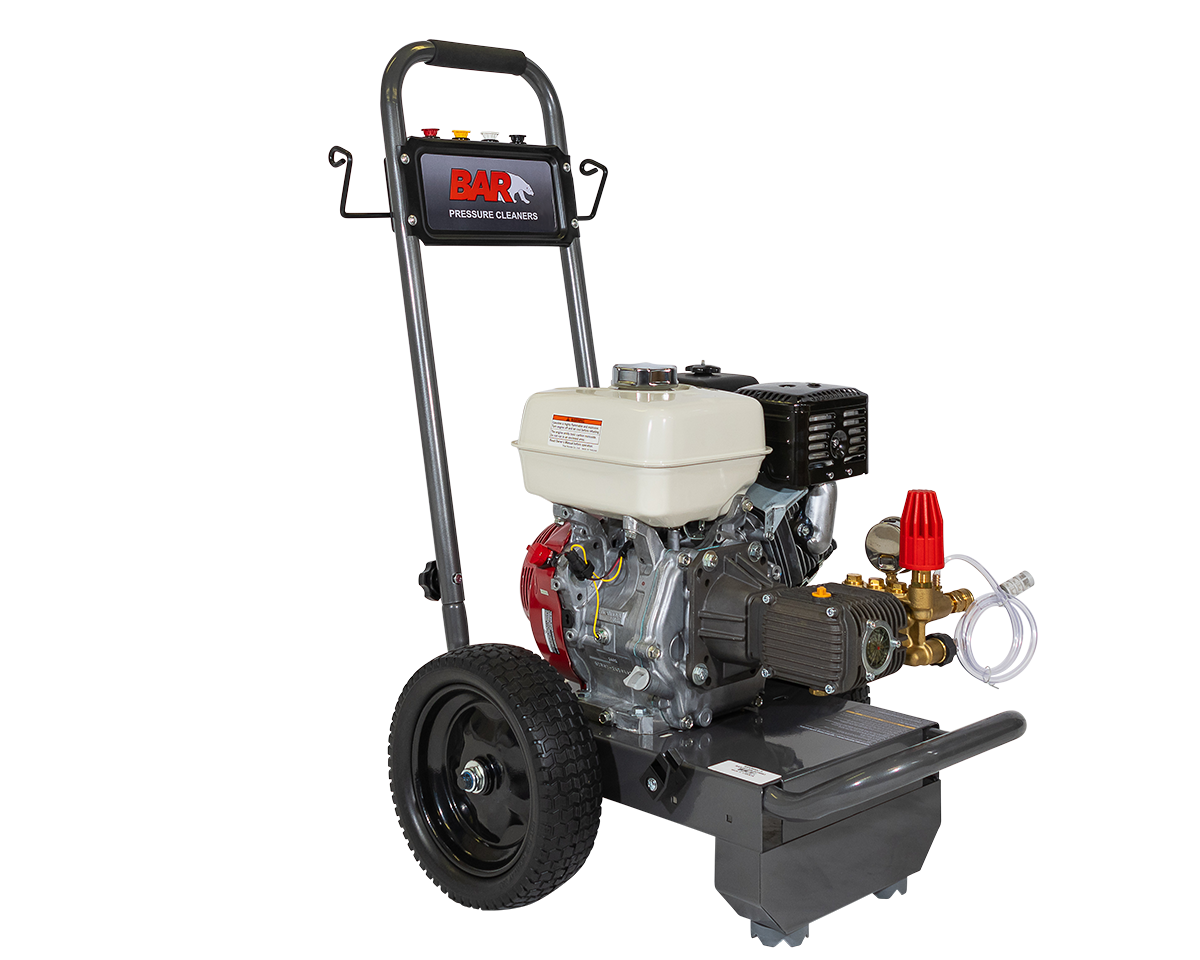
The BAR3890C-H that Freshway lists is a petrol cold-water unit with a Honda GX270 engine, a pull start, an Italian Comet AWD-K3538G plunger pump with a built-in unloader, a steel two-wheel trolley, and a listed 3,800 PSI and 13 L/min. Pull-start means there is no starter battery to look after, but the fuel still needs attention. Follow the Honda engine manual for long-term storage of the fuel system rather than guessing.
Keep stored fuel to a minimum. SafeWork NSW's page on flammable substances says flammable liquids, including petrol, must be kept in the lowest practical quantity at the workplace, and that one litre fully evaporated may produce 5,000 litres of explosive vapour and air mix.
For electric-start machines and trailer rigs with lead-acid batteries, SafeWork SA's guidance on lead acid batteries says not to allow batteries to freeze, notes that an empty battery freezes sooner than a fully charged one, and says never to charge a frozen battery. Store batteries charged, or remove them to a warm, ventilated room.

Trailer storage
A trailer rig adds plumbing: tank, feed lines, filters, hose reels and sometimes a burner or chemical tank. Each one holds water. Drain the tank to empty, open low-point drains, run the reel hose out and drain it, and leave taps and valves open while the rig is parked so trapped water can escape. A shed is better than open ground, but an unheated shed can still drop below zero. If the rig must stay outdoors, cover it against snow load and check it after the first hard frost.
Spring recommissioning
- Inspect the pump, manifold, filter bowl and hoses for cracks before connecting water.
- Connect the water supply and flush out the pump saver as its label directs, with the gun open and the engine off where the manual allows.
- Start the engine, run at low load, and check for leaks at the pump, unloader and fittings.
- Bring the machine up to working pressure with the normal nozzle and watch for pulsing.
- Log the result. Any weeping from the head or manifold goes to a service technician, not back on the job.
Freshway's service and repairs workshop covers pressure washers and lists pump failures and hose leaks among the faults it handles, with a quote approved before work begins.
Spec for cold sites
When buying for a cold site, look past bar and L/min. A machine with an exposed, easily drained pump, a removable inlet filter and a hose reel that can be run out completely is easier to winterise. Petrol units suit sites without power, but consider who will handle fuel. Compare options in the petrol pressure washers collection, and keep spare hoses, guns and fittings from the accessories range on hand for the first week of the season.
Logging seasonal care
Keep a one-page card on each machine: date winterised, who did it, pump saver used, fuel state, battery state, storage location, and the recommissioning check with any faults found. When a pump fails in spring, that card tells you whether the cause was the freeze, the storage or something else, and it gives a service technician a starting point.
Avoiding no-start weekends
The expensive failure is not a cracked head; it is a crew driving to a job with a machine nobody recommissioned. Book the recommissioning a week before the first job, not the morning of. Test-run every unit, carry a spare gun and hose, and do not leave pump saver in a machine that is about to go back into service without flushing it first.
Frequently asked questions
Is draining alone enough?
Draining removes the bulk of the water, but pumps can retain some. A pump saver adds protection where frost is likely.
Can I use car coolant instead?
Use a product made for pressure washer pumps and follow its label, not workshop coolant.
Should I charge a frozen battery?
No. SafeWork SA says never charge a frozen battery. Follow the battery maker’s advice or have it checked.
What if the pump leaks after winter?
Stop using it and have the head, manifold and seals checked before the machine goes back to work.
Supplied to Sydney, Melbourne and Brisbane contractors
Winterise every unit the same way, card it, and recommission before the first job. Freshway supplies commercial petrol pressure washers to businesses in Sydney NSW, Melbourne VIC and Brisbane QLD. Same-day delivery is available in Sydney; Melbourne and Brisbane receive fast delivery. Call 1300 567 002 for a delivered quote, or browse the pressure washers collection.