Accessible Washroom Cleaning Sequences That Respect Dignity
Restore a usable, private accessible room, not just a shiny cubicle.
Shop now
An accessible washroom can look freshly cleaned and still fail the person who needs it next. A wet grab rail, a walking frame pushed into the transfer space, or paper stacked on a high shelf restores shine while removing independence. Dignity is a cleaning outcome, not a poster on the back of the door.
Why accessible washroom cleaning procedures differ
An accessible washroom cleaning procedure commercial teams can use starts with dignity, not speed. Restore a dry, usable room: leave mobility aids where they were placed, clean grab rails without residue, restock consumables within seated reach, and finish so the occupant can lock the door again.
A standard cubicle is cleaned around a toilet and a basin. An accessible room is a workspace the occupant has to enter, transfer, reach and leave independently. The Disability (Access to Premises — Buildings) Standards 2010 set minimum access requirements for sanitary facilities in buildings they cover. The Australian Human Rights Commission's access to premises FAQ is a plain-language reminder that those rooms exist so people can use the building, not so cleaners have a larger store cupboard.
Frequency, traffic bands and replenishment still matter, and Freshway's guide to a commercial washroom cleaning schedule covers that planning. This article stays on the sequence inside the accessible room: how you move, what you touch, and what you must not rearrange.
A sequence that restores usability
Work so the room can be locked and used again as soon as it is dry and stocked. A useful order is:
- Knock, announce, and wait. If the room is occupied, leave and return. If it is free, place an “occupied / cleaning” sign that a person approaching the door can see before they commit to the threshold.
- Look before you move anything. Note where a wheelchair, walking frame, commode or changing bag has been left. Those items are not clutter.
- Remove waste and restock first, so you are not walking a wet floor with paper and liners at the end.
- Clean high-touch fittings next: door furniture, lock, grab rails, tapware, flush, dispenser levers and the transfer side of the pan.
- Clean the basin, then the pan, then the floor, working toward the door.
- Dry grab rails, the transfer surface and the floor path. A shiny rail that is still wet is a slip and a failed handhold.
- Return any aid you had to ease aside exactly as you found it, then leave the circulation space clear.
That order is slower than a spray-and-run on a standard cubicle. It is also the difference between a room that photographs well and a room someone can actually use.
Consumables placement within seated reach
Paper, soap and seat covers only support dignity if the occupant can reach them from the pan or from a seated position beside it. Do not “tidy” extra rolls onto a high cistern, a shelf above shoulder height or the back of the door. Do not park spare cartons on the floor in the transfer space. The room is not a storeroom.
Freshway lists the Elyse Mini 5-Fold Compact Hand Towel Dispenser as a lockable, wall-mounted ABS unit written for tight washrooms, with a viewing window so staff can check the level without opening the cover. A compact dispenser matters in an accessible room because wall space and circulation space compete. Mount and refill it so a seated person can reach the towel; use the window on your service round so you restock before the cabinet is empty. Matching paper and other washroom stock sit in the paper and washroom products and dispensers collections. Check the current product page for the fold type the cabinet actually takes before you order a substitute carton.

Sanitary units, liners and any waste bins belong where they can be used without blocking the transfer path. Browse bins, urinals and mats when you specify those items, and empty them on the same visit as the restock so the next occupant is not negotiating a full unit.
Surfaces and grab rails
Grab rails, backrests and hinged support arms are load-bearing fittings. They also collect hand soil, product residue and moisture. Clean them on every visit, then dry them. A greasy or wet rail is both an infection-control miss and a physical risk. SafeWork NSW guidance on slips, trips and falls on the same level and WorkSafe Victoria's slips, trips and falls pages apply to the floor and to any fitting a person must hold while they transfer.
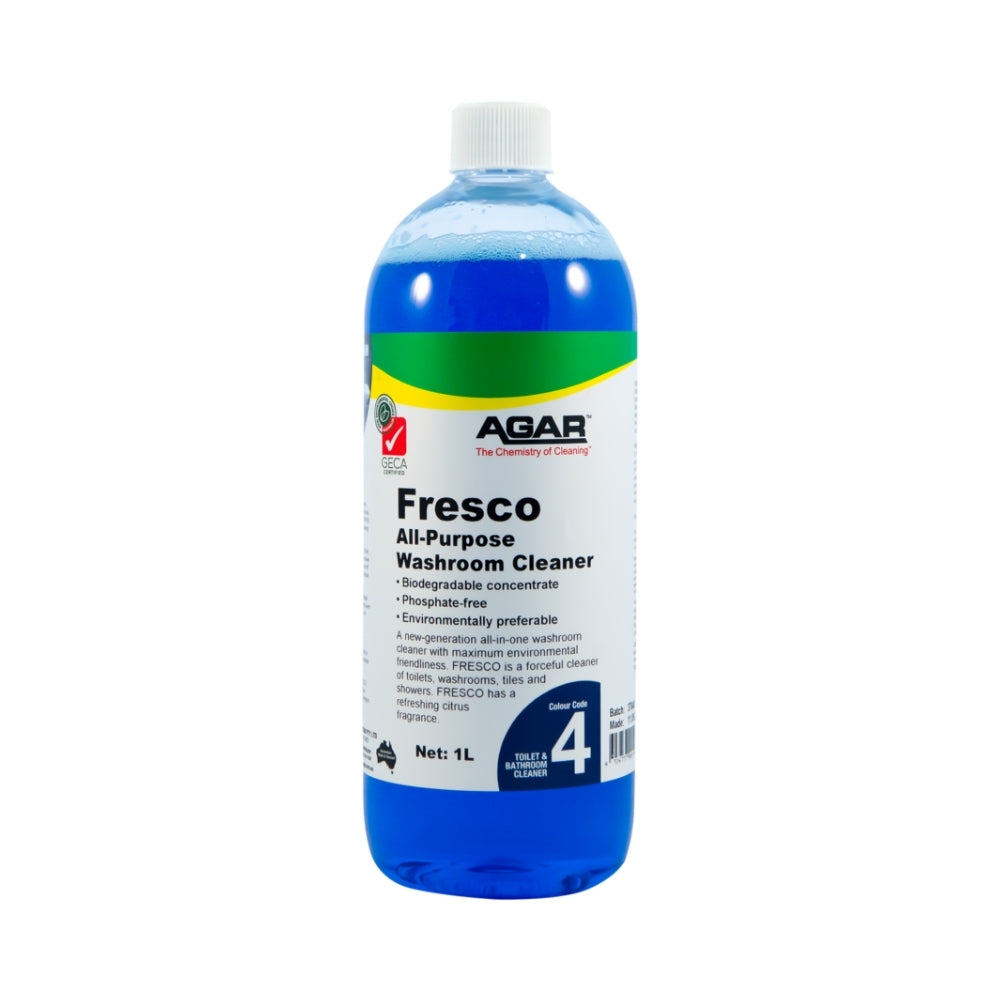
Use a cleaner that the current label writes for washroom fixtures, not an improvised acid or a chlorine splash “to be sure”. Freshway lists Agar Fresco as an all-purpose washroom cleaner made with plant-based surfactants and organic acids, described as biodegradable, non-toxic and non-corrosive, and written for toilets, urinals, showers, tiles, floors, basins, ceramic tiles, shower glass and porcelain. The Freshway page contrasts that profile with heavy industrial acids that can pit chrome tapware. Agar's Australian Fresco page likewise presents it as an all-in-one washroom cleaner for showers, toilets and ceramic tiles. Dilute Fresco according to the current label or product page; Freshway does not print a single ratio on that page, so do not invent one on the wall chart.

Privacy during cleaning
An accessible washroom is often the only suitable room on the floor. Occupying it with a propped-open door, a trolley in the doorway and a radio playing is not a courtesy to other occupants waiting outside. Clean as a closed-door task whenever the site rules allow it, keep the visit short, and never leave personal items, used gloves or a camera phone in view.
If the building has only one accessible facility, schedule the full clean for a predictable window and use a clear sign rather than assuming people can wait indefinitely. A “quick wipe” that blocks the room through a peak period is worse than a planned ten-minute close. Do not start a long periodic clean — grout work, machine scrubbing, or a full consumable rebuild — without telling reception or the floor warden how long the room will be out of service.
Spec products that will not damage fittings
Accessible rooms concentrate expensive fittings into a small wet area: stainless or powder-coated rails, hinged arms, shower seats, sensors and, in some Changing Places or adult-change rooms, a change table and hoist. Choose chemistry the label writes for those surfaces, and keep acids and chlorine for the soils and surfaces they are actually listed for.
Freshway lists Agar Shower Star as a 5-litre concentrated shower and washroom cleaner for soap scum, hard-water scale, mould and mildew, written as biodegradable, phosphate-free and chlorine-free, and listed for ceramic tiles, porcelain basins, grout and stainless steel fittings. Directions on that page say to apply it to wet surfaces, allow several minutes’ dwell, then wipe or rinse, and not to mix it with bleach, disinfectants or other strong chemicals. Agar's Shower Star page likewise describes a foaming washroom cleaner with biodegradable surfactants and no added phosphates or chlorine. Use it where scale and scum have built up on listed surfaces — typically the shower or tiled wet wall in an accessible combined bathroom — not as a daily splash across an unknown coated rail.
Daily fixture work can stay with Fresco, diluted as the label directs. Heavier bowl scale may belong with a labelled toilet cleaner from the Agar bathroom and shower cleaners collection, used on porcelain and ceramic as that label allows, then rinsed so nothing remains on a handhold. Wear suitable gloves; Freshway's gloves and PPE collection is the place to match a disposable nitrile or a reusable pair to the task and the SDS. Handle all of these products under SafeWork NSW chemicals guidance.
Training points for dignity and mobility aids
Write four limits into the induction, not as slogans but as refusals:
- Do not move a wheelchair, walking frame, commode or hoist sling to make mopping faster. If you must ease an item aside to clean under it, put it back on the same footprint and orientation.
- Do not use the accessible room as overflow storage for bulk paper, a mop bucket park or a wet-floor forest of signs.
- Do not leave rails, seats or the floor path wet.
- Do not discuss the occupant, their aids or what you found in the room with anyone who does not need to know.
Changing Places and other adult-change facilities add a change table, often a hoist, and more waste. The same limits apply, plus whatever the site procedure says about the hoist and table. Do not invent a new sequence on the day, and do not treat those rooms as a larger version of a standard accessible toilet.
Accessible-room checklist
| Check | Pass look | Common fail |
|---|---|---|
| Entry and privacy | Knock, wait, signed while closed, visit timed | Door propped open with the trolley in the threshold |
| Mobility aids | Left or returned on the same footprint | Frame folded and leaned in a corner “to mop properly” |
| Consumables | Paper, soap and liners reachable from a seated position | Spares stacked high or dumped in the transfer space |
| Grab rails and seats | Clean and dry, no slippery residue | Wet product left on the rail |
| Floor path | Dry enough to transfer and walk | A shiny, still-wet trail from pan to door |
| Fittings | Chemistry matches the labelled surface | Chlorine or a strong acid used “just in case” on coated rails |
Walk the room as a user would before you leave: can someone enter, lock, transfer, reach paper and soap, use the rail, and leave without negotiating your equipment?
Frequently asked questions
Can we clean an accessible washroom exactly like a standard cubicle?
No. The sequence has to restore a usable, private room: dry handholds, reachable consumables, a clear transfer space and mobility aids left where they were. Speed that ignores those points fails the next occupant.
Should we move a wheelchair or walking frame out of the way to mop faster?
No. Those items belong to the person who left them. If you must ease one aside to clean underneath, return it to the same place and orientation before you leave.
Is a strong acid or chlorine cleaner better for grab rails?
No. Use a product the current label writes for the fitting. Fresco is listed as non-corrosive and gentle on bathroom fixtures; Shower Star is listed for ceramic, porcelain, grout and stainless steel and must not be mixed with bleach or other strong chemicals.
Should we leave the door open so people can see the room is being cleaned?
Not as a default. An open door with a trolley in the threshold blocks the only accessible facility and removes privacy. Use a visible sign and keep the visit as short as the task allows.
Are Changing Places rooms just larger accessible toilets?
No. They add equipment such as a change table and often a hoist, and they need the site procedure for those fittings. The dignity rules still apply: do not treat the room as storage or rearrange aids to make cleaning easier.
Next steps with Freshway
Write the accessible-room sequence on one page, name the daily cleaner and the periodic shower or scale product, and check that dispensers and bins leave the transfer space clear. Use the washroom, dispenser and bathroom-cleaner collections already linked above, and confirm current directions on each product page before you print the card.