Wizzard and Mid Brands: How to Read Scrubber Specs Without Hype
Read Wizzard scrubber width, tanks, brush speed and coverage before the slogans.
Shop now
450 m²/hr versus 250 m²/hr. Those are the theoretical coverage figures Freshway lists for the Hako Wizzard W44P and the W24N. The gap looks huge on a brochure line, yet both machines scrub and dry in one pass; the difference is cleaning width, tank design and where each chassis fits. Reading mid-brand scrubber specs means separating those numbers from slogan fields before you buy.
This guide is a decision path for engineers and buyers: which brochure lines to ignore, which numbers matter, how to judge parts support, how to trial on your own floor, and a side-by-side table built only from Freshway listings.
Wizzard floor scrubber specs: the short answer
Read Wizzard and other mid-brand scrubber specs by cleaning width, tank capacity and feed type, brush speed, listed coverage, weight, noise and power first. Ignore slogan adjectives. Confirm parts and service paths, then trial the machine on your own floor type before you standardise a fleet.
The sections below apply that method to Freshway's Hako Wizzard listings and to neighbouring compact scrubbers.
Ignore slogan fields
Brochure language rarely decides a night shift. Lines that call a machine formidable, elite or revolutionary do not tell you whether it fits between café tables or lasts a school holiday clean. Cross them out mentally and stay with measurable fields.
SafeWork NSW's slips, trips and falls guidance cares whether the floor is left wet, not whether the brochure sounded confident. WorkSafe Victoria's slips page makes the same practical point: wet contaminants cause injuries. Spec sheets that list recovery and drying behaviour matter more than adjectives.
Numbers that matter on a Wizzard listing
On Freshway's Hako Wizzard pages, these fields carry the buying decision:
- Cleaning width / path. W24N lists a 215 mm cleaning width in the 24 cm class; W34N lists 315 mm in the 34 cm class; W44P lists 420 mm in the 44 cm class.
- Theoretical coverage. W24N 250 m²/hr; W34N 350 m²/hr; W44P 450 m²/hr. Treat these as straight-line figures, not a promise for a cluttered retail floor.
- Brush speed and type. W24N and W34N list 650 RPM cylindrical rollers; W44P lists 400–650 RPM.
- Solution tank and feed. W24N 1.2 L; W34N 1.7 L gravity feed; W44P 4 L with active pump. Pump versus gravity changes how evenly solution arrives on a ramp or long pass.
- Motor power, noise, weight. W24N 400 W, 68 dBA, 20 kg; W34N 400 W, 69 dBA, 23.5 kg; W44P 600 W total, 71 dBA, 29.5 kg. All three list 230 V / 50 Hz.

Hako Australia at hako.com.au provides brand background; the Freshway product pages are the source for the figures quoted here.
Support and parts before you standardise
A mid-brand scrubber is only as useful as the brush and blade path behind it. Freshway lists a Hako Wizzard W44P hard brush set (blue) as a direct-fit pair for the W44P with the 4 L pump tank, with brush length about 420 mm each. That is the kind of line-item you want to see before a fleet buy: consumables with clear machine fitment.
Also confirm:
- Workshop access for corded 230 V machines used on Australian sites.
- Whether Freshway's service and repairs team can handle the brand you choose.
- Brush colour or type options for grease versus daily vinyl cleaning.
Central Cleaning Supplies' Australian range at centralcleaningsupplies.com.au is another distributor view of commercial floor care parts; use it for market context, then order against the machine you actually own.
Trial it on your own site
- Pick the tightest aisle and the most open hard-floor run on the site.
- Time a measured rectangle, including dump and refill.
- Check the floor behind for wet rails and detergent haze.
- Lift the machine into a van or goods lift once, with the people who will do it nightly.
- Run the noise level past the building manager if daytime cleaning is required.
- Only then compare theoretical m²/hr figures between models.
A W24N at 20 kg may win a boutique washroom run even though its 250 m²/hr listing sits well below the W44P's 450 m²/hr. The trial makes that obvious; the brochure alone does not.

Compare method: Wizzard beside other compact options
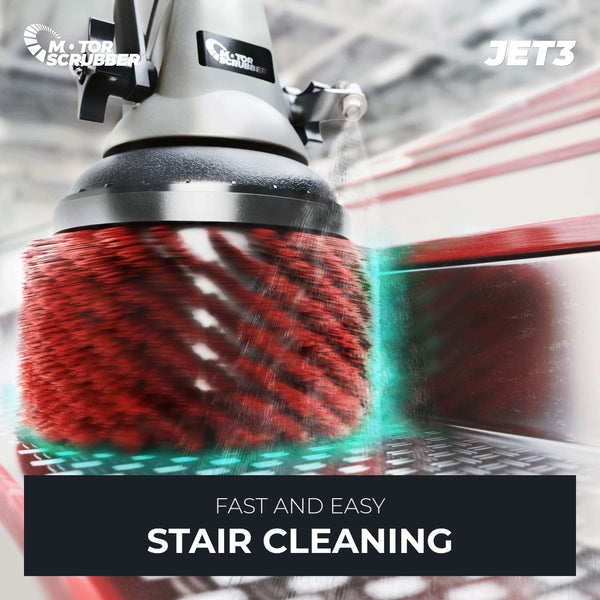
Put mid-brand machines on the same scorecard as better-known compact scrubbers. Freshway lists the Kärcher BR 30/4 at a 300 mm path, 150 RPM cylindrical brush, 4 L fresh / 4 L recovery tanks, 220 W scrub motor and 11 kg empty weight. MotorScrubber JET3 is listed with an 18 cm head, 360 RPM, 1 L backpack tank and 144 m² per hour linear performance for edges and fixtures rather than open floor.
Decision rule:
- Open retail or education corridors: compare W34N / W44P width and tank feed against other walk-behinds in the same width band.
- Tight amenities: compare W24N weight and width against upright compact scrubbers such as the BR 30/4.
- Fixtures, stairs and behind toilets: a handheld such as the JET3 is a different job class, not a substitute for a 44 cm walk-behind.
Kärcher Australia at karcher.com.au and Numatic Australia at numatic.com.au publish local commercial ranges you can score the same way; use the same field list so brand noise does not rewrite the scorecard.
Common mistakes when reading scrubber specs
- Treating theoretical m²/hr as a shift plan without obstacles, dumps or detail work.
- Buying width without checking van space and a single-person lift.
- Ignoring gravity versus pump feed on ramped retail floors.
- Skipping noise figures for daytime hospital or office work.
- Ordering brushes without confirming deck length and model fit.
- Assuming every compact scrubber recovers water the same way on textured safety flooring.
WorkSafe Victoria's hazardous manual handling guidance is relevant when a "compact" machine is still awkward to lift into a high van every night. Weight on the Freshway listing is a handling spec, not trivia.
Quick-reference table
| Freshway listing | Cleaning width | Theoretical coverage | Brush speed | Solution tank | Noise | Weight |
|---|---|---|---|---|---|---|
| Hako Wizzard W24N | 215 mm (24 cm class) | 250 m²/hr | 650 RPM cylindrical | 1.2 L | 68 dBA | 20 kg |
| Hako Wizzard W34N | 315 mm (34 cm class) | 350 m²/hr | 650 RPM cylindrical | 1.7 L gravity | 69 dBA | 23.5 kg |
| Hako Wizzard W44P | 420 mm (44 cm class) | 450 m²/hr | 400–650 RPM | 4 L pump | 71 dBA | 29.5 kg |
| Kärcher BR 30/4 | 300 mm | Not used as the lead figure here | 150 RPM cylindrical | 4 L fresh / 4 L recovery | Not quoted in this article | 11 kg empty |
| MotorScrubber JET3 | 18 cm | 144 m²/hr linear | 360 RPM | 1 L backpack | Not quoted in this article | Backpack system (see listing) |
Coverage maths for perspective: on a clear 900 m² hall, the W44P's 450 m²/hr theoretical figure implies about 2.0 hours (900 ÷ 450), while the W24N's 250 m²/hr implies 3.6 hours (900 ÷ 250). Real sites with fixtures sit below those rates, which is why the trial step stays in the method.
Frequently asked questions
What Wizzard floor scrubber specs matter most?
Cleaning width, tank capacity and feed type, brush speed, listed coverage, weight, noise and power. Use those before brochure adjectives when you compare models.
Is a higher m²/hr figure always the right Wizzard to buy?
No. Theoretical coverage assumes a clear run. Tight amenities often favour the narrower, lighter W24N even when its m²/hr figure is lower.
How do Wizzard machines compare with other compact scrubbers?
Put every brand on the same field list: width, tanks, brush speed, weight and noise. A 300 mm upright and a 44 cm walk-behind solve different layouts.
Where can I get Wizzard brushes and service in Australia?
Freshway lists Wizzard machines and fitment-specific brush sets, and offers service and repairs from Arncliffe. Confirm part numbers against your exact model.
Next steps with Freshway
Compare the Hako range in Wizzard floor scrubbers, and look at edge tools in the MotorScrubber collection when fixtures need a handheld. Match machines to the sectors you clean via shop by industry, book workshop support through service and repairs, and check live stock on each product page before you standardise.