Ask five suppliers how long a commercial pressure washer hose should be and you will get five confident answers, usually the length they happen to stock. The honest answer is that hose length is a trade-off between reach and pressure: every metre adds convenience for the operator and costs flow at the nozzle, and the point where that trade turns bad depends on the machine, the hose diameter and the route. This pressure washer hose length guide works through that trade in the order it matters on a commercial site.
Two numbers decide most of it. The first is the flow the machine can deliver at the pressure it is rated for. The second is the distance the operator actually needs to reach without repositioning the machine, which is a property of the site rather than the equipment. Everything else - reels, couplings, extension hoses - either protects that reach or quietly erodes it.
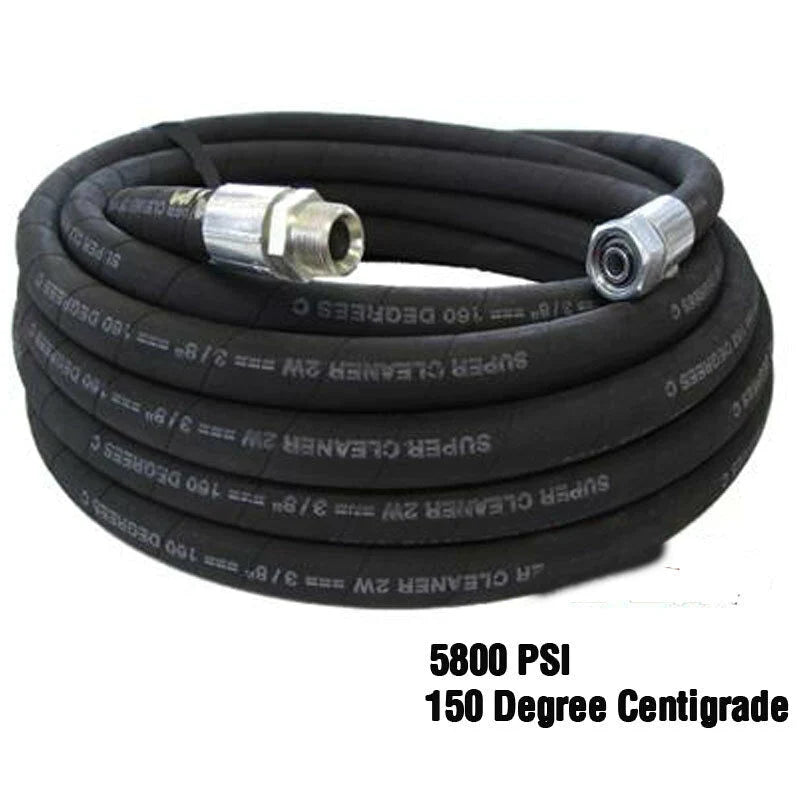
Pressure Washer Hose Length Guide: Start With the Result Required
Begin with what the job has to achieve, then let the hose follow. A facade clean on a two-storey building, a car park washed from a single service point and a plant room cleaned between fixed equipment have very different reach requirements, and the operator's working position is part of the specification rather than an afterthought. Write down where the machine can sit safely, where the operator has to be, and how many times the machine must be moved to cover the area.
Acceptable trade-offs should also be stated. A longer hose means fewer relocations but a lower pressure and flow at the nozzle, which changes how long each square metre takes and how well the surface rinses. Fewer relocations also means the operator spends less time dragging equipment through a wet work area, which is usually the safer option on a busy site. Where the site is compact and the machine can be repositioned easily, a shorter hose is almost always the better engineering choice.
The result to aim for is the shortest hose that lets the crew work the whole route from safe, stable positions.
How Length, Diameter and Bends Cost Pressure at the Nozzle
Water loses pressure as it travels, and the loss depends on how far it travels, how narrow the path is and how many changes of direction it makes. A longer hose, a smaller internal diameter and a kink or a tight bend all reduce the pressure available at the nozzle. The effect is not linear or trivial: on a long run with a narrow hose and worn couplings, a machine can feel like a much smaller machine.
Three practical rules follow. Use the largest internal diameter the machine and its fittings can accept, because diameter matters more than most operators expect. Keep the run as straight as possible, because every bend adds friction and a kink effectively reduces the diameter to nothing at that point. Protect the couplings, because a worn machine-end or gun-end fitting leaks flow that the nozzle will never see.
Where a site genuinely needs reach, the better answer is usually a larger-diameter hose run on a reel, plus a machine sized for the pressure and flow the work requires at the nozzle rather than at the pump outlet.
Which Accessories Change the Effective Working Distance?
Accessories extend the working distance from the machine.
A wand or lance extends reach without adding hose friction, an extension wand keeps the nozzle at a consistent angle over a large area, and a reel keeps the hose off the ground so it cannot be driven over or kinked at the same point every day.
Choosing between hose length and wand length is a genuine decision, not a detail. Adding a metre of hose adds friction along the whole run; adding a metre of lance adds almost none, but it changes the load on the operator's arms and changes how precisely the nozzle can be held. For overhead work such as facades and soffits, a longer lance with a correctly rated nozzle is often the better way to gain reach. For flat work, hose length plus a surface cleaner covers ground faster.
Accessory compatibility is where specifications quietly drift. Couplings are rated for a pressure, hoses are rated for a burst pressure, and a hose that suits a small domestic machine may not be safe on a machine that develops several thousand psi. A hose with the wrong fitting will leak or fail at the joint, and an adapter that is not rated for the pressure is a hazard rather than a solution. Freshway stocks the parts as a system - hoses, couplings, lances and nozzles - and the compatibility guide for pressure washer hoses and fittings is the place to check a combination before ordering it.

What Do Water Supply, Drainage and Exclusion Zones Change?
Where the water comes from and where it goes.
A long hose reduces pressure at the nozzle, so the crew compensates with slower passes and more water, which increases the load on supply, drainage and the people working nearby.
Supply is usually the first limit to appear. A machine rated for heavy flow cannot deliver it from a tap shared with amenities, and a longer hose run simply moves the shortfall further from the pump. Where the supply is marginal, the practical responses are to work in smaller sections, to use a buffer tank so the machine is not drawing directly from a marginal line, or to choose a machine that suits both the supply and the reach the site needs.
Runoff is the second limit. A larger volume of water leaving a commercial area carries soil, and on vehicle hardstands it can carry oils. Containing runoff, protecting stormwater inlets and confirming what the site or the local regulator expects belongs in the method; the NSW Environment Protection Authority water guidance sets out what should not be discharged. A longer hose also means the work may reach parts of the site where drainage is different, so the containment plan should follow the hose rather than the machine.
Exclusion completes the picture. Runs across public areas need signage or a spotter, the hose itself must not become a trip hazard on a shared surface, and the spray direction must not carry onto vehicles, glazing or pedestrians. Working from fewer, safer machine positions is one of the practical benefits of getting the length right.
Operator Controls for High-Pressure Work
High-pressure water jetting is plant and equipment risk, and Australian duties require it to be managed through the equipment, the method and the competence of the operator. Hose management sits in that picture: a pressurised hose is stored energy, and a coupling that fails or a hose that is driven over can whip or rupture.
The controls are practical. Inspect the hose and couplings before each use and replace anything showing abrasion, blistering or a damaged crimp. Keep the hose out of traffic lanes and away from hot surfaces and sharp edges. Never kink a hose to stop the flow; use the machine controls. Never leave a pressurised machine unattended. Eye and face protection, gloves and appropriate clothing remain standard because of rebound and airborne debris, and the risk rises when heated water or detergents are used.
Regulator guidance is the reference for the site procedure: SafeWork NSW publishes plant and equipment material and WorkSafe Victoria's plant guidance covers the same duty, inside the framework set by the Work Health and Safety Regulations 2011. Standards Australia lists the high pressure water jetting series as AS/NZS 4233.1, which is the technical reference industry procedures are built on.
Hoses, Pumps and Service Access
The pump pays for a badly specified hose. Restriction in the hose and fittings raises the pressure the pump must work against, and that added load shows up as heat, noise and shortened seal life. Where a site runs long hoses through undersized fittings, pumps are replaced far more often than the hose specification suggests they should be. Manufacturer documentation for the machine, such as Nilfisk's Australian product information or Karcher Australia's pressure cleaner range, states the hose and fitting sizes the machine is designed for.
Service access should be part of the purchasing decision. Hoses, couplings and nozzles are the parts that fail first, and on a commercial contract a failed hose can stop the whole job. Keeping a spare hose of the same length, diameter and rating on the shelf, with the correct couplings already fitted, converts a lost day into a ten-minute change. The same logic applies to filters and pump seals.
What Is the Cost per Completed Task?
Cost per cleaned square metre, not cost per hose.
The purchase price is one input; what matters is how many hours the crew spends on the site, how often water stops interrupt the work, and how much of the schedule is lost when a hose or coupling fails.
Set against labour, hose is cheap and lost time is expensive. A crew that has to reposition a machine three times on a floor because the hose is one metre too short loses far more in wages than the cost difference between two hose lengths. Conversely, a hose that is longer than necessary makes every pass slightly weaker, which can extend the job or leave the surface under-rinsed. The comparison should therefore be made per site and per route, not per catalogue line.
Include the recurring costs as well: replacement intervals for hoses and couplings, water and chemical consumed on a longer run, and the downtime avoided by holding spares. On multi-site contracts, standardising on one hose specification per machine type keeps the numbers comparable and prevents the drift that turns a tidy specification into a patchwork of adapters.

Reels, Couplings and Storage That Protect the Hose
A hose only performs to its specification while it is undamaged, and most commercial hose damage is mechanical rather than pressure-related. Being driven over, dragged across kerbs, kinked at the same point every day and pulled tight around corners all shorten service life and reduce flow. A reel solves several of these at once by keeping the hose off the ground and stored in a consistent coil, and it makes length per site repeatable, because the operator pays out what is needed rather than laying the whole run out by habit.
Couplings deserve the same attention. Quick-connect fittings are convenient and depend on clean, undamaged surfaces to seal; a gritty coupling leaks, and a leaking coupling costs flow at the nozzle. Swivel ends reduce the torque that pulls a hose into a kink when the operator moves the gun. Where a site works with multiple machines, colour coding or labelling the couplings per machine prevents the cross-matching that puts a low-pressure hose on a high-pressure machine.
Reviewing the Hose Selection When the Site Changes
The right length changes when the site changes, and cleaning equipment usually outlives the layout it was chosen for. New racking, a different service point, an additional level in the building, or a decision to move cleaning to daytime hours can all invalidate the reach assumption the hose was bought for.
Review it against symptoms rather than on a calendar. Relocating the machine more often than planned, operators asking for adapters or extension hoses, pressure that feels weaker than it should, couplings failing early, or the crew finishing later than the schedule allows are all signals that the reach, diameter or rating is wrong for the current route. Reviewing the machine, hose and nozzle as one specification each time the route changes is quicker than replacing kit after it fails, and it keeps the pressure the crew feels at the nozzle - the only figure that affects the job - under control.
Questions we get asked most
- What is a practical pressure washer hose length for commercial work?
- There is no universal figure. The right length is the shortest hose that lets the crew work the whole route from safe, stable positions, because every extra metre costs pressure and flow at the nozzle. Long runs also need a larger internal diameter and clean, undamaged couplings to keep losses reasonable. Decide the hose after you have decided the machine and the working positions.
- Does a longer hose reduce pressure?
- Yes. Water loses pressure as it travels, and the loss increases with length, with a narrower internal diameter and with each bend or kink. A long run of small-diameter hose through worn couplings can make a good machine behave like a much smaller one. Where reach is genuinely required, use a larger-diameter hose and keep the run as straight as possible.
- Can I join two pressure washer hoses together?
- Only with a rated coupling of the correct size and pressure class, and only if the combined hose is still rated for the machine. Each joint is a potential leak and a potential failure point, and every added fitting costs flow. If a site regularly needs two hoses joined, the specification is wrong and a single correctly sized hose with a reel is the safer answer.
- How do I know when a pressure washer hose should be replaced?
- Replace it when you can see abrasion through the outer cover, blistering, a bulge, a damaged or corroded crimp, or a coupling that will not seal cleanly. Any of these can fail under pressure, and a pressurised hose holds stored energy. Hoses are consumable parts: inspecting them before each job is cheaper than replacing a pump or managing a burst hose on site.
Conclusion
Hose length is a reach-versus-pressure decision, and the correct answer is the shortest hose that lets the crew work the whole route from stable, safe positions. Where more reach is genuinely needed, add diameter and use a reel rather than accepting a narrow, kinked run, and keep every coupling clean and rated for the machine.
The specification to write down is simple: machine pressure and flow, hose internal diameter and pressure rating, the fittings at each end, the length, and the number of spares held. Review it whenever the route, the building or the machine changes, and the pressure the operator feels at the nozzle stays predictable.
Compare pressure washer hoses, reels, couplings and lances in the Freshway range, or ask the team to match a hose specification to your machine and your sites.