Concrete is the surface most often damaged by pressure washing, and the damage is usually self-inflicted. Etching, aggregate exposure, blown joint sand and permanent bright streaks all come from using more pressure, a narrower jet or a closer working distance than the slab needed. Learning how to pressure wash concrete safely is mostly a matter of deciding what the slab will tolerate before the machine is switched on.
The good news is that the technique is not complicated. Concrete responds well to chemistry, a controlled fan jet and consistent movement, and it tolerates a surprising amount of pressure when the slab is sound and fully cured. The failures come from treating every slab as if it were the same, and from using pressure to compensate for a method that was never designed for the soil.
How to Pressure Wash Concrete Safely: The Decision to Make First
The first decision is not the pressure setting; it is what the finished surface has to look like. A loading dock that has to read as uniformly clean, a decorative driveway where the aggregate must stay intact, a warehouse slab with a protective sealer and a car park with oil staining all have different definitions of success, and each one sets a different ceiling on pressure.
The second decision is what the slab already is. Age, cure state, finish and jointing all change the answer. New concrete that is still curing should not be pressure washed aggressively at all, and surfaces with a coating, a sealer or a decorative finish need a method that protects that layer rather than a method designed to strip soil from raw concrete. Record the surface, the finish, the joint type and any previous repairs before choosing equipment.
The third decision is the soil. Algae, moss and weathering are surface problems that respond to chemistry and a moderate fan jet. Compacted dirt, tyre marks and oil are heavier problems where a controlled pre-treatment does most of the work and the pressure is mainly used to rinse. When those three decisions are made first, the pressure, nozzle and working distance follow, and the risk of etching drops sharply.
Why Concrete Etches and What Actually Causes It
Etching is not a pressure rating being exceeded; it is too much energy applied to one area for too long. The paste layer at the surface of concrete is the weakest part of the slab, and a concentrated jet removes it, exposing the sand and aggregate underneath. Once that has happened, the surface cannot be returned to its original appearance by cleaning alone.
Four conditions produce it. A narrow jet concentrates energy into a small footprint. A short working distance raises the energy that reaches the surface. A stationary nozzle keeps applying that energy in one place instead of moving across the slab. And a slab that is weak, friable, newly placed, over-blasted previously or finished with a delicate surface treatment has less material to spare in the first place.
Match Pressure and Flow to the Slab
Pressure breaks the bond between soil and surface; flow carries the loosened material away. On flat concrete, flow is what makes a pass productive and consistent, while pressure determines how much force each pass applies. Machines are sold on both figures, and the larger pressure number tends to attract the attention, but on a slab the combination matters more than either figure alone.
Sound, fully cured concrete tolerates substantial pressure, and the practical limit is usually set by the finish rather than the slab. Exposed aggregate, coloured finishes, saw-cut decorative patterns, sealers and repair patches all tolerate less. Where a slab carries traffic films or a sealer, pre-treat the soil and reduce the pressure, because the sealer coating is what the jet will damage first.
Flow also determines how quickly the work moves, which matters for the result as much as for the schedule. Where flow is high and the fan is wide, each pass rinses as it cleans and the operator sweeps the slab steadily without stopping. Where flow is low, the operator is tempted to linger, and lingering is the habit that produces marks. Matching the machine to the slab's size and soil load, rather than to the biggest pressure figure available, is what keeps a job both quick and safe.
Which Nozzle, Surface Cleaner and Working Distance to Use?
Use a fan jet or surface cleaner and keep it moving.
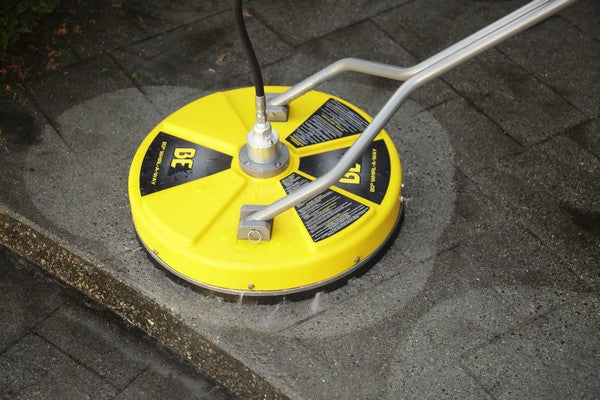
A fan tip between fifteen and forty degrees with a consistent working distance is the safe default on concrete, and a rotary surface cleaner holds the nozzles at a fixed height for even results on large flat areas.
The distinction matters because the two tools fail differently. A hand-held fan jet gives full control but depends entirely on the operator maintaining distance and angle, which is why large slabs cleaned by wand show banding. A rotary surface cleaner removes that variation, but it concentrates water at the edges of the head and depends on a skirt in good condition; a worn skirt lets water escape and reduces cleaning efficiency across the whole pass.
Working distance is the operator's most useful control and the one most often ignored. Moving the nozzle further from the surface spreads the energy and reduces the risk of etching, and it costs only a little cleaning speed. Holding a nozzle close for a stubborn patch is precisely the moment damage happens, and on coloured or sealed concrete that mark is permanent. Where a patch resists at a safe distance, the answer is a pre-treatment and dwell time, not a closer nozzle.

What Do Water, Runoff and Exclusion Zones Change?
Where the water goes, and who is exposed to the spray.
A slab clean uses a steady volume of water for a long period, so supply, containment and the separation of people from the work area are planned before the first pass rather than improvised afterwards.
Supply is the first practical limit. A machine rated for heavy flow will not deliver it from a tap shared with amenities, and a pump starved of water is damaged even on a short job. Where supply is marginal, work in smaller sections, use a buffer tank, or select a machine that suits the site rather than forcing the supply to suit the machine.
Runoff is the second. Water leaving a hardstand carries soil, and on vehicle areas it can carry oils and detergents. Containing runoff, protecting stormwater inlets and confirming what the site or the local regulator expects is part of the method; the NSW Environment Protection Authority water guidance explains what should not be discharged, and where a site discharges to sewer or trade waste the local water authority such as Sydney Water sets the conditions. On a sealed or coloured slab, runoff also carries the sealer that the jet has loosened, which is one more reason to keep the pressure conservative.
Exclusion protects people, property and the result. High-pressure spray rebounds off concrete and carries grit, mist drifts onto glazing and parked vehicles, and overspray onto a neighbouring surface dries as a visible mark. Cordon the work area, control the spray direction, and treat the perimeter - kerbs, drains, doorways and anything painted - as part of the job rather than a boundary you stop at.
Operator Controls and Job Sequence
High-pressure water jetting is plant and equipment risk, and Australian work health and safety duties require it to be managed through the equipment, the method and the competence of the operator. On concrete, the same controls that protect the operator also protect the slab: a trained operator, a machine and hose in serviceable condition, appropriate eye and face protection, gloves and clothing for rebound debris, and a method understood well enough that work stops when something changes. SafeWork NSW publishes plant and equipment material and WorkSafe Victoria's plant guidance covers the same duty, inside the framework set by the Work Health and Safety Regulations 2011.
The sequence that produces an even finish is straightforward. Clear the surface of debris, pre-treat the soil and let it dwell, work in defined sections rather than wandering across the slab, keep the nozzle moving at a consistent distance, and rinse in a direction that pushes soil away from the finished area rather than back over it. Where a surface cleaner is used, overlap each pass, keep the skirt in contact, and finish the perimeter and joints with a fan jet. Test an inconspicuous area first and inspect it once it dries, because concrete often looks unchanged while wet and shows the damage afterwards.
Hoses, Pumps and Service Access
Concrete work is hard on equipment. Grit in the water supply wears seals and nozzles, long hoses cost flow, and pumps run at their limits for long periods. The parts that fail mid-job are predictable: nozzles, inlet filters, seals, couplings and hoses. Keeping a spare set of each on site converts a lost day into a short change, and checking the inlet filter before every job is the cheapest protection a pump can have.
Service access should be part of the specification. A machine with local parts and repair support is worth more on a commercial contract than a cheaper machine whose consumables take weeks to arrive, because the cost of downtime is measured in missed schedules rather than in parts. Freshway Supplies stocks industrial pressure washers and cleaners, surface cleaners, nozzles and fittings, and handles equipment service and repairs from its Sydney base.
What Is the Cost per Completed Task?
Cost per cleaned square metre, not cost per machine.
Labour hours on the slab, water and chemical consumption, wear parts and downtime all sit in the same equation, and on a large slab the labour is normally the largest item.
That is why a wider, gentler method usually wins. Working at a conservative pressure with a pre-treatment and a surface cleaner protects the slab and reduces the chance of a repair, a recoat or a complaint, and those are costs that dwarf the difference in cleaning time. Where a job is being quoted, the useful comparison is hours per square metre measured on the real surface, including the perimeter work and the time spent managing water and containment.
Include the equipment consequences as well. A method that pushes a machine beyond its intended operating point shortens pump life and increases failure frequency, which shows up as unplanned downtime rather than as a line on a quote. Recording the method, the nozzle, the working distance and the time taken for each area is what makes the next similar job predictable, and it is the evidence that protects the crew when a client questions the result.

Approval Checklist for the Final Specification
Once the method is agreed, write the specification down so the next crew, the next site and the next purchase order all describe the same thing.
- Surface: concrete type, age, finish, sealer or coating, and joint type recorded per area.
- Method: pre-treatment product and dwell time, machine pressure and flow, nozzle or surface cleaner used, and the working distance the operator works to.
- Water: source, containment, how runoff is managed, and who signs off the discharge arrangement.
- Access and exclusion: where the machine sits, how the hose is routed, how the public is separated from the work area.
- Result: what the dried surface has to look like, who inspects it, and the process for a patch that does not pass.
- Parts: nozzles, filters, seals and hoses carried as spares, with the part numbers recorded against the machine.
That checklist does more than document a job. It is the document that stops a specification drifting towards higher pressure each time a new operator takes over, which is the most common way a well-cleaned slab eventually gets etched.
Questions we get asked most
- What pressure should I use to clean concrete without etching it?
- There is no single figure, because the finish matters as much as the slab. Sound, fully cured, unsealed concrete tolerates substantial pressure, while coloured, exposed-aggregate, saw-cut or sealed surfaces tolerate much less. Choose the pressure the finish will survive, then use a fan tip or rotary surface cleaner at a consistent working distance and let pre-treatment do the heavier work.
- Why does pressure washing leave white or bright patches on concrete?
- Those patches are usually etched or over-cleaned areas where the surface paste has been removed and the aggregate exposed. The usual causes are a narrow nozzle, a working distance that is too close, or a nozzle held in one place. The damage is mechanical and permanent, so prevention matters more than any cleaning pass afterwards.
- Can I pressure wash pavers with sand joints?
- You can, but the joint sand is the vulnerable part, not the paver. A narrow jet held close scours the joint and washes out bedding sand, which leaves the paving loose and lets water penetrate. Use a wider fan at a greater distance, avoid directing the jet straight into joints, and plan to top up joint sand after cleaning as part of the job.
- Should I use detergent on concrete before pressure washing?
- For oils, grease, films and weathered grime, yes. Pre-treatment with an appropriate detergent, followed by the dwell time the label specifies, lifts soil that pressure alone struggles to remove and lets the machine rinse instead of blast. On a sealed or coloured slab, confirm the product is compatible with the finish before applying it across the whole area.
Conclusion
Concrete etching is caused by concentrated energy rather than by pressure alone, so the controls that prevent it are the ones that spread that energy: a wider fan or a rotary surface cleaner, a longer working distance, consistent movement, and chemistry doing the work that pressure should not have to do.
Decide what the finished surface has to look like, what the slab and its finish will tolerate, and what the soil actually requires, then write the method down with the nozzle, distance and containment plan included. Concrete cleaning without etching follows from that, and it is a specification you can hand to any competent operator.
Compare industrial pressure washers, surface cleaners, nozzles and spare parts in the Freshway range, or ask the team which combination suits the concrete and paving you clean.