Asbestos and H-Class Vacuum Cleaners: A Buyer's Guide
Asbestos work is not negotiable. H-class filtration and disposal bags, or nothing.
Shop now
Searching for an asbestos vacuum is the point at which cleaning equipment stops being a purchasing decision and becomes a compliance one. The machine has to be certified to the right class, matched to the dust on site, and supported by filters and bags you can actually keep in stock.
What actually makes a vacuum suitable for asbestos
An asbestos vacuum must be a certified H-class machine built to AS/NZS 60335.2.69, which is the filtration class for high-risk dust including asbestos. H-class is not a marketing tier: the class comes from the site’s hazard assessment, and the machine, filters and bags all have to match it.
This article explains how the classes work and what we supply. It is not remediation advice, and it does not replace the licensed removal requirements that apply to asbestos work in NSW.
Prices are Freshway catalogue prices as at 16 September 2026 and are subject to change. Confirm the current price, and whether GST applies, before quoting.

The classes, and why they are not interchangeable
| Class | Intended for | Practical consequence |
|---|---|---|
| Standard (unclassed) | General cleaning dust and debris | Not suitable for hazardous dust |
| L class | Low-hazard dusts with a defined exposure limit | Entry point for classed extraction |
| M class | Medium-hazard dust including wood and many construction dusts | The common specification on building sites |
| H class | High-hazard dust including asbestos and carcinogenic dusts | Required for asbestos work; highest filtration demand |
Two practical points follow. First, a standard machine with a HEPA filter fitted is not an H-class vacuum — the class is a property of the whole machine and its sealing, not of one cartridge. Second, the class is set by the hazard assessment of the dust on site, which belongs to the site, not to the cleaning contractor.
Machines we stock by class and format
| Machine | Format | Price |
|---|---|---|
| Numatic HZ370 H-class asbestos vacuum | 15 L, dry only | A$1,849.00 |
| Nilfisk AERO 26 H-class compact safety vacuum | Compact, 1500 W | A$1,650.00 |
| Nilfisk VHS 42 L40 HC | 40 L wet and dry, H-class | A$2,939.48 |
| Nilfisk VHS 120 HC | Large capacity wet and dry safety vacuum | A$6,105.00 |
| Nilfisk ATTIX 761-21XC | Industrial wet and dry | From A$2,812.50 |
| Nilfisk IVB 965-2H/M SD XC | Wet and dry industrial | A$4,775.00 |
The choice between formats is mostly about how the machine will be used: a compact unit for confined interior work where it has to be carried, a 40 L machine for volume, and larger capacity where the job runs long enough that emptying frequency matters more than weight.
Filters and bags are half the specification
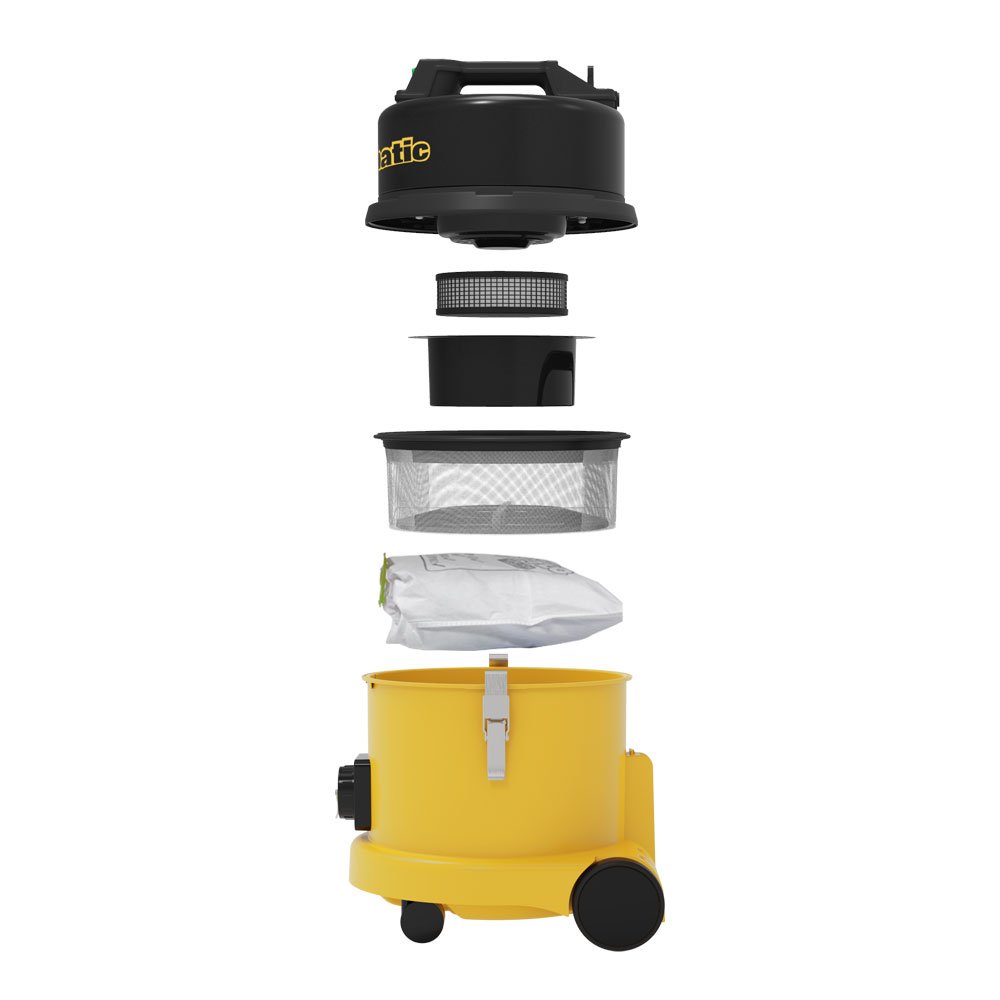
An H-class machine only performs to class with the correct filter and bag fitted, and those are consumables rather than lifetime parts. This is where a fleet quietly falls out of compliance: the machine is correct, the filter has been substituted with an M-class equivalent, and nobody notices until an audit or an incident.
| Part | Fits | Price |
|---|---|---|
Nilfisk H14 HEPA filter element, 107413555
|
VHS 40/42 and ATTIX 33 H | A$148.72 |
Nilfisk flat vacuum filter, 107413540
|
ATTIX 33/44 IC and VHS 40/42 | A$121.70 |
Nilfisk M-class vacuum filter, 107400562
|
ATTIX and IVB range | A$137.50 |
Fleece filter bag, 107419591
|
ATTIX 30 and Alto | A$78.25 |
| Disposable vacuum bags, 5 pack | VHS 40/42, ATTIX 33/44 | A$75.00 |
Hold a spare filter and a box of bags per machine. A classed vacuum sitting idle because a bag is on backorder is the same operational failure as a machine that has broken down. Our dust bags range covers the cross-references, and Numatic and Nilfisk cover the machine side.

Maintenance on a classed machine
H-class machines are cleaned and serviced differently from ordinary vacuums, and the difference is about protecting whoever does the maintenance.
- Change bags before they are full. Overfilled bags are how dust ends up in the motor housing and how seals are stressed.
- Never blow out a filter with compressed air in an open area. The whole point of the class is containment.
- Check seals and latches whenever the machine is opened, because the class depends on the housing sealing.
- Document what was done. For classed work the service record is part of the evidence pack.
Where a machine needs repair rather than a consumable, our service and repair team handles it, and we will tell you when a machine is not economically worth repairing rather than selling you a filter for it.
The compliance context
Asbestos work in NSW is regulated, and much of it is licensed work that a cleaning contractor must not take on with a vacuum alone. SafeWork NSW publishes what is required for identification, removal, decontamination, transport and disposal, and that guidance is the thing to read before quoting any asbestos job. Where the work is licensed removal, the vacuum is one control in someone else’s process rather than the service you are selling.
Hiring or buying a classed machine
Classed machines are available for hire, and for one-off remediation projects hiring is often the rational choice. The complication is consumables: filters and bags are model-specific, and a hired machine with the wrong filter fitted is not the machine the hire agreement implies. Where a site does classed work regularly, owning the machine and holding filters locally is what keeps the schedule intact.
What to have ready when you order
We can match a machine to a specification faster with four things in hand: the dust and the class your hazard assessment requires, the volume of material to be collected, whether the machine has to be carried into confined spaces, and whether wet pickup is needed. With those, the format and the consumables list generally narrows to one or two machines rather than six.
References
- SafeWork NSW — asbestos: identification, removal, decontamination and waste.
- NSW Environment Protection Authority — chemicals, including waste and disposal.
Questions we get asked most
- What type of vacuum for asbestos?
- An H-class machine certified to AS/NZS 60335.2.69, fitted with the correct H-class filter and bags for that model. Class is a property of the whole machine, so a HEPA cartridge in a standard vacuum does not make it suitable for asbestos.
- What is an H-class vacuum cleaner?
- H-class is the highest dust filtration class in the AS/NZS scheme, intended for high-hazard dust such as asbestos and carcinogenic dusts. It sits above L and M class and is the class required where the hazard assessment identifies that level of risk.
- Is it safe to vacuum asbestos?
- Only as part of a compliant removal or remediation process, with a classed machine, correct filters and bags, appropriate PPE and controlled access. Vacuuming is a containment step, not a substitute for licensed removal, and most asbestos work in NSW requires a licence.
- Will a HEPA filter remove asbestos?
- A HEPA filter of the correct grade is the filtration element that makes H-class performance possible, but filtration alone does not create a classed machine. Sealing, bag design and the machine as a whole determine whether the unit performs to class.
- What is better, H or M class vacuum?
- Neither is better in the abstract. M class suits medium-hazard dust such as wood dust; H class is required for high-hazard dust including asbestos. The dust on site decides the class — buying above the requirement costs more, buying below it creates a compliance problem.
Specifying for hazardous dust?
Tell us the dust on site and how the machine will be used, and we will confirm the class, the format and the consumables to hold — and say so if the job is one we think should go to a licensed removalist. Browse hazardous dust vacuums or ask our team.
Filed under the commercial vacuum guide, with the backpack comparisons and the bag and filter matching guides.