Aged Care and Clinics: Hygienic Vacuum Selection Backpack vs Barrel
Choose the filter first, then let rooms, stairs and staff decide the format.
Shop now
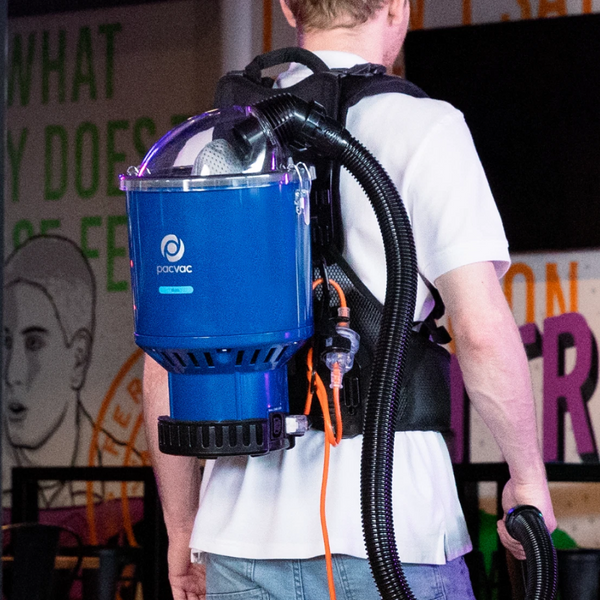
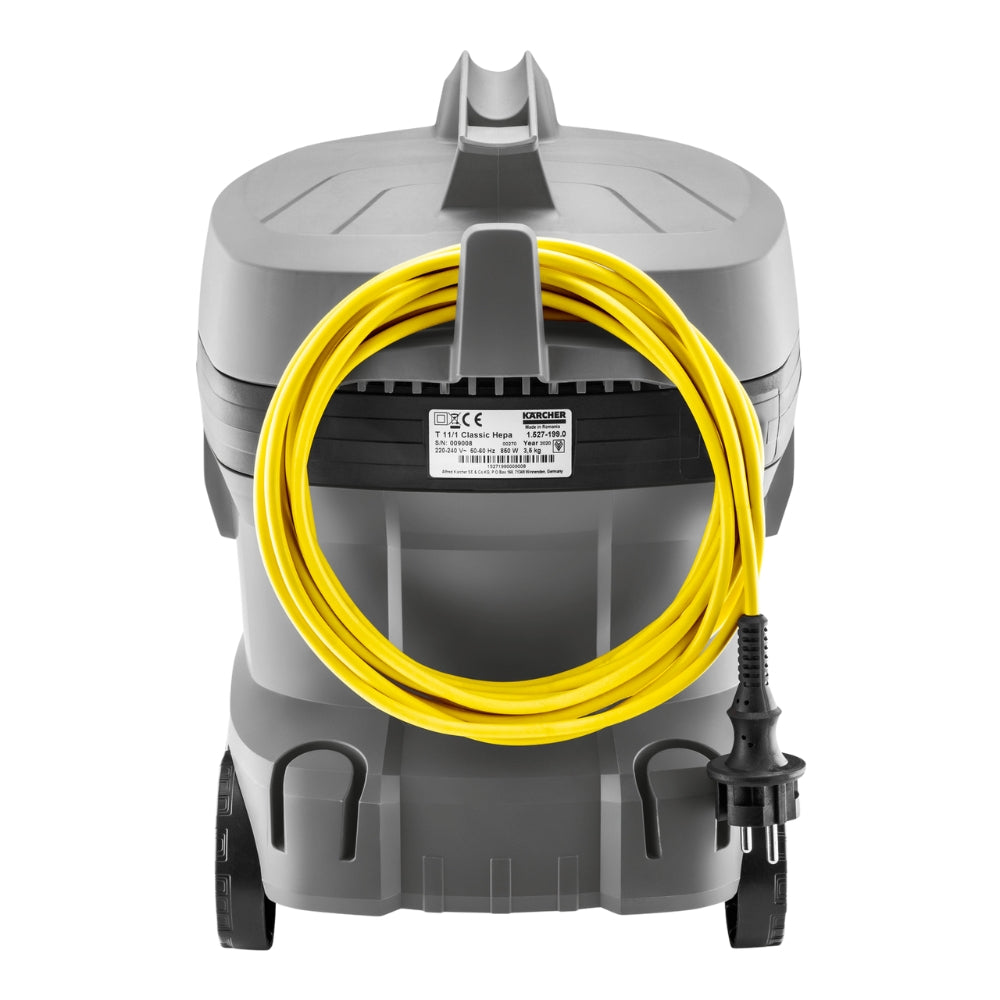
Two cleaners, one aged care wing, and the noise readings are only 1 dB apart. One wears a Nilfisk GD5 HEPA backpack, which Freshway lists at 62 dB(A) with an H13 HEPA filter and a 5-litre capacity. The other pulls a Kärcher T 11/1 Classic HEPA barrel vacuum, listed at 61 dB(A) with a HEPA 14 filter and an 11-litre container.
On paper, the barrel collects more than twice as much before it needs emptying (11 ÷ 5 = 2.2), and the decibel figures barely separate them. On the floor, the differences show up somewhere else: in the stairs and tight rooms, in who handles the full bag, in what happens when someone finds a spill, and in how the operator's back feels at the end of a shift. This guide works through those questions from the cleaner's side of the trolley.
Aged care commercial vacuum: the short answer
An aged care commercial vacuum should have a listed HEPA filter, a bag or container you can change without releasing dust, and a noise level that suits resident areas. Backpacks suit tight rooms and stairs. Barrel vacuums suit corridors and lounges. Neither is for body-fluid spills, which need a separate spill procedure.
Most facilities end up with both formats. The sections below help you decide the mix and set the rules that make either one hygienic.
Infection-control lens: what the guidance asks of a vacuum
"Does it matter which vacuum I use in a resident's room?" Yes, but the filter matters more than the format. The Victorian Department of Health's infection control cleaning procedures say floors in hospitals and day-care facilities should be cleaned with a vacuum fitted with a particulate-retaining filter, that the filter should be changed in line with the maker's instructions, and that exhaust air should be directed away from the floor to avoid spreading dust. The same page says cleaning methods should avoid generating aerosols.
That gives you three checks for any machine: a listed filter grade, a clear filter-change instruction, and an exhaust that does not blast across the floor. Tennant Australia adds that high filtration bags are used by long-term care facilities and other places where air hygiene is a priority, so ask what bag the machine takes as well as which filter.
Quiet and dignity: working around residents
"Can I vacuum while residents are in the lounge?" Usually, if the machine is quiet and you plan the order. SafeWork NSW describes 85 dB(A) averaged over eight hours as the workplace exposure level and explains that every 3 dB increase doubles noise intensity. Every machine in this article is listed well under that level, so the question is disturbance, not hearing damage.
Freshway lists the Nilfisk VP400 barrel vacuum at 57 dB(A), five decibels below the GD5 HEPA backpack. Tennant Australia notes canister vacuums are usually quieter than uprights, which makes them suitable for noise-sensitive places such as hospitals. In practice, dignity is as much about timing as decibels. Ask before vacuuming a room someone is resting in, vacuum shared lounges when they are emptiest, and keep the cord out of walking frames' paths.
Dry vs occasional wet: where the vacuum stops
"There's a spill in the hallway. Do I grab the vacuum?" Not if it is blood, urine, vomit or another body substance. NSW Health's policy directive Cleaning of the Healthcare Environment says small spills, up to 10 cm across, are wiped up with absorbent material such as paper towel, and larger spills are first contained and confined with absorbent material before cleaning. It says disinfectant use should be based on an assessment of transmission risk with infection prevention staff.
Plain water is a different job. A leaking shower or an overflowing basin needs a wet-capable machine, not a dry HEPA vacuum. Freshway lists the Numatic WVD570 with 15 litres of wet extraction capacity, and a machine like that belongs in the maintenance store, kept apart from resident-room equipment. Never put water through a dry vacuum.
Filter discipline
A HEPA filter only works if it is seated, intact and changed on time. Build the routine into each shift:
- Check the filter is seated before switching on, every time the machine has been opened.
- Change bags at the fill line rather than squeezing in one more room.
- Seal and bin full bags straight away. Do not empty, shake or tap filters out inside resident areas, because that is exactly the aerosol the guidance warns about.
- Replace filters on the interval in the machine's instructions, and write the date on the machine's log.
- Keep spare bags and filters on the cleaning trolley, not in a store two floors away.
Freshway's vacuum parts and accessories range carries bags, filters and tools. Order by machine model so the filter seals properly.
Colour-coding tools
Hoses and floor tools move from room to room, so they can carry soil with them. NSW Health's directive recommends colour coding reusable cleaning equipment and gives this scheme for its facilities: yellow for infectious and isolation areas, red for toilets, bathrooms and dirty utility rooms, green for food service areas, blue for general cleaning and white for operating theatres.
Many aged care providers use a similar chart. Follow your facility's own scheme, then apply it to the vacuum: a tagged floor tool and wand per zone, and a separate set for isolation rooms that never leaves the zone. Backpacks make this easier because the tools travel with the operator. With barrels, park the machine at the doorway and change the tool, not the machine.
Staff capability: who carries what
"Is a backpack harder on my back?" It depends on the weight and the fit. Freshway lists the corded GD5 HEPA at 4.4 kg and the cordless GD5 Battery at 8 kg including its battery, so going cordless nearly doubles the load on the operator. A barrel such as the VP400, listed at 6 kg, is pulled rather than worn, but it still has to be lifted up stairs and into lifts.
SafeWork NSW says manual tasks include lifting, carrying, pushing and pulling, and that businesses must consult the workers affected when managing hazardous manual tasks. Ask your cleaners which format suits each wing before you buy, and let them try both.
Spec-sheet fields to check on a vacuum
All figures below come from Freshway product pages. "Not listed" means the page does not give it.
| Machine | Format | Filter as listed | Listed noise | Capacity | Power and reach | Weight |
|---|---|---|---|---|---|---|
| Nilfisk GD5 HEPA | Corded backpack | HEPA H13 | 62 dB(A) | 5 L | 15 m detachable cord | 4.4 kg |
| Nilfisk GD5 Battery | Cordless backpack | Not listed | 65 dB(A) | 5 L | 36 V, up to 60 min | 8 kg with battery |
| Kärcher T 11/1 Classic HEPA | Corded barrel | HEPA 14 | 61 dB(A) | 11 L container | 2.5 m suction hose | See product page |
| Nilfisk VP400 | Corded barrel | HEPA H13 | 57 dB(A) | 15 L bag | 10 m cable | 6 kg |
Read it the way a cleaner would. The battery backpack gives up a listed filter grade and nearly doubles the load in exchange for no cord. The VP400 is the quietest and holds the most, at the cost of a machine on the floor behind you. Compare the full range in Freshway's HEPA backpack vacuums and canister and barrel vacuums collections, and check each product page for current pricing.

What not to buy
- A vacuum with no filter grade on the spec sheet for resident areas. "Fine filter" is not a grade.
- Bagless domestic machines that have to be emptied and tapped out by hand.
- A dry vacuum for wet work, or any vacuum as the answer to body-substance spills.
- One machine for the whole building, including isolation rooms, with no separate tool sets.
- A backpack bought without fitting the harness to the people who will wear it.
- A "HEPA" vacuum for renovation or construction dust. That is a different job, so ask about dust-class machines.
Training and sign-off
A short, practical sign-off works better than a long induction. Run it on the floor, with the actual machine:
- Zones and colours. Walk the wing and show which tool set belongs where.
- Pre-use check. Cord or battery, filter seated, bag fitted, and the test tag in date. SafeWork NSW says a record of electrical testing must be kept and can take the form of a tag on the equipment.
- Harness fit. Adjust the backpack to the operator, not the last person who wore it.
- Room routine. Knock, ask, vacuum away from the resident, keep the cord behind you.
- Spill rule. Stop, leave the vacuum, use the spill kit and follow the facility procedure.
- Bag and filter change. Demonstrate it in the cleaner's room, then have the trainee do it.
- Sign-off. A supervisor watches one full room and records the date.

Summary: what to take away
- Pick the filter first, then the format.
- Backpacks for rooms and stairs, barrels for corridors and lounges.
- Noise figures are all well below exposure limits. Plan timing for residents instead.
- Vacuums never handle body-substance spills.
- Colour-code the tools, not just the cloths.
- Let the people who carry the machine help choose it.
Frequently asked questions
Is a backpack vacuum less hygienic than a barrel vacuum?
Not because of its format. Hygiene comes from the filter grade, careful bag handling and exhaust direction. Freshway lists an H13 HEPA filter on both the GD5 HEPA backpack and the VP400 barrel.
Does a HEPA filter make a vacuum suitable for every spill?
No. NSW Health's procedure cleans blood and body substance spills with absorbent material, with disinfection based on risk. Keep dry vacuums for dry soil.
Isn't the quietest vacuum always right for aged care?
Not always. The listed figures here all sit well below the 85 dB(A) exposure level. Route timing, cords, capacity and weight often matter more than a few decibels.
Do cordless backpacks remove the trip risk completely?
They take the cord off the floor, but Freshway lists the GD5 Battery at 8 kg with its battery against 4.4 kg for the corded GD5 HEPA. Weigh trip risk against the load on the operator.
Next steps with Freshway
Map your wings by room type and zone colour, then shortlist one backpack and one barrel. If cords are the main concern, compare the battery-powered backpack vacuums on weight and runtime. For disinfectants, spill kits and consumables, Freshway's guide to cleaning supplies for aged care and healthcare facilities covers the rest of the trolley, and the shop by industry page groups aged care and healthcare products together. The Arncliffe team can confirm bags and filters for each model before you order.