Childcare Centre Cleaning Supplies: A Practical Compliance Guide
Unperfumed and food-safe, so it is safe on everything a child touches.
Shop now
Childcare cleaning sits between domestic and healthcare work. The surfaces are cleaned constantly, the occupants are the most vulnerable group in any commercial setting, and the chemicals have to be both effective and safe to use in a room where children are present.
Mild chemistry used often beats strong chemistry used rarely
Childcare cleaning is driven by frequency rather than by strength. Surfaces are cleaned many times a day, so the correct specification is a mild, low-residue product used consistently, with a separately stored disinfectant for nappy change areas and sanitary facilities. Strong chemistry is the wrong tool here.
That is the opposite of how most commercial cleaning is specified. In an office, a stronger product used less often is efficient. In a childcare room, residue from a strong product ends up on surfaces children eat from, so the priority shifts to mild chemistry and frequent wiping.
Prices are Freshway catalogue prices as at 16 September 2026 and are subject to change. Confirm the current price, and whether GST applies, before quoting.

What makes childcare different
- Frequency over strength. High chairs, tables and toys are wiped between uses, not once a day.
- Residue is the risk. Children put hands and mouths on cleaned surfaces, so residue-free rinsing matters more than a strong product.
- Two chemistry zones. General rooms and nappy change or sanitary areas have different requirements and should not share cloths or buckets.
- Storage. Every chemical has to be inaccessible to children, including products in use, not just in storage.
The chemical kit
| Product | Use | Price |
|---|---|---|
| Multipurpose surface cleaner and sanitiser, 5 L concentrate | Tables, high chairs, hard toys and general surfaces | From A$74.00 |
| Neutral floor cleaner, 5 L concentrate | All floor cleaning | From A$42.00 |
| Disinfectant with a stated contact time | Nappy change areas and sanitary facilities | From A$54.00 |
| Glass cleaner, 5 L concentrate | Windows, mirrors and glazed doors | From A$42.00 |
| Hand soap and sanitiser | Staff and child hand hygiene | From A$25.00 per dispenser |
The disinfectant is the only product in this list that needs a strong formulation, and it should be used in defined areas rather than across the whole centre. Using a hospital-grade disinfectant on a dining table is both unnecessary and a residue risk.
Equipment
| Equipment | Why it suits childcare | Price |
|---|---|---|
| Flat microfibre mop with colour-coded heads | Low moisture and fast drying where children are present | From A$10.00 per refill |
| Bucket set, colour-coded by zone | Separates general rooms from washroom areas | From A$15.50 |
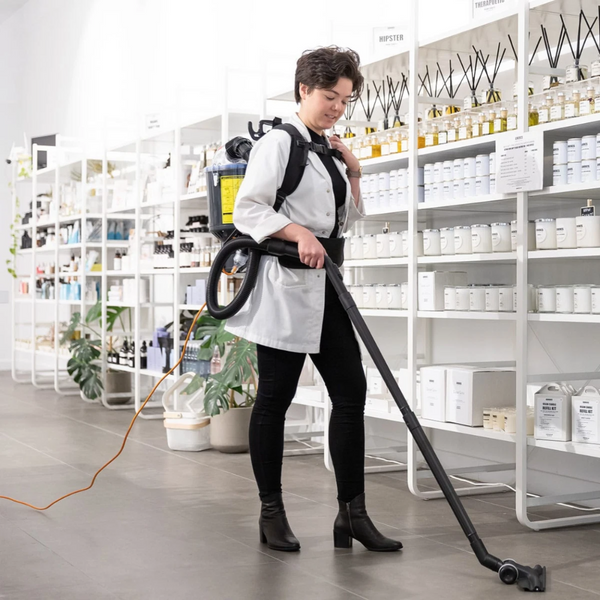
| Quiet commercial vacuum | Usable during rest periods without disturbing children | From A$339.00 |
| Microfibre cloths in zone colours | Prevents cross-use between rooms | From A$2.75 |
| Carpet extractor for periodic deep cleaning | Regulatory and hygiene deep clean cycles | From A$1,199.00 |

Nappy change areas
This is the highest-risk area in the centre and the one that should be specified separately from everything else.
- A dedicated disinfectant with a stated contact time, used at the labelled dilution.
- A dedicated cloth in a dedicated colour, laundered separately.
- A defined waste route, so nappy waste does not travel through food preparation or play areas.
- A written procedure posted at the change table, because this task is done by educators as well as cleaners in most centres.
Toys, soft furnishings and shared equipment
Toys are the surface that gets forgotten in a cleaning specification, and they are handled constantly. The practical approach is to sort toys into hard-surface and soft categories, because they cannot be cleaned the same way.
Hard toys can be washed in a low-residue sanitiser solution and air-dried. Soft toys, dress-up clothing and fabric books generally need laundering on a cycle, which means the centre needs enough stock to rotate rather than clean in place. Our cloths and wipes range covers the cloth side of both routines.
Storage and supervision
Chemical storage in a childcare centre has one requirement that overrides convenience: no child can reach it, including products in active use. That rules out a bucket left in a corridor and a spray bottle on a shelf, and it means the cleaning trolley itself has to be secured wherever it is parked.
Two further points that come up in audits: decanted bottles must be labelled with product and dilution, and safety data sheets must be available to staff. We publish ours at Freshway safety data sheets.
Calculating supplies for a centre
Consumption per child per day is the useful measure, and in childcare it runs much higher than in any other setting because of the cleaning frequency.
- Counting unit: per child per day, not per room.
- Count period: a full week, because usage varies with the programme.
- Include laundered items — cloths and mop heads are consumed by laundering cycles, not by wear.
- Watch the disinfectant separately, since it is confined to specific areas and should not scale with occupancy in the same way.
The childcare and education range groups the core specification, and our team can build a centre-specific list.
Frequently asked questions
- What cleaner do daycares use?
- A mild, low-residue neutral cleaner for general surfaces and hard toys, applied frequently, with a disinfectant reserved for nappy change areas and sanitary facilities. Strength is deliberately not the specification in a childcare setting; frequency and residue are.
- What cleaning products are safe for children?
- Low-residue products used at the label dilution and allowed to dry, on the surfaces children actually touch. Unscented options reduce the load on children with asthma, and anything decanted into a smaller bottle must be labelled and stored out of reach.
- What are the recommended cleaning guidelines for daycares?
- There is no single national cleaning schedule for childcare. The requirement is that premises are clean and hygienic and that the centre can show how, so centres document a schedule by area — change tables between uses, toys on rotation, floors daily — and follow their approved provider’s policy.
- Can I use the same cloth for the playroom and the nappy change area?
- No. The nappy change area needs a dedicated cloth in a distinct colour, laundered separately from general cleaning cloths. This is the control that prevents cross-contamination and it is one of the first things an audit checks.
- What documentation does a childcare centre need for cleaning chemicals?
- Current safety data sheets accessible to staff, and labelled containers for anything decanted. Where the centre also uses cleaning products for food preparation areas, those products should be listed separately.
References
- SafeWork NSW — chemicals and other substances: labelling, storage and safety data sheets.
- NSW Environment Protection Authority — chemicals, including storage and disposal.
Equipping a childcare centre?
Tell us the number of children, the number of rooms and whether nappy change areas are in every room, and we will build a centre-specific list with a consumption estimate per child. See childcare supplies or ask our team.
This article is one section of the cleaning by industry guide, which covers what each kind of site actually buys.